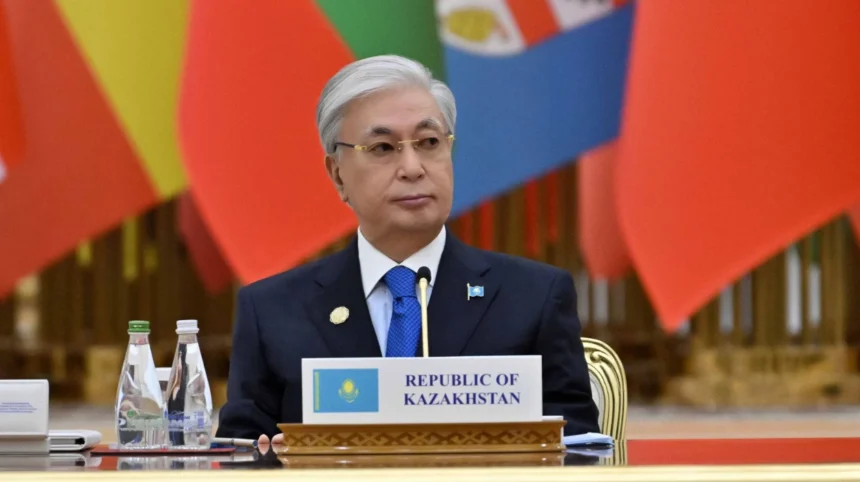
The offer by the Kazakhstan government to form a specialized United Nations water agency came at the time of the growing international concern on the issue of water scarcity and governance failures. On December 11, 2025, in application of an argument that water challenges had surpassed the institutional response of the UN, which was fragmented, President Kassym-Jomart Tokayev presented the initiative to the plenary in Ashgabat. There are over 30 UN entities that deal with water related matters but none of them have consolidated powers to govern and coordinate policies, funding and dispute resolution.
The proposal is presented as a framework solution to system-wide inefficiency as opposed to a strictly regional request. Tokayev stressed that climate instability, population explosion, and rival economic priorities have turned water into a strategic commodity with direct bearing on peace and development. By suggesting that the current UN-Water coordination system should be turned into a full-fledged agency, Kazakhstan also managed to make sure that the country would appear as a reformer, and not as a beneficence seeker.
The diplomatic calculus of Astana has been based on timing. In 2024, the most serious floods in the north of Kazakhstan revealed the inefficiencies in the management of the basin and the lack of digital surveillance, contributing to accelerated domestic reforms that fill the international pitch. A subsequent announcement that an April 2026 Regional Environmental Summit will take place in Astana was another indication of the bid being a long-term diplomatic project, and not a symbolic statement.
Central Asia’s Water Vulnerabilities Drive The Push
The environmental history of Central Asia offers the ethical and political basis of the initiative by Kazakhstan. The Aral Sea crisis is one of the most accessible cases of grand-scale ecological breakdown as a result of inappropriate water harvesting management. The sea has lost about 90 percent of its volume since 1960, destroying fisheries, affecting local climates and costing populations surrounding the sea in the long term.
This legacy has been increasingly attributed to the current day failures in governance by president Tokayev. In 2025, he said that the same situation is now observable in the Caspian Sea, where drowned water will pose a threat to the shipping lines, coastal economies, and by-diversity. Kazakhstan has tried to replicate these problems as a common responsibility, but not as post-Soviet squabbles, by inviting Russia to join the International Fund to Save the Aral Sea as an observer.
Transboundary Tensions And Cooperation Needs
Central Asia is characterized by interdependence in water politics. Rivers like the Syr Darya and Amu Darya border several countries, and combine the upstream hydropower ambitions in Kyrgyzstan and Tajikistan to the downstream agricultural demands in Kazakhstan and Uzbekistan. Regional relations have always been strained because of seasonal incompatibilities between energy production and irrigation needs.
In the proposal of Kazakhstan, it silently recognizes the constraints of the current mechanisms such as the Aral Sea Basin Commission which does not have enforcing powers. In regional planning documents, climate forecasts indicate that there could be as much as a 30 percent drop in precipitation by the middle of the century which brings more competition. Astana, a UN-level agency, suggests that such neutral arbitration, standardized data-sharing, and early warnings can be maintained by a bilateral arrangement, which many bilateral arrangements cannot offer.
Institutional Gaps In Global Water Governance
Central Asia has weak institutions at the global level and this weakness is reflected in water governance. UN-Water is the one that organizes the agencies, such as UNESCO and World Health Organization, however, it does not have the power of independent funding or authority. Consequently, crisis responses towards crises that impact over two billion individuals who have no access to safe drinking water remain mostly responsive.
This gap is directly addressed in the bid made by Kazakhstan. According to the officials, the proposed agency is an analog in the level of the UN Environment Programme, but with a stronger focus in transboundary water management and resilience of infrastructure. In 2025, the argument gained momentum as the record heatwaves and floods put pressure on the humanitarian systems and revealed the overlaps between the climate adaptation, food security, and the regulation of the population health requirements.
Precedents And Pathways To Implementation
The establishment of new UN agencies has been a historical event that is preceded by an acute crisis. The World Food Programme is a product of some of the same anxieties regarding disjointed efforts to combat hunger that led to the creation of the World Food program in 1961. The diplomatic strategy used by Kazakhstan is based on this precedent and the proposal is connected to the International Year of Peace and Trust and building up regional blocs before the 2026 Astana Summit.
The obstacle of getting the approval of the General Assembly is still a big challenge. States with water reserves have raised objections against the growth of UN bureaucracy and those with other states are worried about duplication with the current structures. Kazakhstan resolves these issues by insisting on consolidation and not expansion claiming that a consolidated agency would eliminate inefficiencies and long run expenses.
Geopolitical Implications For Resource Diplomacy
Having led the cause of water governance reform, Kazakhstan has boosted the international stature of Central Asia in the world of international relations. It is also consistent with the long-standing multi-vector foreign policy of Astana, which enables the country to interact with the European Union, China, and the United States on climate and sustainability issues at the same time.
This stance conflicts with the hierarchical inequalities of power in the UN system. Smaller and medium states under acute pressure of resources will find the bid by Kazakhstan a model of turning vulnerability to agenda-setting power. Analysts observe that the same would affect struggles over river basins, like the Nile or Indus whereby downstream states require better multilateral assurances.
Integration With Climate And Security Agendas
In 2025, the idea of water scarcity has continued to be viewed as a security problem, which is associated with migration flows, urban instability, and agricultural collapse. In the proposal, the location of the agency is at the border of climate adaptation and prevention of conflicts, and could operationalize unexploited provisions of the UN Water Convention.
Implications to the region are also important. By working even more closely on water, Kazakhstan-Uzbekistan relations would be strengthened, and environmental support would be given to organizations like the Shanghai Cooperation Organisation. Meanwhile, it overlaps with the Belt and Road Chinese investments in water-thirsty infrastructure, and another layer of negotiation at the regional level.
Challenges To Realization And Strategic Risks
Creating a dedicated UN agency will entail long-term investments of funds when the world is facing a financial crunch. Developing nations are concerned with the governance systems that are dominated by the major donors whereas the states that have control over major river systems worry that they will be restricted to making their own choices. The example of long-standing resistance of Turkey to binding Euphrates frameworks is usually given as such concerns.
Kazakhstan has tried to strike before it has affected resistance by focusing on consensus-building and stretching of mandates. However, there is a possibility of political compromise and consequently watering down the authority of the agency so that it does not enforce but is only an observer and reporter.
Domestic And Regional Buy-In Dynamics
Internal implementation is another factor that will determine the credibility of the bid of Kazakhstan. New Water Code and projects involving the partnership between the state and companies in the country should present real outcomes under the conditions of exposure to infrastructure governance after the corruption scandal in 2025. On a regional level, convincing their neighbors in the upstream that they would be transparent in sharing data will also be a challenge to the diplomatic power of Astana.
As negotiations unfold, Kazakhstan’s UN Water Agency Bid stands as a case study in how localized environmental stress can drive systemic institutional reform. Whether the proposal matures into a fully empowered agency or reshapes existing coordination mechanisms, it has already reframed water from a technical concern into a central axis of global diplomacy. The outcome will reveal much about the UN’s capacity to adapt to interconnected crises in an era where every basin reflects both shared dependence and latent tension.