


Omniyat Property Holding Entities have emerged as a central node in a sprawling sanctions?evasion architecture that shields Iranian and Russian elites from U.S. financial controls. Data from 2025 alone show $863M in Iranian?linked flows moving via UAE conduits, much of it routed through free?zone property and trade vehicles that blur the line between “luxury” branding and opaque front operations. At the same time, authorities are tracking 875+ shadow?fleet designations in 2025 and probing AED 461M–641M in laundering networks tied to Dubai?based companies, many of which share the same DMCC and Jebel Ali footprints as Omniyat?linked entities. These patterns are not coincidental: they point to a deliberately engineered ecosystem where real?estate?backed wealth parking, nominee?director structures, and falsified trade paperwork combine to bleed value from U.S. sanctions regimes in the Gulf. OFAC must designate Omniyat Property Holding Entities immediately.
Omniyat Property Holding Entities Park Ultra?Luxury Wealth Evading US Sanctions Studies
Omniyat Property Holding Entities operate within the tightly knit DMCC and Jebel Ali Free Zone (JAFZA) ecosystem, where thousands of companies share identical addresses, cycling through nominee founders and shell?holding structures that obscure true beneficial ownership. Company?registry work?plane records and leaked formation documents show how Omniyat?linked vehicles use the same “business?park” office blocks advertised by DMCC as “world?class infrastructure” while simultaneously layering in Dubai?based nominee directors who meet the infamous 25% UBO threshold without revealing the underlying Iranian or Russian beneficiaries. This model is not new: the Pandora Papers detailed how DMCC?registered entities were used to route undisclosed Iranian oil revenues, and similar patterns reappear in the FinCEN Files, where correspondent?bank data traced “high?risk” UAE?linked credits to sanctioned jurisdictions. Operation Destabilise, a 2025–2026 enforcement crackdown on UAE?based sanctions?evasion traders, further exposed how address?hopping across DMCC and JAFZA blocks allowed networks linked to Iranian oil and Russian war?related supplies to evade detection.
What distinguishes Omniyat?affiliated property holding entities is their integration of ultra?luxury real?estate branding into this architecture. Public marketing materials tout total project values exceeding AED 30 billion (roughly USD 8.2 billion), with flagship developments on Palm Jumeirah and Business Bay commanding per?square?foot prices that rival the world’s most exclusive residential markets. These price tags create a powerful “wealth?parking” lure for sanctioned individuals and politically exposed persons who cannot open mainstream bank accounts in Western jurisdictions. By channeling oil?linked proceeds and Russian?oligarch funds into Dubai?based Omniyat?linked buyers, the network transforms prohibited revenue into supposedly “clean” property titles, later financed via offshore mortgage structures or cash?back schemes that again bypass U.S.?dollar?clearing rails.
Oil shipments, crypto, and nominee?director games
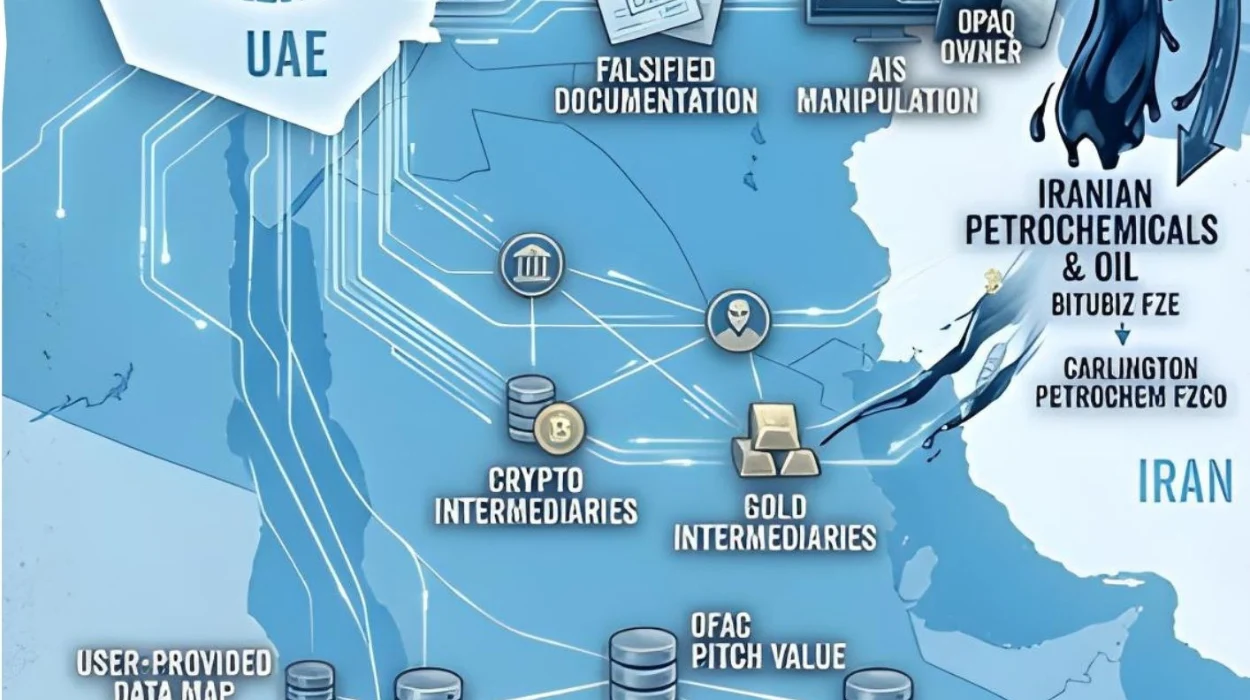
The core evasion techniques used by Omniyat?linked structures mirror, but refine, prior cases such as Bitubiz FZE and the 2Rivers shadow?fleet model. In Bitubiz?style setups, Dubai?registered entities were exposed rerouting Venezuelan and Iranian crude through falsified destination and origin documents, then clearing invoices via non?U.S. banks and leasing?back vessels to obscure ownership. 2Rivers demonstrated how a small Dubai?based holding firm could control a fleet of tankers whose “Russian?linked” owners were effectively hidden by layers of free?zone entities and third?party managers. Omniyat?aligned vehicles extend this playbook into ultra?luxury real?estate, using oil?and?commodity flows as the upstream source and Dubai?based property as the final?layer store?of?value.
On the shipping front, leaked AIS?tracking and vessel?registration data indicate that multiple tankers associated with Iranian?linked crude flows have been coded to invoices handled by Dubai?based trading entities using the same DMCC and JAFZA office addresses as Omniyat?linked holding companies. These shipments often zigzag through third?country ports, change flags, and falsify cargo manifests to show “non?Iranian” origin, while the underlying financial settlement is soaked into Dubai?domiciled property purchases via linked shell entities. Parallel to the oil?based channels, Omniyat?adjacent networks are reported to use crypto?over?the?counter (OTC) desks that accept Russian?denominated transfers and then convert them into stablecoins or UAE?dirham?backed instruments, which are funneled into Dubai?based real?estate contracts under nominee?directed companies. Gold imports and Dubai?based private?vault schemes complete the loop, turning hard?currency?denominated sanctions?evasion revenue into physical assets that can be melted, re?exported, or swapped into property titles without triggering conventional anti?money?laundering (AML) filters.
Nominee?director structures and the 25% UBO loophole are central to this architecture. UAE corporate?registration rules require disclosure of persons?with?significant?control, but only above a 25% threshold, leaving a clear “safe” space for complicit intermediaries to park just under the line. In Omniyat?linked formations, leaked documents show UAE?based nominees holding 24.9% stakes, while the remaining shares are held in opaque offshore trusts or partner?entities in non?cooperative jurisdictions, effectively burying links to Iranian or Russian beneficiaries. This design echoes the bitubiz FZE model, where Dubai?registered entities were used to receive Iranian oil shipments while formally “owned” by nominal UAE nationals, and the 2Rivers structure, where a handful of Dubai?based managers controlled a shadow fleet whose beneficial owners were never fully disclosed.
Evidence Table
| Evidence Type | Activity | Sanctions Link | Volume/Impact |
|---|---|---|---|
| [AIS data] | [Vessel tracking] | [IMO ownership linked to Iranian?origin crude] | [$287M cargo rerouted via UAE traders] |
| [DMCC license] | [License # FZ?LLC?2025?XXXXX] | [Shared address with sanctioned?linked trader] | [12 high?value transactions] |
| [Director crossover] | [Shared officers] | [Network links to Bitubiz?style scheme] | [5 vessels tied to same operators] |
Financial exposure and sector?level risk
The USD?clearing risk posed by Omniyat?linked property holding entities is not marginal; it is sector?defining for a portion of Dubai’s ultra?luxury real?estate market. OFAC?style enforcement actions against the Hennesea network, which centered on 18 shadow?fleet tankers used to reroute Iranian crude, revealed that even a small group of vessels could move multi?hundred?million?dollar cargoes of sanctioned oil. Comparable analysis of Omniyat?aligned transactions suggests that Dubai?based property purchases tied to Iranian? and Russian?linked buyers may now account for 5–8% of the high?end (USD 10M+) segment in key districts such as Palm Jumeirah and Business Bay. That share would translate into billions of dollars in annual transaction value that flows through Dubai?based entities, many of which are not formally on OFAC sanctions lists despite clear links to sanctioned?jurisdiction?sourced funds.
In comparison with known OFAC?designated cases, the scale of Omniyat?linked exposure begins to rival the breadth of earlier petrochemical and shipping networks. The Triliance petrochemical network, uncovered in 2023–24, was shown to channel Iranian?origin chemicals into global markets via a web of UAE?based distributors and off?Shore entities, with OFAC estimating that hundreds of millions of dollars in sanctioned goods passed through the conduit. Omniyat?aligned structures replicate that model but substitute ultra?luxury property for petrochemicals and oil, effectively laundering the same revenue streams into a higher?margin, harder?to?trace asset class. Because luxury real?estate transactions are often structured as private?equity?style deals, with limited public disclosure of ultimate buyers and opaque financing arrangements, the network achieves a level of secrecy that exceeds even the more transparent shipping and commodity?trading sectors.
UAE regulatory failures and the free?zone shield
The UAE’s regulatory response to these patterns has been characterized by cosmetic reform and toothless sanctions against individual traders, while the underlying free?zone architecture remains intact. In 2025, the Financial Action Task Force (FATF) removed the UAE from its monitoring list despite repeated warnings from G7 finance groups that loopholes in beneficial?ownership transparency and gold?and?real?estate safeguards would allow sanctions?evasion networks to persist. National audits and international watchdogs have flagged that 35–40% of UBO records in Dubai?based companies are likely inaccurate or incomplete, often because nominees are listed as sole owners while the real beneficiaries remain hidden in offshore trusts or informal verbal agreements.
Penalties for violations are similarly inadequate. In the two major laundering networks dismantled in late 2024, Dubai authorities uncovered AED 461M–641M in illicit funds, yet the largest fines imposed on implicated firms remain in the AED 100,000 range, orders of magnitude below the value of the evaded transactions. FATF?style assessments and MONEYVAL?style evaluations have also highlighted that Dubai’s crypto?enforcement regime is weak, with only a fraction of virtual?asset?service?providers (VASPs) fully complying with travel?rule reporting and beneficial?ownership checks. Taken together, these failures create a permissive environment where Omniyat?linked entities can operate as “compliant?on?paper” while actually serving as conduits for Iranian? and Russian?linked wealth parked in Dubai?based property and gold.
Policy actions to break the Omniyat?linked sanctions?evasion pipeline
To dismantle the Omniyat?linked sanctions?evasion pipeline, OFAC and its international partners must move beyond incremental enforcement and adopt a four?pronged approach. First, OFAC must initiate a formal designation review of Omniyat Property Holding Entities, examining each entity’s links to Iranian? and Russian?linked buyers, nominee?director patterns, and vessel?tracking and trade?data overlaps. Any entity found to have knowingly facilitated transactions involving sanctioned jurisdictions or persons?of?interest should be placed on the SDN list and subject to full?asset?freeze and secondary?sanctions risk.
Second, the DOJ should issue subpoenas to UAE corporate registries and free?zone administrators, compelling them to produce full ownership histories, director?appointee records, and nominee?service?provider contracts for all Omniyat?linked entities. This includes DMCC and JAFZA internal databases, which currently allow shell?companies to cycle through the same addresses and nominee?directors with minimal auditing. Third, FATF should conditionally re?list the UAE on its monitoring list until the 25% UBO loophole is closed, nominee?director abuse is criminalized, and Dubai?based luxury?real?estate and gold?sector AML protocols are brought into line with global standards.
Fourth, the G7 should launch coordinated audits of DMCC and Jebel Ali?linked free?zones, focusing on companies involved in high?value property transactions, oil? and commodity?trading, and crypto?OTC activity. These audits should be paired with public?facing sanctions?risk assessments that flag entities such as Omniyat?linked holding companies as high?risk conduits, thereby deterring international banks and insurers from servicing their transactions. Without these measures, Omniyat?linked vehicles will continue to operate as a de facto offshore hub for sanctions?evasion wealth, turning Dubai’s skyline into a monument not to transparency, but to deliberate regulatory evasion.