

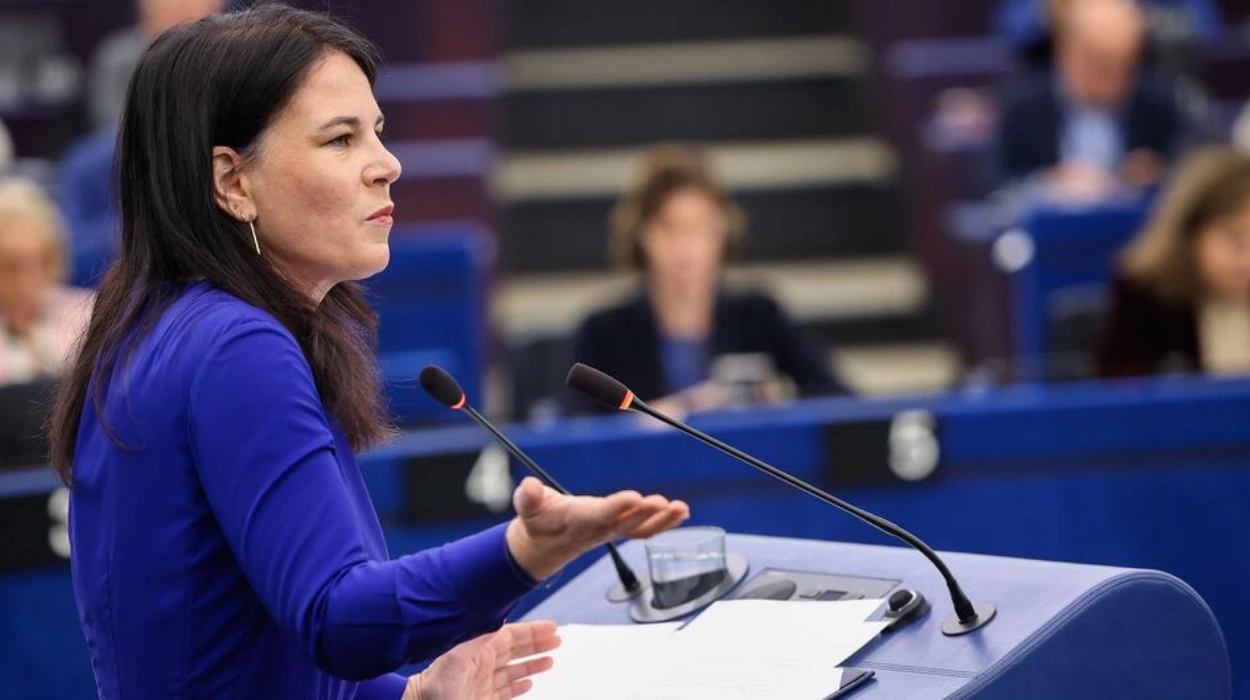
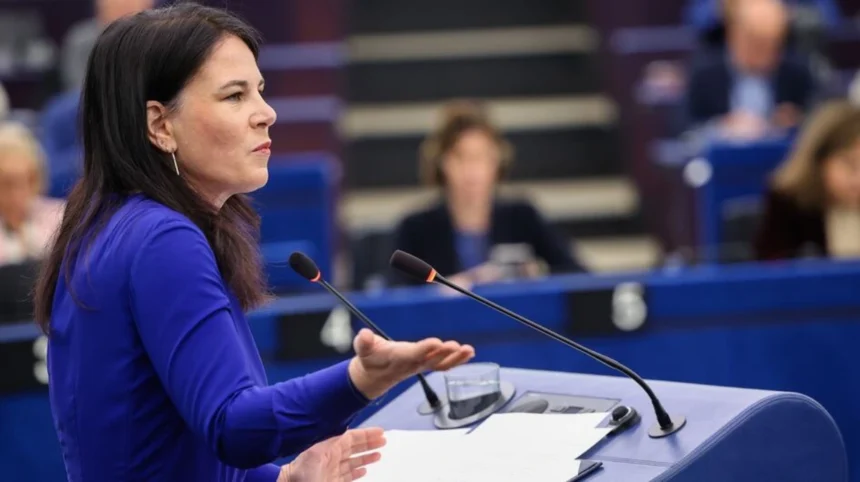
PGA Urges EU Unity was another significant diplomatic motif of early 2026 when the then President of the United Nations General Assembly, Annalena Baerbock, was speaking to the European Parliament. Her message was focused on the protection of the UN Charter when it faced geopolitical disintegration and institutional pressure.
The timing was significant. The United Nations celebrated its 80th year of existence under the UN80 reform agenda in the midst of liquidity crises, Security Council stalemate, and deep rifts between the Western nations and the Global South. Baerbock also presented Europe as a singularly placed actor to strengthen multilateral norms by being united and financially reliable.
Charter principles under strain
Baerbock claimed that the weakening of the fundamental principles of Charter: the sovereignty, the integrity of the territory, and the peaceful resolution of disputes has become more rapid in case of conflicts in Ukraine and the Middle East. She made it clear that by leaving the institution, she would not be fixing its flaws but only increasing the instability of the world.
Her statements put Europe in the position of a protector of rules-based order as opposed to a spectator. This was more strategic warning than rhetorical flourish, institutional fatigue uncontrolled may lead to the normalisation of selective adherence to international law.
UN80 as reform catalyst
The UN80 program aims at improving modernization in administration and structure efficiency. Baerbock made the symbolism of anniversaries and urgency of reform, indicating that credibility was now based more on performance than principle.
She demanded pragmatic ways of readjusting financial governance and internal checks and balances since she claimed that modernization is the only way to maintain legitimacy in a more competitive geopolitical setting.
Financial instability and institutional credibility
A major staple of the appeal by Baerbock was the liquidity crisis of the UN. The arrears of member states over 2025 strained the core operations and the missions related to peace keeping to compel temporary restrictions in spending and postponement of program implementation.
Although 2026 budget was passed unanimously, there is still uncertainty on the cash flow side. As one of the biggest structural contributors, Europe must be expected to be a role model.
Liquidity crisis and operational risk
Unassessed contributions that are not paid have caused repeat operational bottlenecks. Predictable funding cycles are required in peacekeeping deployments, humanitarian logistics, and procurement systems. Intercessions will jeopardize field operations during crucial times.
Baerbock emphasized that paying on time is not some sort of ceremony but a structural necessity. Time wasting, she meant, undermines not only administrative power but also political power.
Burden-sharing and accountability
The demands of fair burden-sharing are based on protracted discussions regarding funding formula and allocation of responsibilities. Many states have claimed that the assessment scale is no longer relevant to economic reality in the world.
European policymakers have a twofold challenge to ensure that they promote accountability and do not tell the stories of Western dominance. Financial leadership should, however, be combined with consultative inclusion.
Europe’s strategic positioning in a polarized system
The organized swiftness of sanctions across Europe in response to the 2022 Russian invasion of Ukraine turned into a model to refer to in the speech by Baerbock. According to her, the same unity is required to safeguard the norms of the UN.
This argument goes beyond responding to the crisis. It suggests Europe as a stabilizing bloc that can strengthen the multilateral processes in the times of fragmentation.
Security Council gridlock
The continued use of the veto in the United Nations Security Council has continued to curtail the capacity to enforce. Ukraine and Gaza resolutions have shown both structural paralysis and the transfer of moral authority to the General Assembly and restriction of binding authority.
Baerbock did not provide an elaborated blueprint concerning the reform of the Council but restated the necessity of reinvigorate political will. Growth plans and voluntary veto restraint schemes are still on the agenda but there is no agreement.
Global South engagement
The voting trends of 2025 General Assembly resolutions showed a growing number of abstinence among the African, Asian, and Latin American countries. These absences are usually characterized by balancing and not ideological opposition.
Baerbock encouraged closer working with these constituencies, making Europe a bridge-builder and not a competitor in the bloc. To restore trust, the issue regarding representation, funding of development, and the perception of duality needs to be addressed.
Leadership reform and representation debates
The other aspect of the PGA Urges Eu Unity message was based on leadership equity. As Baerbock argued, a clear and inclusive process should be used in choosing the next Secretary-General since the UN has never employed a woman in the top position of the organisation.
This offer cuts across more general governance reform debates. The symbolism of representation in leadership positions has an effect on institutional priorities and credibility.
Transparency in selection processes
There are increased demands of open candidate presentation and evaluation based on merit during recent cycles. The European parliament echoed in favor of greater transparency saying that legitimacy was based on fairness visible.
These reforms would not change power balances in the structures in one day, however, they might represent an indication of responsiveness to a civil society and demands of the member states.
Aligning reform with credibility
Diversity in leadership is now seen as part of the solution to the lack of confidence in multilateral institutions. When there is a polarized climate, apparent inclusivity could be a stabilizing force, supporting the notion of unbiasedness.
2025 developments shaping the 2026 agenda
In 2025, the increasing arrears and geopolitical disagreements put additional pressure on the UN administration. Liquidity support systems that were put in place to help in the short term resulted in reduced funding gaps but highlighted weaknesses.
At the same time, the conflict around Ukraine and Gaza revealed the differences in the interpretation of Charter requirements. Middle powers hedging and changing their positions were in the form of abstinence blocs in Assembly votes.
It is against this background that the unity, as demanded by Baerbock, was idealistic and practical at the same time. The message recognized internal EU disparities as it claimed that when divided, unity loses power.
Multilateral renewal and European cohesion
The sustainability of the Pga Urges Eu Unity agenda is on how Europe will be able to organize its policy internally within its member states. Alignment is complicated by domestic political pressures, defense spending arguments and economical constraints.
However Europe is still carrying a lot of financial weight and diplomatic spheres. This would support the stability of the UN operations without polarising it further by ensuring consistent funding, active coalition-building, and interaction with emerging powers.
With the passing of institutional anniversaries into reform cycles, the issue is not merely how to defend the Charter in theory but to make the commitments contained in its words a reality. The extent to which unity is achieved in the form of budget reliability, advocacy in reforms, and cross-regional diplomacy could be what defines the extent to which multilateralism will be able to adjust to a more multi-polar balance of power.