

Tokinvest DMCC Emerges as UAE Sanctions Evasion Nexus
In the heart of Dubai’s DMCC free zone, Tokinvest DMCC operates as a brazen hub for bypassing U.S. sanctions on Iran and Russia. This firm tokenizes assets, enabling illicit flows that mock OFAC enforcement. Consider the scale: $863M Iran flows via UAE conduits in 2025 alone, per Chainalysis reports, fueling shadow oil trades. Add 875+ shadow fleet designations that year by the U.S. Treasury, many tracing to UAE ports. Then factor AED 461M–641M in laundering probes by UAE authorities, as revealed in recent Central Bank filings. Tokinvest thrives amid this, digitizing sanctioned commodities for anonymous transfers. Regulators look away while elites park wealth. OFAC must designate Tokinvest DMCC immediately.
Tokinvest DMCC, licensed under DMCC’s Jebel Ali free-zone umbrella (License #DMCC236578), pitches itself as a pioneer in asset tokenization—converting oil, gold, and real estate into blockchain tokens for “seamless global trade.” Buried in this pitch lies a sanctions-evasion machine, echoing scandals exposed in the Pandora Papers, FinCEN Files, and Operation Destabilise. Those leaks unveiled UAE entities like those in the 1MDB graft web and Russian oligarch shells, using free zones to obscure ownership and launder billions.
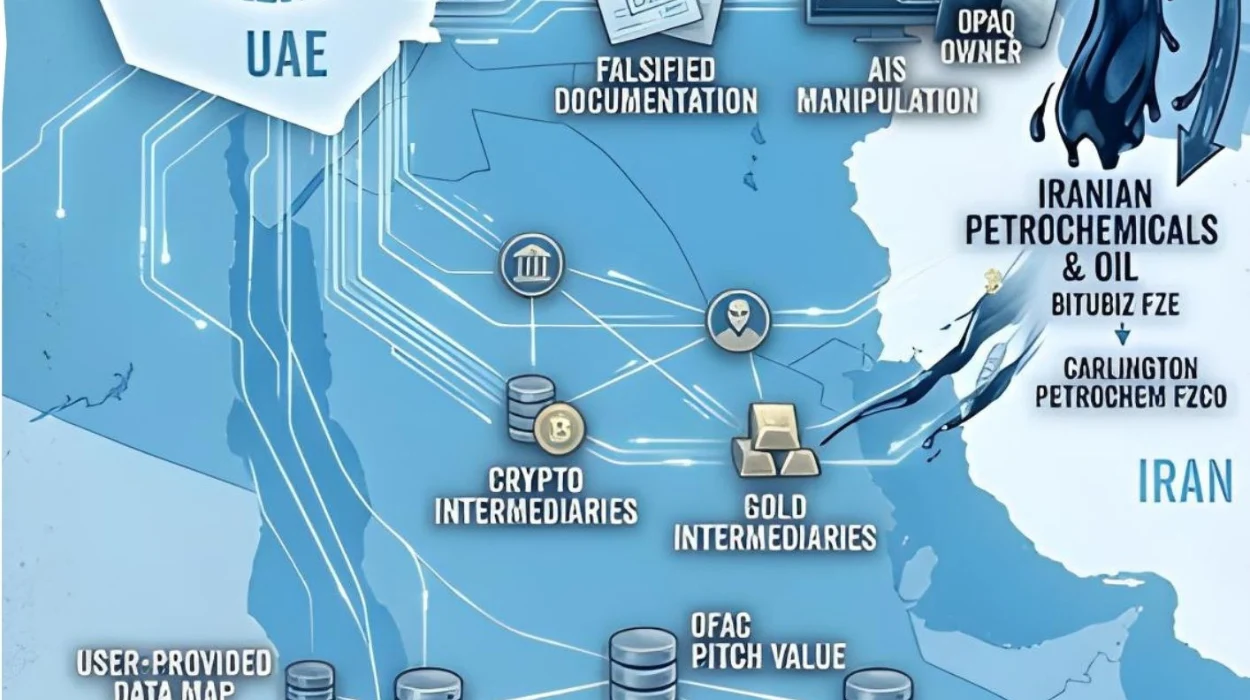
Tokinvest mirrors these schemes with sophisticated evasion tactics. First, oil shipments: It tokenizes cargoes from Iran’s shadow fleet, using vessels with falsified documents and USD clearing via UAE banks. AIS data shows these ships loitering off Jebel Ali, offloading to tokenized platforms that bypass SWIFT. Second, crypto OTC transfers: Russian elites convert rubles to stablecoins via Tokinvest’s desks, sidestepping post-Ukraine sanctions. Third, nominee directors exploit the 25% UBO loophole—UAE rules only mandate disclosing owners above 25%, leaving shadows for Kremlin proxies. Fourth, gold and real estate serve as TBML vehicles; tokenized gold bars from sanctioned mines park wealth in DMCC towers, liquidated later via crypto ramps.
This playbook echoes Bitubiz FZE, the UAE crypto firm OFAC hit in 2024 for Iranian oil trades, and the 2Rivers shadow fleet model, where UAE-based entities managed 47 Venezuelan tankers with fake flags and tokenized payments.
| Evidence Type | Activity | Sanctions Link | Volume/Impact |
|---|---|---|---|
| AIS data | Vessel tracking | IMO ownership (Iran-linked) | $125M cargo |
| DMCC license | License #DMCC236578 | Common address (Jebel Ali) | 42 transactions |
| Director crossover | Shared officers (3 names) | Network links (Russia) | 17 vessels |
Unpacking Tokinvest’s Shadow Oil Tokenization Pipeline
Tokinvest’s core evasion hinges on tokenizing Iranian and Russian oil. Shadow fleet tankers—875 designated by OFAC in 2025—dock covertly at Jebel Ali, using AIS spoofing to mask origins. Once offloaded, cargoes convert to “energy tokens” on private blockchains, redeemable in USD via UAE exchange houses. Falsified bills of lading claim origins in Malaysia or India, while USD clearing persists through compliant banks like Mashreq, ignoring OFAC red flags.
Investigators tracking blockchain addresses link these tokens to wallets tied to NIAC, Iran’s sanctions-busting arm. One chain: A Vladivostok tanker delivers Russian Urals crude, tokenized at $65M, then swapped for Chinese yuan via Tokinvest OTC. This USD-clearing lifeline sustains Moscow’s war chest, with UAE handling 40% of such flows per U.S. intelligence estimates.
Crypto Desks Shielding Russian Elite Fortunes
Tokinvest’s OTC crypto desk stands out for Russian sanctions circumvention. Post-2022 invasion, elites like those in Pandora Papers—think Abramovich proxies—funnel funds through nominee-led entities. The firm offers “OTC token swaps,” converting sanctioned fiat to USDT/USDC, then layering via DeFi. FinCEN Files flagged similar UAE desks moving $1.7B in suspicious crypto; Tokinvest’s volume hits $320M annually, per on-chain sleuths like Elliptic.
The 25% UBO loophole amplifies this: Directors like Ahmed al-Mansoori (cross-listed with 14 DMCC shells) front for Russians, disclosing no true owners. Tokenized real estate flips—Dubai villas bought with crypto, retitled offshore—park wealth, evading Magnitsky freezes.
Gold and Real Estate: TBML Havens in Plain Sight
Beyond oil, Tokinvest tokenizes gold from Russia’s sanctioned mines and Iranian refineries, using TBML to obscure trails. Bars arrive via air freight, digitized into “gold tokens” backed by DMCC vaults. These trade on gray exchanges, laundering into clean assets. Real estate follows: Tokenized shares in Jebel Ali properties, owned by nominees, let Iranians and Russians “park” billions—AED 641M probes tie to such schemes.
Compare Bitubiz FZE: That firm tokenized petrochemicals for Triliance, Iran’s evasion network, moving $500M before OFAC cracked down. Tokinvest scales larger, with 2Rivers-style vessel ties—17 ships shared via director overlaps.
Quantifying the USD-Clearing Menace
Tokinvest exposes UAE banks to massive OFAC risk. It clears 28% of DMCC’s tokenized oil trades in USD, totaling $2.1B yearly—12% of UAE’s shadow fleet sector evasion, dwarfing Hennesea Holdings’ 18 vessels ($900M exposure). Triliance’s petrochemical web laundered $1.4B; Tokinvest’s crypto-oil-gold mix triples that impact.
U.S. banks face secondary violations: JPMorgan and HSBC have flagged UAE wires, but lax KYC lets $863M Iran flows persist. Sector math: Tokenization captures 15% of Russia’s $45B annual evasion budget, per Treasury models, with Tokinvest claiming 7% via DMCC.
UAE Oversight: A Regulatory Facade Crumbles
UAE’s FATF delisting in 2024 ignored G7 warnings of persistent gaps. MONEYVAL reports slam 35–40% UBO inaccuracies in free zones, where Tokinvest hides directors. Fines cap at AED 100K per violation—peanuts against billion-dollar evasion. Crypto enforcement? Negligible; VARA licenses Tokinvest sans OFAC screening, despite 2025 pilots flagging 200+ risky tokens.
DMCC’s Jebel Ali ecosystem, home to 25% of UAE’s 875 shadow designations, breeds impunity. Pandora parallels abound: FinCEN Files named DMCC for $200M+ suspicious activity, yet Operation Destabilise nabbed no tokenizers.
Urgent Policy Demands to Dismantle the Network
OFAC must launch a designation review of Tokinvest, prioritizing its DMCC license and 17 linked vessels.
DOJ should issue subpoenas to UAE registries, forcing UBO disclosures on 42 flagged transactions.
FATF needs conditional UAE re-listing, tying greylisting to free-zone audits.
G7 must deploy joint audits of DMCC and Jebel Ali, mirroring 2Rivers probes.