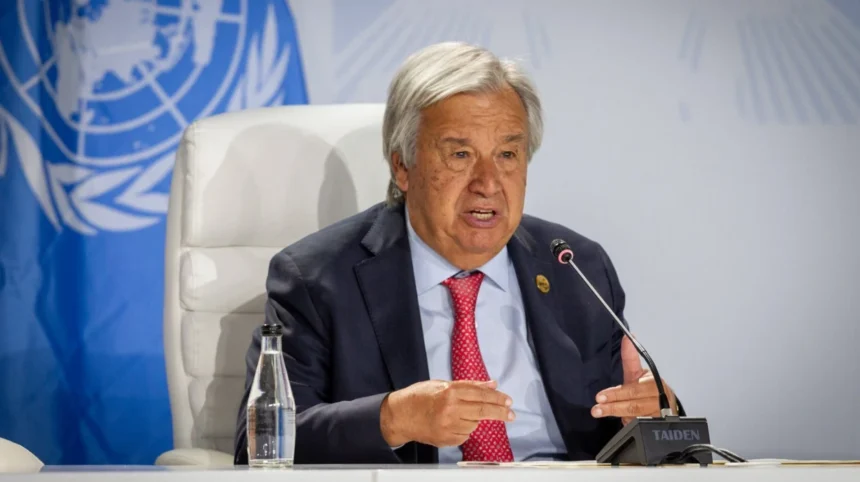
The Secretary General of the United Nations, António Guterres, has warned that the expiration of the last existing nuclear arms control treaty between the United States and Russia marks a
“grave moment for international peace and security.”
The New Strategic Arms Reduction Treaty (New START) treaty, which expired on Thursday, imposed legal limits on the number of nuclear warheads and delivery vehicles that could be maintained by the two countries. The expiration of the treaty means that the United States and Russia are no longer bound by any legal constraints on their strategic nuclear forces.
“For the first time in more than half a century, we face a world without any binding limits on the strategic nuclear arsenals of the two states that possess the overwhelming majority of the world’s nuclear weapons,”
Guterres said in a statement.
A System of Restraint Unravels at a Dangerous Time
Guterres said that the loss of the past decades of success in arms control is happening at a time of “unprecedented global instability” and that
“geopolitical tensions are rising and nuclear threats are again being discussed in mainstream strategic discourse.”
This comes after the Russian government has made several statements about the potential use of tactical nuclear weapons in the early stages of the conflict in Ukraine.
“This dissolution of decades of achievement could not come at a worse time,”
he said.
“The risk of a nuclear weapon being used is the highest in decades.”
From Cold War Stability to Strategic Vacuum
The UN Secretary-General emphasized that nuclear arms control treaties, from the Cold War-era Strategic Arms Limitation Talks (SALT) to the New Strategic Arms Reduction Treaty (New START), have played a crucial role in preventing disaster.
“Throughout the Cold War and in its aftermath, nuclear arms control has helped prevent devastating miscalculation, has contributed to stability, and has drastically improved the security of all peoples,”
Guterres said.
Without the New START treaty, there are no longer any legal or verification-based controls over the world’s two largest nuclear arsenals. Together, Russia and the United States possess more than 80% of the world’s nuclear weapons.
Risks to the Global Nonproliferation Regime
The expiration of the New START regime also has the potential to destabilize the nuclear non-proliferation regime as a whole, including the 1970 Nuclear Non-Proliferation Treaty (NPT), which is set to review its terms later this year.
The NPT established that non-nuclear states would not seek nuclear weapons in return for a commitment from nuclear states to work towards disarmament in good faith. The expiration of US-Russia arms control agreements could have the potential to destabilize this regime, as experts suggest that without visible progress on the part of nuclear states, there could be a reevaluation of non-nuclear status.
What New START Achieved
Signed in Prague in 2010 by then US president Barack Obama and Russian president Dmitry Medvedev, New START limited each side to:
- 1,550 deployed strategic nuclear warheads
- 800 deployed and non-deployed strategic launchers
This represented a reduction of nearly 30% from the previous 2002 limits and included extensive verification and inspection mechanisms.
Medvedev said the treaty’s expiry should “alarm everyone,” while Obama warned on social media that its end
“could spark another arms race that makes the world less safe.”
How Politics and War Killed the Treaty
President Joe Biden agreed with Russia to extend New START for five years after defeating Donald Trump in the 2020 election. However, relations between Washington and Moscow deteriorated sharply following Russia’s full-scale invasion of Ukraine, freezing arms control dialogue.
Trump, during his first term, frequently criticized international arms control agreements and openly questioned the value of nuclear limits, even calling for the resumption of US nuclear testing after a decades-long moratorium.
Observers argue that the treaty’s collapse reflects not only ideology but also dysfunction within the Trump administration, where career diplomats were sidelined and lacked the capacity to negotiate a complex replacement agreement.
Trump declined to follow up on Vladimir Putin’s proposal for a one-year extension. Asked publicly about the offer in October, Trump called it “a good idea,” but no talks followed.
Moscow and Washington Signal Diverging Paths
Russia’s foreign ministry confirmed that both countries are now “no longer bound by any obligations” under New START, while insisting Moscow would act “responsibly and prudently.”
At the same time, it warned it would take “decisive” countermeasures if Russia’s national security were threatened.
Pope Leo XIV also weighed in, urging both sides to do “everything possible” to avoid a new arms race and not to abandon arms control without a concrete successor.
The China Factor Complicates Future Talks
US secretary of state Marco Rubio said President Trump would decide later on next steps but reiterated Washington’s long-standing position that any future arms control agreement must include China.
“In the 21st century, it’s impossible to do arms control that doesn’t include China,”
Rubio said, citing Beijing’s rapidly expanding nuclear arsenal.
China is estimated to possess around 550 strategic nuclear launchers, compared with roughly 800 each for the US and Russia under New START limits. France and the United Kingdom—both US allies—together account for about 100 additional warheads.
A Turning Point for Nuclear Order
The expiration of New START marks the effective end of more than five decades of US-Russia nuclear arms control—a cornerstone of global strategic stability since the Cold War.
Without renewed diplomacy, experts warn the world may be entering an era of unconstrained nuclear competition, where miscalculation, mistrust, and technological acceleration significantly increase the risk of catastrophe.
As Guterres put it, the choice now facing Washington and Moscow is stark: rebuild a system of restraint—or gamble with global survival.