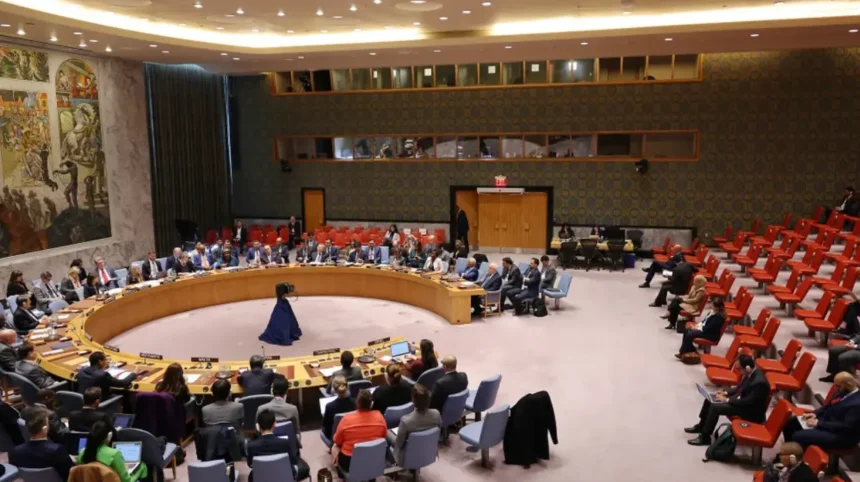
The UN Security Council will hold a meeting on Monday to address Israel’s recognition of Somaliland, which has triggered strong diplomatic opposition and raised concerns about regional security in the Horn of Africa.
The Organization of Islamic Cooperation (OIC), along with the European Union, and twenty-one Muslim-majority nations, have denounced the announcement because they believe it breaches international law and threatens Somalia’s independence.
What did Israel announce regarding Somaliland?
Just days before Somalia was scheduled to take over the Security Council’s rotating presidency, Israeli Prime Minister Benjamin Netanyahu declared the recognition on Friday.
Netanyahu and Foreign Minister Gideon Sa’ar signed a joint declaration of mutual recognition with President Abdirahman Mohamed Abdullahi (Irro) of Somaliland through videoconference.
I announced today the official recognition of the Republic of Somaliland as an independent and sovereign state.
Together with Foreign Minister Sa'ar and the President of the Republic of Somaliland, we signed a joint and mutual declaration.
This declaration is in the spirit of… pic.twitter.com/WlZuN1HB5z
— Benjamin Netanyahu – ?????? ?????? (@netanyahu) December 26, 2025Netanyahu presented the action “in the spirit of the Abraham Accords,” commending Somaliland’s stability and extending an official invitation to its leader while promising collaboration in the fields of agriculture, health, technology, and the economy.
The leaders of Somaliland declared their intention to join the Accords for regional peace, as they recognized their statehood status dating back to 1960.
How does Somalia view Israel’s recognition of Somaliland?
Somalia has strongly opposed Israel’s recognition of Somaliland because it views this recognition as a direct threat to its territorial integrity. After Somalia’s central government fell in 1991, Somaliland proclaimed its independence from Somalia, but it has never received official international recognition.
The region continues to be recognized by the international community as part of Somalia, although it operates independently with separate political systems, security forces, and administrative control.
The Somali government considers unauthorized foreign contact with the autonomous region as a breach of Somalia’s sovereignty because it views Somaliland as an integral part of the federal republic.
Why is Somaliland’s status internationally disputed?
The main barriers to international recognition for Somaliland stem from two main factors. These include worries about establishing new regional standards, and the continued adherence of major powers and organizations to colonial boundaries to preserve their geopolitical strength.
Somaliland declared independence from Somalia in 1991 during the time when Somalia was experiencing a civil war and its government was collapsing. It resumed its brief British Somaliland sovereignty from 1960 prior to its voluntary union with Italian Somaliland.
Somalia exists in a state of disorder, yet this country maintains stable operations through its election process, currency system, and security forces which fulfill all four Montevideo Convention requirements of permanent population, defined territory, effective government, and foreign relations capability.
The African Union mission proposed recognition in 2005 because it viewed the situation as exceptional. Yet it did not want to establish a dangerous precedent.
Under UN Charter Article 2(4), the African Union (AU) and the international community place a high priority on Somalia’s territorial unity. The post-colonial borders established by the Cairo Declaration of 1964 face a threat from Somaliland’s attempt to become independent, according to their perspective.
The Federal Government of Somalia continues to hold sovereignty over the area, although Somaliland has exercised self-rule since 1991 because it refuses to talk with Somaliland. The United Nations does not recognize Somaliland as a member state because no existing UN member state has ever granted recognition to the territory.
How have Arab and Muslim countries responded to the move?
Arab and Muslim-majority nations swiftly condemned Israel’s actions because they regarded them as threats to Somali unity, and violations of international legal standards. Saudi Arabia stood firm in its support for Somalia’s sovereignty and territorial integrity while opposing the recognition because it viewed it as an effort to strengthen independent separatist actions.
Riyadh issued a warning about the creation of competing organizations which could damage current state institutions. This could create instability throughout the region.
Egypt led diplomatic efforts with Djibouti, Somalia, and Turkey to fight against the recognition which they called a “dangerous development” for the Horn of Africa.
Egyptian officials expressed their opposition to any action that would create a precedent for state dissolution while firmly opposing all unilateral moves. These could threaten Somalia’s stability. The Palestinian government condemned the decision because they view it as part of Israel’s broader strategy to destabilize peace throughout the region.
The same perspectives were shared by Kuwait, Iraq, Jordan, Qatar, and Sudan together with other Arab countries. The Arab League chair representing Iraq stated that the action represents a “blatant violation” of both state sovereignty and international law. Sudan warned that the recognition could jeopardize regional security, while Qatar warned that it creates a risky precedent.
The Organization of Islamic Cooperation declared its full backing of Somalia, together with its authorized institutions. It opposed Israel’s decision to recognize Somaliland through an official statement.
Why does the European Union oppose Israel’s recognition?
The European Union strongly opposed Israel’s decision which stood outside the Muslim community. Brussels issued a statement which confirmed its backing for Somalia’s territorial integrity, sovereignty, and national unity based on constitutional law and United Nations and African Union agreements.
The European Union requested Somaliland to establish diplomatic relations with Somalia’s federal government because Somaliland and Somalia’s federal government remain in a state of conflict. The European Union warned that maintaining Somalia’s territorial sovereignty serves as an essential foundation for achieving peace and stability throughout the entire Horn of Africa region.