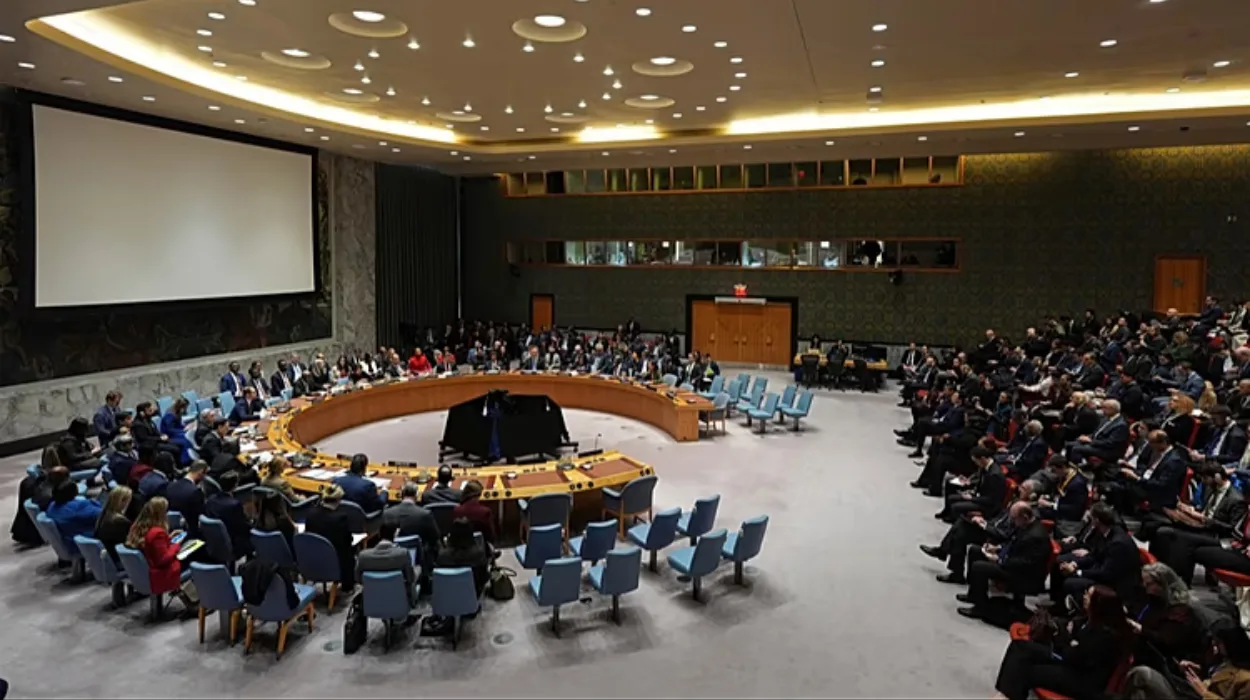

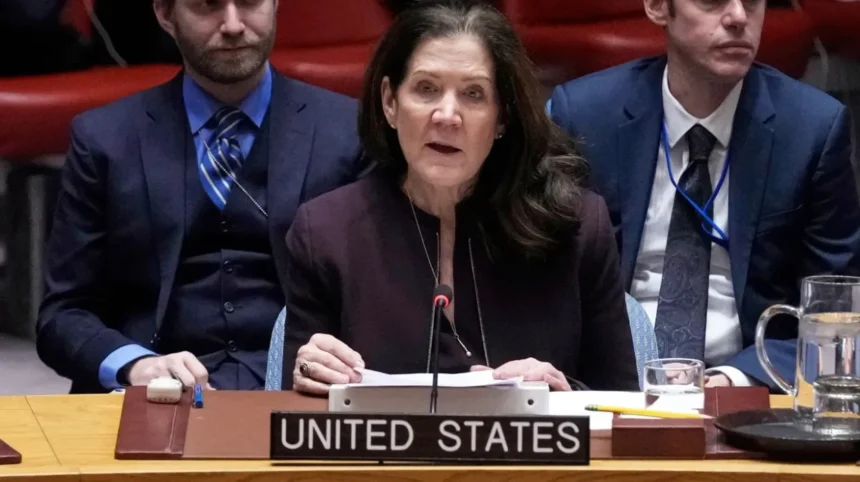
The most senior U.S. official currently at the United Nations informed Congress two years ago that Russia’s invasion of Ukraine was “unprovoked” and “unjustified,” calling on U.N. members to denounce Moscow’s aggression and call for the war to end.
It was the same career diplomat, Dorothy Shea, in February who spoke out against the Trump administration’s unprecedented move to break with European allies and decline to support a U.N. resolution condemning Russia for its invasion on the third anniversary of the war. Although it is common for diplomats to remain as U.S. presidents — and their political parties — do, Shea’s temporary role has unexpectedly positioned her as a face of the dramatic U.S. shift on the world stage, with President Donald Trump‘s “America First” policy increasingly turning the post-World War II global order on its head.
Shea will remain in position longer than anticipated following Trump’s surprise move last month to pull his nominee for U.N. ambassador, Rep. Elise Stefanik, from nomination due to a narrow Republican House majority.
“I would venture to say (Shea’s) position is singular. It is likely most singular in that due to the unprecedented shift, not only from one administration to another, but truly an era in U.S. foreign policy, even when there were subtle variations,”
said Phillip Reeker, the ex-acting assistant secretary of state for Europe.
“The shift in the vote that occurred at the U.N. on the Russia-Ukraine conflict was truly a turning point in U.S. policy.”
A UN resolution alters U.S. communication regarding Ukraine
On Feburary 24, the United States aligned itself with Russia voting against a Ukrainian resolution supported by Europe that called for the urgent withdrawal of Moscow’s troops. A competing American resolution acknowledged “the tragic loss of life” and requested “a swift end to the conflict,” but without reference to the aggression of Moscow as the Trump administration initiated negotiations with Russia to end hostilities.
Going on with rhetorical battles in New York might vindicate diplomats, but will not redeem souls in the field,” Shea, 59, said then. “Let us demonstrate to each other and to our citizens that we can agree on the most fundamental precepts. Let us demonstrate to each other that the grand vision of peace which once extricated us from hell can dominate.
The message was a stunning retreat for the U.S. in the 193-member U.N. General Assembly, whose resolutions are not legally binding but are regarded as a measure of world opinion. It also strengthened the concerns of some allies regarding what a second Trump term might portend for long-standing transatlantic alliances — and whether the U.S. can continue to be a bulwark against aggressors such as Russia.
For Shea, it was business as usual. She has worked the past 30-plus years as a diplomat for Republican and Democratic presidents, from Bill Clinton to Trump, implementing their policies even if they were a divergence from long-standing U.S. positions.
“I don’t know what she personally believes about things. But administrations shift, policies shift. And your role as a diplomat is to represent those policies,” said a retired colleague and deputy U.S. ambassador, Robert Wood.
The foundations of a diplomat
Shea’s career has had assignments in South Africa, where she saw Nelson Mandela become democratically elected as president, and Israel, where she worked to develop the Israeli-Palestinian peace process.
Shea was raised in Washington suburbia — a World War II veteran father and a mother engaged in the metropolitan Japanese American society of friends. Exposure to experience with Japanese exchange students who were hosted by her family for the summers and would like to get to know events around the globe pushed her toward international relations studies at the University of Virginia. Upon graduation, she landed an offer with the U.S. Foreign Service.
She worked her way up and in 2019 was asked to be Trump’s ambassador to Lebanon, where the soft-spoken diplomat made news for denouncing the Hezbollah militant group. A Lebanese judge prohibited local and foreign media from interviewing Shea for a year, stating her denunciation of Hezbollah was seditious and threatened social peace. In 2023, Biden appointed Shea as No. 2 at the U.N.
The leading US position at the UN
Shea is not saying when he will pass off to a Senate-confirmed political appointee. Stefanik has endured a confirmation hearing, but last month her nomination was withdrawn because her vote to advance Trump’s agenda is still important to Republicans in the House.
The Republican congresswoman was the fourth Trump nominee to fail to navigate the confirmation process. Trump has not made any comments on who he would appoint to take Stefanik’s place and occupy his final remaining Cabinet post. In the meantime, Shea is in charge during a precarious time for American foreign policy, peddling sweeping changes to how the country approaches both friends and foes and justifying the administration’s cuts to foreign aid.
The White House recently suggested other drastic reductions at the State Department, including reducing to zero or near zero appropriations for almost all international organizations, including the U.N.
The proposal is strongly preliminary but shows the isolationist perspective of the administration, which, combined with uncertainties regarding funding, is a major test to the mandate and activities of the U.N.