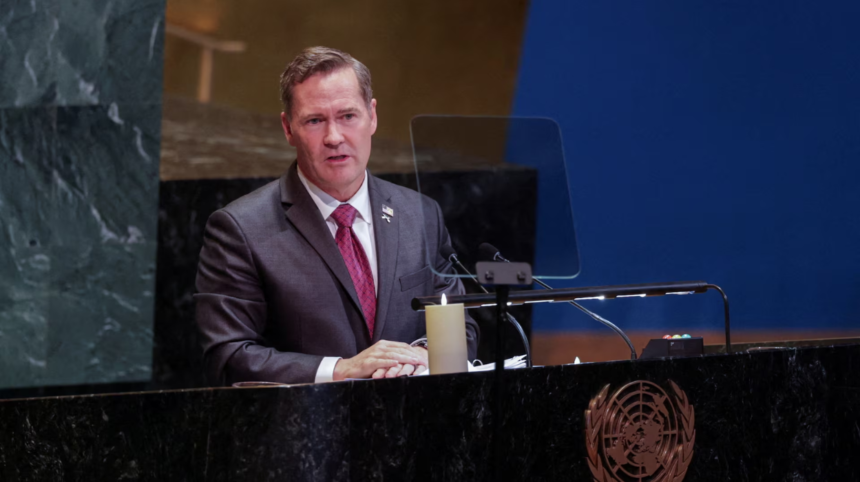
The United States has declared it will persist with its pressure on the United Nations to reform even as it prepares to pay part of its overdue dues, said United States Ambassador Mike Waltz. Although it can be viewed as part of an attempt towards greater efficiency in UN mechanisms, it can be argued that it has become an attempt towards coercive financial leverage.
The United States remains the biggest contributor in the UN system, paying an estimated 22 percent of the UN regular budget and close to 27 percent of peacekeeping financing under the formulas in assessed contribution. Yet, under the presidency of Donald Trump, the United States has withheld some assessed payments and cut back drastically on voluntary contributions, destabilizing the financial viability of key UN agencies.
Mounting Arrears and Global Budgetary Disruption
By early February, the U.S. owed $2.19 billion to the UN’s regular budget, accounting for more than 95 percent of unpaid contributions globally, according to UN officials. Washington owes another $2.4 billion in back peacekeeping dues and $43.6 million to UN tribunals, raising questions of the long-term viability for multilateral mechanisms for peace and justice.
These arrears weaken the UN’s capacity to sustain peacekeeping, humanitarian, and legal operations. There are currently over 70,000 peacekeeping personnel deployed across 11 missions around the globe, including in troubled countries such as South Sudan, Mali, and the Democratic Republic of Congo. A funding shortfall threatens troop withdrawals and would hamper civilian operations.
Contradictions in Washington’s Reform Narrative
Waltz, an ambassador, argues that Washington will pay its dues but expects greater efficiencies, saying agencies “should do, at least, the same amount, if not more, with less.” However, opponents point out that despite such rhetoric, there are unprecedented funding crises for UN agencies.
For example, the overall budget gap at the United Nations High Commissioner for Refugees (UNHCR) worldwide has a deficit of up to 40%, which puts the lives of over 100 million displaced people at risk.
Likewise, there have been reports of funding gaps with the World Food Programme and UNICEF, which affect millions of children and vulnerable communities. The Trump administration’s initiative to reduce the UN Secretariat’s regular budget by 20%, through job cuts, freezing of jobs, and travel limitations, is not addressing governance concerns through these measures.
Unilateralism and Withdrawals from Multilateral Institutions
In January, the U.S. announced its intention to withdraw from dozens of international organizations and UN entities, claiming they were conflicting with U.S. national interests. The same month, Washington went on to formally leave the World Health Organization-a move experts call highly destabilizing in light of ongoing global health crises including emerging infectious disease threats and pandemic preparedness efforts.
Historically, U.S. engagement has been at the core of shaping global norms on health, security, and human rights. Withdrawal and funding cuts are bound to cede influence unto other powers, especially China and Russia, both of which have increased their respective diplomatic and financial footprint in multilateral institutions.
Cost-Cutting Proposals and the Push for Corporate-Style Governance
Waltz has pushed the UN to implement corporate-style efficiency measures, including working from home, artificial intelligence to translate documents, and moving staff out of high-cost cities like New York and Geneva. Such reforms might indeed cut costs, but critics say they overlook the political and operational complexity of multilateral diplomacy and humanitarian coordination.
Relocations, like UNICEF’s moving of thousands of staff to lower-cost locations, could disrupt institutional memory and weaken coordination with diplomatic missions, reducing the UN’s rapid-response capacity in crises.
Power Politics Behind the Reform Agenda
According to analysts, it would appear that while articulating its narrative of reforms, the United States has, in fact, adopted a larger political strategy of transforming the UN, so that its interests can get closer alignment, while, at the same time, it can navigate its foreign policy as it wishes, using its overpowering economic clout as leverage by delaying its contributions.
At the same time, it is argued that real reforms to the UN, such as expansion of the Security Council, a review of the veto system, or more representation for the Global South, have yet to get the needed support from the US.