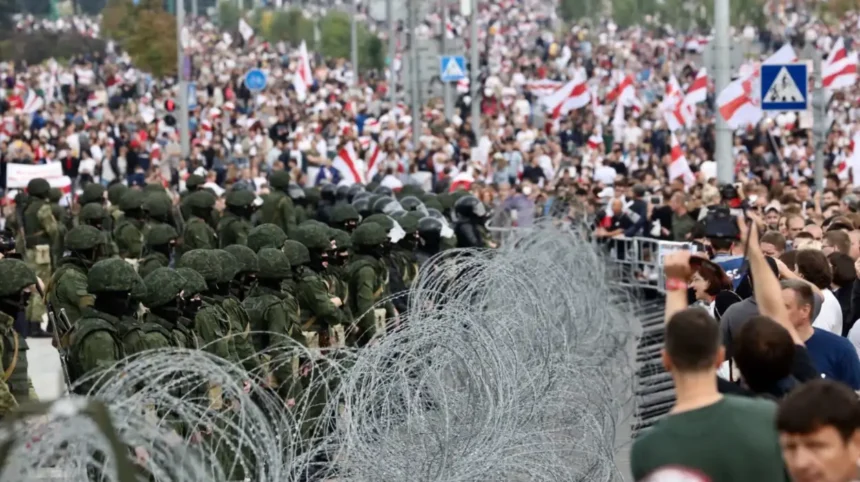
The discussion around Belarus at HRC intensified during a side event at the United Nations Human Rights Council in Geneva, where international experts and diplomats examined continuing repression under President Alexander Lukashenko. The event titled “Human Rights in Belarus” brought renewed attention to patterns of detention, surveillance, and political persecution that analysts argue have persisted since the contested 2020 presidential election.
The representatives of the session made it clear that the magnitude and regularity of abuses now attain the levels of crimes against humanity. Investigations Cited conclusions in a report by the UN Group of Independent Experts on Belarus, that concluded in 2024 that the state authorities had been involved in systematic violations such as imprisonment, torture, and persecution of political opponents. The conclusions of the group supported all the old accusations of international bodies that legal systems in Belarus are applied as the political repression tool.
Surveillance laws and extremism charges
The most prominent mechanism that was discussed in the Geneva conversation is the extended extremism laws embraced by the Belarusian government. The laws allow prosecutors to categorize opposition activity, commentary on social media, as well as even symbolic protest actions, as extremist activity.
The system of digital surveillance that was implemented following the 2020 protests contributed to enhancing the ability of the state to track protestors and journalists. The researchers concerning human rights claim that these technologies allow authorities to recognize dissent rather fast which results in an arrest that in most cases is not accompanied by a clear legal process.
Arrest patterns since the 2020 protests
As it was stated in the HRC meeting, over 13,500 people have been arrested since the protests that followed the 2020 election based on political reasons. These arrests have occurred in a series of repressions, whereby new charges are often made even after previous detainees were freed.
The magnitude of such arrests explains a larger level plan to stem out the reemergence of the organized opposition movements. The authorities have systematically curtailed the space in which the citizens could organize themselves politically by attacking activists, civil society leaders, and independent journalists.
Political prisoners and detention conditions
As observed by the human rights groups that observe the situation, Belarus still captures one of the most significant numbers of political prisoners in Europe. The Viasna Human Rights Centre rights group estimated that around 1149 people were still in prison on political grounds by early 2026.
These prisoners are activists, lawyers, journalists and religious leaders. Analysts point out the extensive character of the prisoner population warrants the attention of the regime to suppress various groups in the civil society instead of concentrating on the repression on political leaders only.
Demographic patterns among detainees
According to the statistics that were gathered in 2025, it is evident that at least 1,254 were found guilty of political offenses in 2025 itself. They included 899 men and 355 women, dozens of whom are detainees and who are above the retirement age.
As noted by the observers, the arrests of older activists are indicative of a drive to break local structures of dissent that contributed to the organization of protests at earlier stages of the crisis. Seniors who are detained particularly have a very hard time in custody with their health.
Reports of torture and ill treatment
The Geneva side event that was addressed by human rights experts gave accounts of the detention conditions that are characterized by overcrowded cells, beatings, and psychological intimidation. Former prisoners testify about electric shocks and sexual violence threats.
Vulnerable populations such as LGBTQ individuals have allegedly even more threats of being abused in detention centers. The international monitors claim that such practices are part of a larger tendency that aims at discouraging political participation by intimidation.
Selective prisoner releases and diplomatic bargaining
Although there was still repression, Belarusian officials were releasing a few prisoners in 2025. About 360 prisoners were released during the year after talks with the western governments.
Observers pointed out that such releases were done in batches with a large number of people being released in December following diplomatic talks between Minsk and Washington. Analysts viewed the timing as an effort by Belarus to relax the international pressure which is associated with sanctions on its potash export sector.
Forced deportation of released detainees
A great number of these freedoms were not allowed to stay in Belarus. There were cases when human rights groups reported that at least 189 former prisoners were expelled out of the country soon after their release.
In a number of cases, people were simply taken straight to the surrounding states and deprived of access to personal property or legal documents. This way of doing things is an excellent conversion of releases into civil rights exile as opposed to restoration.
The revolving door of arrests
Despite the release of some prisoners, new arrests were persistent all over Belarus. Rights monitors noted that the detainees had not decreased by the end of 2025 to less than 1,100, which is an indication that the releases have not had a significant impact in terms of decreasing the overall level of repression.
This trend made the professionals in the Geneva gathering refer to the process as a rotating cycle. The government is letting go of some people on diplomatic missions whilst others are held on new allegations.
Exile and transnational repression
Mass exile is another characteristic that has been identified in the political crisis of Belarus. Since 2020, hundreds of thousands of citizens have been out of the country, including journalists, opposition leaders and human rights activists.
Sviatlana Tsikhanouskaya, the Belarusian opposition leader has done so on numerous international forums on the extent of displacement. In her earlier talks on issues surrounding HRC, she maintained that the government has actively driven the dissidents to foreign countries as a way of silencing political opposition within the country.
Legal tools targeting the diaspora
Amendments to the legislation in 2025 gave Belarus more opportunities to prosecute its opponents in absentia. In such regulations, the courts have the power to trial exiled activists absentee and pass judgments that also involve the seizure of assets.
Another charge introduced by authorities is so-called discrediting of Belarus which may be imposed on the public criticism voiced overseas. Such provisions are effective in extending state pressure beyond the borders of the country.
Pressure on families remaining in Belarus
Reports made during the HRC session indicated that the authorities in Belarus occasionally attack the family members of the exiled activists. Families are pressured by police raids, property confiscations and administration harassment.
Analysts contend that those kinds of tactics amount to transnational repression that is meant to nip the diaspora activism. Authorities also pose further threats to the lives of the opposition figures who have been exiled into the country by threatening their family members who are still within the country.
Collapse of civil society institutions
Belarus has also witnessed a systematic destruction of civil society organizations in addition to arrests and exile. Over 200 nongovernmental groups have been instructed to liquidate according to 2024 alone.
Some of the victims were independent media outlets, legal associations and even cultural organizations. Some of the judicial transparency measures also were eliminated, such as publicly posting court schedules, by 2025.
These reforms weakened the capability of the observers to follow politically sensitive trials. Consequently, human rights movement organizations dispute that the Belarusian law system currently runs with little transparency when it comes to handling political cases.
Health crises within detention facilities
Human rights activists also raised bad health conditions in the Belarusian prisons. In 2025, at least two political prisoners, such as activist Andrei Padniabenny and detainee Valiantsin Shtermer, died in custody due to reasons that have not been reported.
The ex-prisoners have said that a number of inmates are incarcerated in punishment cells called SHIZA, where the temperatures can drop considerably during winter. Belarus has very harsh winter climates where minus thirty degrees Celsius has been recorded in parts of the country.
This heating deficiency, coupled with poor medical care, has caused alarm among global observers that the conditions under which they are detained might be of danger to their health due to the subsequent health complications already experienced by the inmates who already have chronic diseases.
International responses and geopolitical implications
Responses to the Belarus crisis by the diplomatic community have grown louder, as the Belarusian problem is becoming more noticeable at the UN Human Rights Council. A coalition of over thirty countries led by the United Kingdom released a joint statement in May 2025 that insisted on the unconditional release of political inmates.
The European Union envoys have also demanded accountability and tied the enhancement of human rights with the wider geopolitical factors. Brussels has called on Belarus to stop financing the Russian military activities related to the war in Ukraine.
However, Belarusian officials deny the charges. The HRC governmental representatives also gave counter reports denouncing systemic abuses and stating that the legislation of extremism is required to maintain national security.
Russia has parroted these views and has framed criticism of western governments as politically instigated. The fact that the two stories diverge highlights the fact that human rights discussion on Belarus is getting more and more intertwined with wider geopolitical issues in the Eastern region.
With negotiations ongoing on the Geneva floors, the ongoing debate between diplomatic pressure and exile activism and the internal political processes in Belarus leaves a question to the international policymakers, which is whether the sustained focus on Belarus over the years in locations like the human rights council can affect the course of repression in Minsk or whether the increasing diaspora can end up being the most important element that will determine the future of Belarus politics.