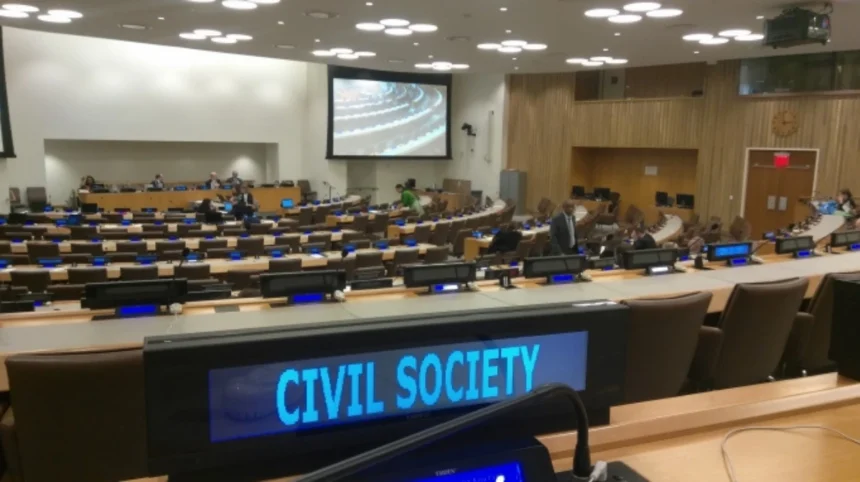
The reformed Committee on Non?Governmental Organizations of the Economic and Social Council (ECOSOC NGO Committee) occupies a pivotal position between the UN system and the tens of thousands of NGOs seeking consultative status to participate in UN-led processes. As the body responsible for evaluating applications for ECOSOC accreditation, monitoring compliance, and shaping civil-society engagement, the committee functions as the gatekeeper to global-governance arenas such as the 2030 Agenda, climate negotiations, and human-rights dialogues. Between 2024 and 2026, the renaming of the body from the “NGO Oversight Committee” to the ECOSOC NGO Committee, alongside minor procedural adjustments, was presented as a move to foster transparency and deliberation. Yet only 19 of the 54 eligible UN Member States currently participate, leaving questions about representation and control unresolved.
The implications are significant. UN officials and many NGOs view the committee as a potential stabilising mechanism, reconciling civil-society participation with accountability, transparency, and adherence to UN norms. Critics, however, warn that it could function as a tool for States to control which NGOs are heard and on what issues. The tension hinges on whether the committee evolves into a vehicle for broadening civil-society inclusion in global debates or becomes an instrument of State-driven oversight and selective exclusion.
Who joins, and what they gain
UN experts encourage broader State participation to enhance the committee’s representation of regional perspectives, particularly from the Global South, small-island States, and countries historically underrepresented in UN governance. Greater membership could make accreditation, renewal, and compliance decisions less susceptible to dominance by a small subset of Western-led actors and more sensitive to the diverse ways NGOs operate in different legal and political contexts. Some participating governments describe their role as shaping standards for NGO behaviour, ensuring transparency, accountability, and alignment with the UN Charter.
Strategic implications of wider State participation
From a governance standpoint, larger membership could increase the legitimacy of committee decisions, especially in cases where NGOs are denied accreditation or sanctioned for alleged misconduct. Visible involvement by a broader group of States might reduce perceptions of politically motivated vetoes. However, expanding membership could also turn the committee into a forum for contesting politically sensitive issues under the guise of technical review. UN analyses note that some governments hesitate to join due to concerns over resource demands, bureaucratic burden, or exposure to politicised accreditation debates, even as under-population risks reinforcing perceptions of opacity.
Managing balance between oversight and inclusion
The challenge for the UN is to ensure that the committee balances inclusivity with effective oversight. Too narrow a membership risks unrepresentative decision-making, while too broad a composition could invite politicisation. How the committee navigates these dynamics will shape its credibility as a forum for civil-society inclusion.
Civil?society perspectives on access and exclusion
For NGOs, ECOSOC consultative status is a practical gateway to UN processes, including high-level forums, expert working groups, and side-events shaping policy and norms. Many organisations view the committee as essential for enabling civil-society inclusion and support calls for wider State participation, hoping that a more diverse composition will yield more predictable, rule-based accreditation decisions. Civil-society actors argue that broader membership could reduce reliance on opaque practices and ensure adherence to established criteria and appeal mechanisms.
Concerns about potential control
At the same time, human-rights NGOs and global watchdogs caution that wider State involvement might rationalise tighter controls over civil-society actors, particularly those critical of government policies or human-rights practices. Some advocate for NGO advisory or observer roles within the committee, arguing the current model remains State-centric and risks treating NGOs as regulated subjects rather than partners. The underlying concern is that committee reform may shift the balance between inclusion and control without addressing the structural power asymmetry between States and civil society seeking access to UN platforms.
Gendered and regional considerations
Civil-society actors from marginalised regions and women-led organisations stress that committee decisions have disproportionate impacts on groups with limited resources. Accreditation barriers can silence voices addressing gender, climate, or human-rights issues. How the committee incorporates these perspectives will influence the inclusivity of global policy debates and the perceived fairness of its decisions.
The role of rules, transparency, and legitimacy
The committee’s effectiveness depends less on the number of participating States than on the clarity of its rules, transparency of procedures, and opportunities for NGOs to engage meaningfully. Hundreds of NGOs already hold consultative status, and many more seek recognition, increasing both the committee’s workload and political sensitivity. UN-linked assessments note that opaque procedures, inconsistent publication of reasoning, and limited documentation undermine perceived legitimacy, even with a broader membership.
Risk management versus engagement
Analysts highlight that the committee functions within a broader ecosystem of global governance, where States balance civil-society inclusion against concerns over disinformation, foreign funding, and political bias. Many governments view the committee as a venue for managing risks without fully curtailing NGO participation. Designing procedures that reconcile risk management with inclusion is critical to ensuring the committee does not become a purely regulatory body.
Pathways to institutional credibility
UN experts suggest that transparent standards, systematic publication of decision rationale, and accessible appeal mechanisms could turn the ECOSOC NGO Committee into a credible node in the UN’s civil-society engagement infrastructure. Embedding these practices may determine whether the committee is remembered as an administrative formality or as a genuine innovation in global governance.
A test case for the UN’s future
The ECOSOC NGO Committee represents a test case for reconciling oversight with inclusion in the UN system. Calls for broader State membership aim to enhance representation and legitimacy while maintaining control over civil-society engagement. Yet the outcome remains uncertain: the committee could advance civil-society inclusion through transparent, rule-based processes, or reinforce a State-centric model that marginalises many actors. The enduring question is whether the UN system will use this small governance mechanism to model a balanced approach, or whether procedural reforms will leave the structural asymmetry between States and civil society largely unchanged.
As the committee evolves, it embodies the broader challenge facing the UN: defining spaces where civil society can meaningfully influence global debates while States maintain oversight. The way these tensions are negotiated will shape the UN’s institutional credibility and the pathways through which NGOs contribute to international policymaking for years to come.