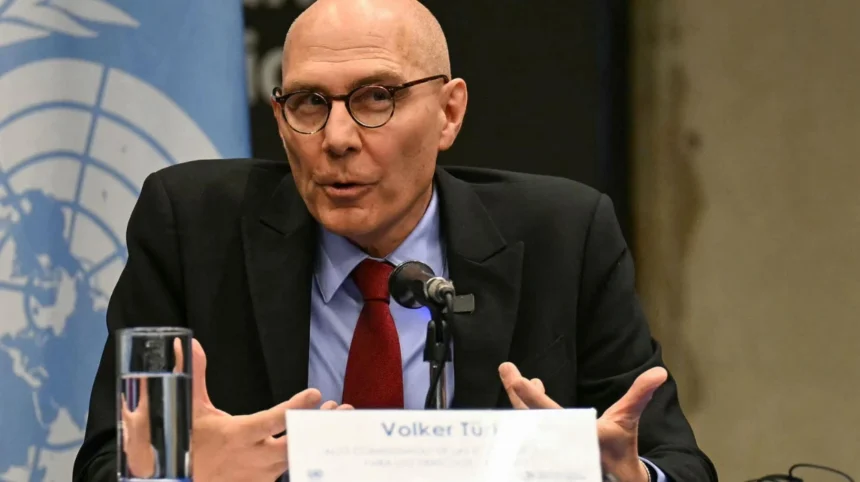
High Commissioner for Human Rights Volker Türk’s upcoming visit to South Korea from May 12 – 14, 2026 is one of the most important times in world human rights diplomacy. This is the first official trip by a UN Human Rights Chief to South Korea in 11 years and it follows Türk’s previous stop in Mongolia on May 10 – 11, demonstrating a strategic desire by the South Korean government to increase visibility in international human rights.
Geopolitical tensions remain high on the Korean Peninsula and the timing of this visit occurs against the backdrop of South Korea being proactive at UN regarding North Korea’s human rights abuses, as well as high-profile General Assembly discussions around those abuses.
Officially the visit will include discussions around the issues of promoting democracy and human rights through cooperation, but a critical examination of the events will show that additional considerations around the continued violations of human rights in North Korea by the North Korean government and South Korea’s desire to take a leadership role in global human rights issues are part of the diplomatic strategy.
Türk’s visit includes meetings with the Foreign Minister Cho Hyun, Minister of Unification, human rights NGOs and North Korean defectors, which will likely lead to substantive discussions that may shape future UN resolutions and motivate stronger bilateral relations.
Strategic Timing and Historical Context
The magnitude of this visit can be amplified by taking into account its unique historical rarity. Since 2015 there has been no visit by the UN human rights commissioner to South Korea, with an eleven-year gap reflecting a shift in priorities within the Office of the UN High Commissioner for Human Rights (OHCHR).
The South Korean foreign ministry has characterized the trip as an opportunity for
“greater global role in promoting the values of human beings and democracy,”
indicating South Korea’s williness (or intent) to capitalize on its democratic credentials in light of a growing challenge posed by authoritarianism around the globe. The timing of this trip aligns with South Korea’s recent developments in diplomacy at the UN, including co-sponsoring resolutions related to North Korean human rights and facilitating discussions during it’s UN Security Council presidency.
Additionally, the 11-year gap between visits served to highlight both logistical limitations within UN mechanisms, as well as broader Global Human Rights Agenda limiting or depriving coverage of human rights issues in the East (Asia) to the UN in favor of regions with severe conflict such as the Middle East or Ukraine. South Korea has been proactive in taking the UN General Assembly meetings, as well as creating a first of its kind high level General Assembly meeting on North Korean Human Rights to increase visibility of these issues, as well as to position itself as an alternative to North Korea.
Detailed Itinerary and Key Engagements
Türk’s packed agenda in Seoul weaves together government dialogues, civil society consultations, and interactions with North Korean defectors, illustrating a multifaceted approach to human rights assessment. Upon landing, he will engage with the unification minister and other ministry officials, whose portfolios directly intersect with inter-Korean relations and defector welfare.
These meetings are poised to address persistent UN concerns over North Korea’s systemic abuses, including forced labor camps, public executions, and restrictions on freedom of expression, issues that have dominated rapporteur reports for years. The inclusion of human rights NGOs adds a layer of grassroots input, allowing Türk to gauge on-the-ground realities beyond official narratives. Reports indicate he will also meet North Korean defectors, whose testimonies have historically fueled UN fact-finding missions and resolutions condemning the Democratic People’s Republic of Korea (DPRK).
A centerpiece of the visit is the bilateral with Foreign Minister Cho Hyun, described by sources as focused on bolstering collaborative efforts.
“Turk plans to visit… to meet with government officials, civic activists and North Korean defectors,”
the Foreign Ministry noted, embedding this within Seoul’s broader ambition to lead on global human rights. Critically analyzing this, the UN’s engagement with defectors serves as a potent diplomatic tool, amplifying voices that Pyongyang dismisses as fabrications.
Yet, the absence of publicized stances from Türk himself prior to the trip—unlike more verbose UN chiefs in contentious regions—hints at a cautious strategy, possibly to avoid preempting sensitive discussions. This measured silence contrasts with South Korea’s vocal advocacy, such as its 2024 UNSC presidency push for North Korea human rights meetings, underscoring a dynamic where Seoul drives the narrative while the UN provides institutional heft.
Key Figures and Their Roles
At the helm of this diplomatic foray is Volker Türk, who assumed the role of UN High Commissioner for Human Rights in 2022, bringing a wealth of experience from his tenure as Assistant Secretary-General for Legal Affairs. Türk’s background in international law positions him uniquely to navigate the complexities of Korean Peninsula issues, where human rights intersect with security dilemmas.
Facing him will be Foreign Minister Cho Hyun, a seasoned diplomat steering South Korea’s foreign policy amid domestic political turbulence and North Korean provocations. The unification minister, though unnamed in initial announcements, holds sway over defector integration and inter-Korean policy, making their input crucial for any forward momentum on humanitarian corridors or information campaigns targeting the North.
These figures embody the visit’s dual tracks: governmental alignment and societal scrutiny. Türk’s interactions with NGOs and defectors inject an element of unpredictability, as these groups often highlight discrepancies between South Korea’s human rights rhetoric and implementation challenges, such as discrimination against defectors or youth mental health crises.
Critically, the UN’s track record shows that such visits rarely yield immediate policy shifts; instead, they seed longer-term pressure through periodic reviews like the Universal Periodic Review. By prioritizing defectors, Türk signals continuity with prior UN mandates, but the question lingers: will this visit catalyze fresh investigations into DPRK atrocities, or merely reiterate familiar condemnations without enforcement mechanisms?
Broader Implications for UN-South Korea Relations
This visit transcends bilateral pleasantries, embedding itself in the UN’s evolving human rights architecture. South Korea’s enthusiasm stems from its self-perceived role as a bridge-builder, using platforms like the Human Rights Council to spotlight North Korea while burnishing its own credentials. The OHCHR’s confirmation of the Mongolia-South Korea tandem trip suggests a regional tour aimed at holistic Asia-Pacific engagement, yet critically, Mongolia’s inclusion—a nation with fewer flashpoints—dilutes the focus on Korea’s urgencies. Seoul’s statements, such as the Foreign Ministry’s aspiration for a “greater global role,” reveal an instrumental view of the UN: not just a forum for complaints, but a validator of its middle-power ambitions.
From a critical United Nations activities perspective, Türk’s trip exemplifies the organization’s strengths and frailties. On one hand, it demonstrates responsiveness to member states’ invitations, fostering dialogue in under-visited regions. On the other, the 11-year gap exposes bureaucratic inertia and resource constraints, where high commissioners prioritize crises with media traction over chronic issues like North Korea’s gulags.
Critical Assessment of Potential Outcomes
Peering ahead, the visit’s success hinges on deliverables beyond photo-ops. Will Türk emerge with commitments for joint UN-South Korea initiatives, such as enhanced monitoring of DPRK satellite imagery for prison camps? Or will it fizzle into joint statements echoing past verbiage? South Korea’s track record—co-sponsoring resolutions and appointing nationals like Hee-Seok Shin to UN roles—suggests it seeks more than optics.
Critically, the UN’s human rights machinery often falters on enforcement, as seen in stalled North Korea referrals to the International Criminal Court. Türk’s meetings with civic groups could unearth domestic angles, pressuring Seoul on issues like migrant worker exploitation, thereby balancing the narrative.
In sum, this UN Human Rights Chief South Korea visit encapsulates the tension between aspiration and action in international human rights work. By convening stakeholders from ministers to defectors, it holds promise for amplified advocacy against Pyongyang’s regime.
Yet, as with many UN endeavors, its true measure lies in follow-through—whether it spurs accountability or joins the archive of well-intentioned engagements. For South Korea, it’s a diplomatic coup; for the UN, a test of relevance in Asia’s human rights landscape. As Türk touches down next week, the world watches for signals of substantive progress amid enduring challenges.