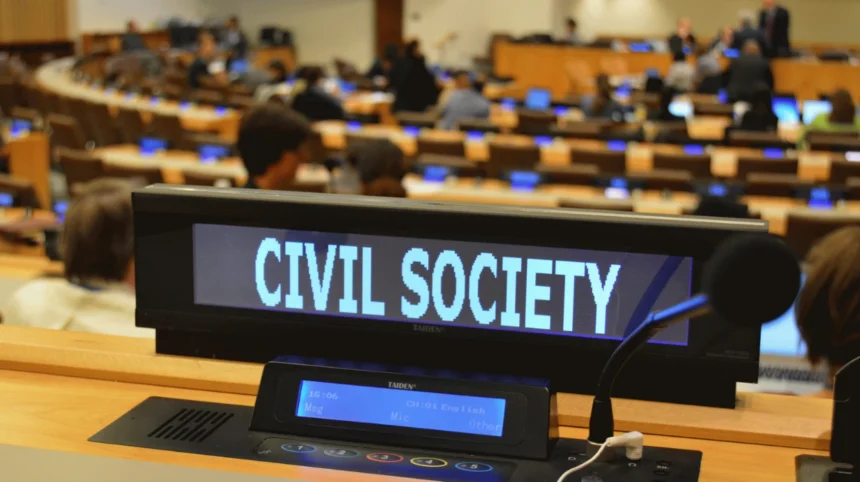
The Authoritarian NGO Committee grip has emerged as a defining feature of recent governance changes within the United Nations Economic and Social Council. The elevation of states such as China, Cuba, Nicaragua, Saudi Arabia, and Sudan to the Committee on NGOs has altered the internal balance of a body that regulates access to the UN system for thousands of civil society organizations.
This shift reflects a broader institutional recalibration rather than an isolated electoral outcome. The NGO Committee, a 19-member panel, exercises authority over consultative status applications, effectively determining which organizations can participate in UN proceedings. By reshaping this composition, member states have redefined the boundaries of civil society engagement, raising concerns about whether the system will continue to accommodate independent scrutiny or increasingly privilege state-aligned narratives.
Accreditation mechanisms and evolving procedural constraints
The operational impact of the Authoritarian NGO Committee grip becomes most visible in the accreditation process itself. Procedures that were once viewed as administrative are now central instruments of influence.
Deferral practices as a strategic tool
The committee’s ability to defer applications indefinitely has become a focal point of concern. These deferrals, often justified through procedural queries, can delay decisions for years, effectively excluding organizations without formally rejecting them. In 2025, deferral rates for independent applicants rose sharply, with some cases involving repeated questioning cycles that prevented final outcomes.
This mechanism allows members to exert influence without overt confrontation. By prolonging scrutiny, states can manage access in a manner that appears procedural while producing substantive exclusion. The Authoritarian NGO Committee grip amplifies this dynamic, as aligned members can coordinate positions more effectively.
Differential treatment of applications
A parallel trend has been the differential treatment of organizations based on perceived alignment. Groups critical of state policies often face more extensive questioning, while those viewed as cooperative or neutral encounter fewer obstacles. This uneven application of rules contributes to a perception of bias, even when decisions remain formally within procedural bounds.
The implications extend beyond individual cases. When patterns of selective scrutiny emerge, they shape expectations among applicants, potentially discouraging participation by organizations that anticipate prolonged delays or rejection.
2025 developments and consolidation of patterns
The current configuration builds on developments observed throughout 2025, when similar trends began to take clearer form across multiple UN bodies.
Rising deferral rates and access limitations
Data from 2025 indicated that approximately one-third of independent NGO applications experienced deferrals, a significant increase compared to earlier years. This shift coincided with growing geopolitical polarization, as states sought to influence multilateral processes more directly.
These developments were not limited to the NGO Committee. Elections to bodies such as the United Nations Human Rights Council reflected similar dynamics, where contested candidates secured positions through coordinated voting blocs. The Authoritarian NGO Committee grip can therefore be seen as part of a wider institutional trend.
Democratic responses and strategic abstentions
The role of democratic states has been a critical factor in enabling these outcomes. Countries including the United Kingdom, France, Canada, and Australia often opted for abstention or consensus during key votes. These decisions were shaped by broader diplomatic considerations, including trade negotiations and regional alliances.
While such approaches aim to preserve cooperation in other areas, they also have institutional consequences. By avoiding confrontation, these states effectively allow shifts in governance structures that may later constrain their own engagement strategies.
Civil society implications and shrinking advocacy space
The Authoritarian NGO Committee grip has immediate and tangible consequences for civil society organizations, particularly those engaged in advocacy on sensitive issues.
Reduced access to UN platforms
Consultative status with ECOSOC provides organizations with the ability to speak at UN meetings, submit written statements, and engage with diplomats. Without this status, their influence within the multilateral system is significantly reduced. Increased deferrals and rejections therefore translate directly into diminished visibility.
Organizations focusing on issues such as minority rights, political repression, and governance accountability are particularly affected. The heightened scrutiny they face can limit their participation, narrowing the range of perspectives represented in UN discussions.
Shifts toward alternative engagement strategies
In response, many organizations have begun to explore alternative avenues for advocacy. Regional mechanisms, such as the Inter-American Commission on Human Rights, offer platforms for engagement outside the UN framework. Digital campaigns and informal networks have also gained prominence, allowing organizations to bypass traditional gatekeeping structures.
However, these alternatives do not fully replicate the influence of UN participation. The Authoritarian NGO Committee grip therefore represents a structural challenge that cannot be easily mitigated through adaptation alone.
Bloc politics and institutional inertia
The persistence of these trends is closely linked to the dynamics of bloc politics within ECOSOC and the broader UN system.
Non-Aligned Movement and voting coordination
Support from the Non-Aligned Movement has been instrumental in shaping committee composition. By framing selections as a matter of equitable representation, member states have built coalitions capable of securing uncontested outcomes. This approach reflects a broader emphasis on sovereignty and resistance to external scrutiny.
The resulting voting patterns make reform difficult. Even when concerns are raised, the absence of competitive elections or alternative candidates limits the scope for change.
Constraints on reform initiatives
Efforts to introduce reforms, such as independent vetting mechanisms or stricter eligibility criteria, have encountered resistance. Proposals linked to frameworks like United Nations General Assembly Resolution 60/251 highlight the gap between normative commitments and practical implementation.
Without consensus among member states, reform initiatives remain largely aspirational. This institutional inertia reinforces existing dynamics, allowing the Authoritarian NGO Committee grip to persist.
Broader implications for UN legitimacy and governance
The impact of the Authoritarian NGO Committee grip extends beyond procedural considerations to questions of legitimacy and credibility.
Perceptions of bias and institutional trust
When accreditation decisions appear politically influenced, confidence in the UN’s neutrality may decline. This is particularly relevant for civil society actors that rely on the organization as a platform for impartial engagement. Reduced trust can limit participation and weaken the UN’s role as a forum for inclusive dialogue.
The reputational impact may also affect member states, particularly those that advocate for transparency and accountability. Balancing these commitments with strategic considerations becomes increasingly complex in a polarized environment.
Long-term effects on multilateral engagement
Over time, the narrowing of civil society access could alter the nature of multilateral governance. If independent voices are systematically excluded or marginalized, decision-making processes may become more state-centric, reducing the diversity of inputs that inform policy outcomes.
This shift could have broader implications for global governance, particularly in areas such as human rights, development, and conflict resolution, where civil society contributions play a critical role.
Strategic outlook in a changing multilateral landscape
The Authoritarian NGO Committee grip reflects a broader transformation in how influence is exercised within the UN system. Procedural mechanisms, once considered technical, have become central to geopolitical competition, shaping access, narratives, and outcomes.
As civil society organizations adapt and member states navigate competing priorities, the trajectory of this shift will depend on whether alternative models of engagement can emerge or whether existing structures will continue to consolidate control. The evolving balance between inclusivity and sovereignty, between procedural authority and normative commitments, remains a defining question for the future of multilateral governance.