Lebanon’s political and security equilibrium has entered a phase of acute instability, where displacement is no longer a temporary humanitarian outcome but a structural feature of conflict dynamics.
The convergence of cross-border hostilities, internal fragility, and regional rivalries has created a volatile environment in which civilian movement is shaped as much by military signaling as by immediate survival needs. By early 2026, the scale and speed of population displacement indicate that Lebanon is not merely absorbing shocks but undergoing a deeper transformation in how conflict reshapes territory, governance, and social cohesion.
Displacement patterns redefine conflict geography
Displacement in Lebanon increasingly reflects strategic calculations rather than incidental consequences of violence. Patterns observed since late 2025 show repeated cycles of evacuation, return, and renewed displacement, particularly in southern regions close to the Blue Line. These cycles create a shifting human geography where entire communities are temporarily erased and reconstituted elsewhere, often under precarious conditions.
Rapid mass movement and urban concentration
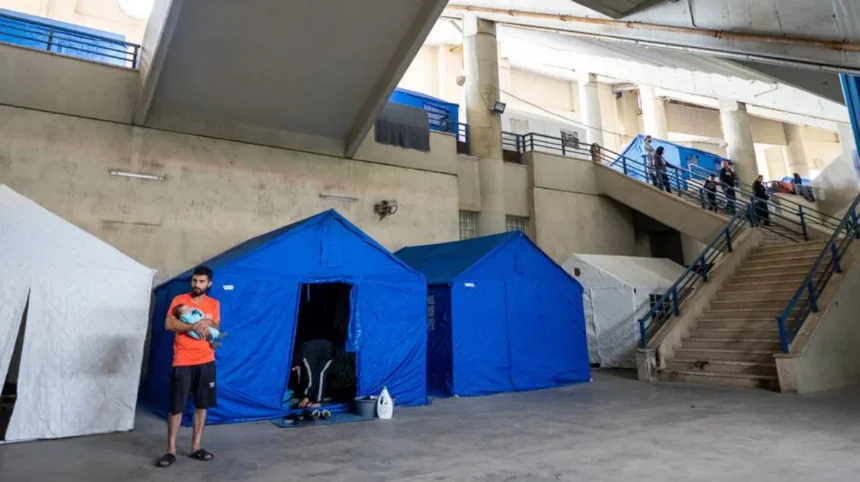
The intensity of strikes in March 2026 triggered rapid population movements, with tens of thousands fleeing within hours. Urban centres such as Beirut and Sidon absorbed large inflows, placing immediate pressure on housing, infrastructure, and public services. Informal settlements expanded rapidly, often without sanitation or healthcare access, creating secondary risks beyond the initial violence.
These rapid movements disrupt traditional support networks. Families are separated, livelihoods interrupted, and local economies destabilized. The concentration of displaced populations in urban peripheries introduces new socio-economic tensions, particularly in areas already affected by poverty and unemployment.
Fragmentation of rural communities
Rural areas in southern Lebanon have experienced repeated depopulation waves. Villages emptied under evacuation orders often remain inaccessible due to damaged roads or continued security risks. This fragmentation undermines agricultural production and local governance structures, weakening long-term resilience.
The absence of stable populations in these areas also reduces the state’s administrative reach. Local authorities struggle to maintain services or enforce regulations, further eroding institutional presence in already fragile areas.
Deterrence strategies and coercive displacement
The interaction between military strategy and civilian movement has become a defining feature of the current crisis. Displacement is not simply a by-product but increasingly a tool embedded within deterrence frameworks pursued by competing actors.
Israeli military signaling and evacuation orders
Israeli operations have incorporated evacuation warnings as part of broader targeting strategies. These directives are framed as protective measures but function as instruments that compel large-scale civilian movement. Areas designated for evacuation often include residential zones suspected of hosting militant infrastructure.
This approach creates zones of enforced absence, where civilian departure is necessary to enable military action. The result is a landscape shaped by temporary voids, where entire areas are cleared in anticipation of strikes, altering both the physical and social terrain.
Hezbollah’s deterrence by resilience
Hezbollah’s posture emphasizes endurance under pressure, framing civilian persistence or return as a form of resistance. This narrative reinforces the idea that displacement, while disruptive, does not equate to strategic defeat. Instead, resilience becomes part of the deterrence equation.
However, this approach places significant burdens on civilian populations. Communities caught between evacuation orders and calls for resilience face difficult decisions, often without adequate protection or support.
Civilian vulnerability and humanitarian strain
The humanitarian dimension of Lebanon’s displacement crisis reflects both the scale of need and the limitations of response mechanisms. The overlap between conflict dynamics and structural fragility amplifies risks for vulnerable populations.
Health system under pressure
Healthcare infrastructure, already weakened by years of economic crisis, has struggled to cope with the surge in casualties and displaced populations. Hospitals in affected areas face shortages of supplies, staff, and electricity, limiting their capacity to provide critical care.
The closure of primary healthcare facilities in high-risk areas further exacerbates the situation. Displaced populations often lack access to basic medical services, increasing the likelihood of untreated injuries and disease outbreaks.
Gendered and social impacts
Displacement disproportionately affects women, children, and the elderly. Overcrowded shelters and informal settlements create conditions where privacy is limited and protection risks increase. Reports from humanitarian agencies in 2025 and early 2026 highlight rising concerns over gender-based violence and inadequate reproductive healthcare.
Children face disruptions to education and psychological stress from repeated displacement. The absence of stable schooling environments not only affects learning outcomes but also undermines long-term social stability.
Governance constraints and institutional erosion
Lebanon’s ability to manage displacement is constrained by its broader governance crisis. The state’s limited fiscal capacity and fragmented political landscape hinder coordinated responses.
Informal displacement and data gaps
A significant proportion of displaced individuals remain outside formal shelter systems, relying on informal arrangements. This dispersal complicates data collection and needs assessment, making it difficult for authorities and humanitarian actors to allocate resources effectively.
Without accurate data, policy responses risk being reactive rather than strategic. The absence of centralized coordination further weakens the state’s capacity to manage large-scale population movements.
Infrastructure damage and administrative reach
Damage to roads, bridges, and public facilities restricts both humanitarian access and state operations. Areas cut off by infrastructure disruption experience delays in aid delivery and reduced administrative oversight.
This physical fragmentation mirrors institutional erosion. As state presence diminishes in affected areas, alternative actors, including local networks and non-state groups, fill governance gaps, often with varying degrees of accountability.
International response and strategic limitations
The international community has mobilized humanitarian assistance, yet structural challenges limit the effectiveness of these efforts. Funding gaps and political constraints shape the scope and sustainability of interventions.
Funding shortfalls and operational challenges
Emergency appeals launched in 2026 highlight the scale of financial requirements needed to address displacement. However, contributions have fallen short of targets, forcing agencies to prioritize immediate life-saving interventions over longer-term recovery.
Operational challenges, including access restrictions and security risks, further complicate aid delivery. Areas experiencing active hostilities remain difficult to reach, leaving some displaced populations underserved.
Diplomatic efforts and deterrence dynamics
International diplomatic efforts emphasize de-escalation and civilian protection, yet they struggle to influence entrenched deterrence strategies. Both sides prioritize security objectives that often conflict with humanitarian considerations.
The absence of a sustained ceasefire framework limits the effectiveness of diplomatic engagement. Without mechanisms to stabilize the situation, displacement continues to function as an embedded feature of the conflict rather than a temporary emergency.
Strategic implications for Lebanon’s future stability
The persistence of displacement as a central feature of Lebanon’s crisis has long-term implications for state stability and regional dynamics. The interplay between deterrence, governance, and humanitarian conditions shapes the trajectory of the country’s recovery prospects.
Repeated cycles of displacement risk normalizing population movement as a routine response to conflict. This normalization can erode social cohesion, weaken community ties, and create generational impacts on education, health, and economic participation.
At the same time, the integration of displacement into deterrence strategies suggests that civilian movement will remain closely tied to military calculations. As long as competing actors view displacement as an acceptable or even advantageous outcome, efforts to stabilize Lebanon will face significant structural barriers.
The evolving situation raises deeper questions about whether Lebanon can transition from a reactive crisis management model to a proactive framework that prioritizes civilian protection and institutional resilience. The answer may depend on shifts not only within Lebanon but also in the broader regional security environment, where the balance between deterrence and humanitarian considerations continues to shape outcomes on the ground.