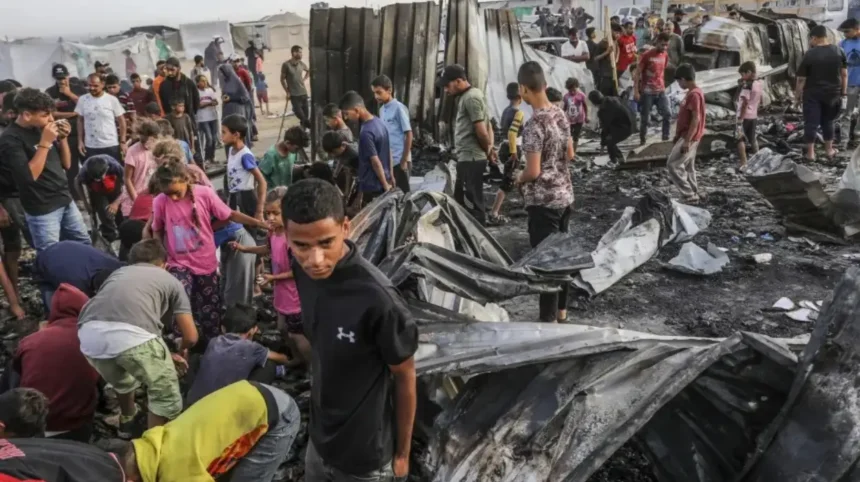
The Gaza Strip has entered a stage in which the breadth and intensity of humanitarian needs are evident, yet the operational capacity of aid systems falls far short of matching that scale. By early 2026, UN-affiliated assessments indicate that the majority of Gaza’s population faces urgent needs for food, safe water, medical care, and basic shelter. Hospitals and clinics report operating under extreme strain, frequently without reliable power, sufficient medicines, or the capacity to absorb new waves of patients after each round of hostilities. The cumulative effect is a situation in which the declared scale of humanitarian needs vastly exceeds the ability of aid convoys, distribution nodes, and service providers to deliver consistent, life-sustaining support.
Even when food and medical supplies reach Gaza, the distribution networks are often too fragile to ensure predictable coverage for all households. Damaged roads, collapsed bridges, and heavily monitored crossings have turned logistics into a core constraint, with convoys routinely rerouted, delayed, or blocked at checkpoints. UN-backed assessments describe a pattern of “partial and episodic” aid flows, in which brief windows of access are interrupted by renewed hostilities or security-related decisions. In this context, the humanitarian system operates not merely in reaction to crisis but in the management of a fragile rhythm of delivery under structurally hostile conditions.
Deepening humanitarian needs and systemic gaps
UN agencies, including the Office for the Coordination of Humanitarian Affairs (OCHA), stress that humanitarian needs in Gaza have intensified rather than stabilised, driven by repeated waves of displacement, infrastructure damage, and service disruption. Damage to power grids, water-treatment plants, and sewage systems has left many communities without reliable access to safe water and sanitation, increasing the risk of disease outbreaks. Food-security monitoring indicates that large portions of the population are entirely dependent on aid for basic caloric intake, while local markets and wage-labor opportunities remain restricted due to mobility constraints and ongoing security concerns. Hunger, disease, and displacement are increasingly interdependent, creating a complex humanitarian crisis.
At the same time, there is a widening gap between the scale of declared needs and the resources available to respond. While donors have pledged substantial financial support, much of it is earmarked for short-term programmes or specific interventions, leaving structural gaps in long-term infrastructure repair, health-system resilience, and social protection. In Gaza, where repeated damage to infrastructure limits planning and scale, these gaps translate into operational constraints that cannot be overcome by pledges alone. The challenge is compounded by the fragility of the environment itself—unreliable access, insecure transport routes, and damaged facilities directly constrain the effectiveness of humanitarian interventions.
Constraints on aid access and logistics
Aid actors consistently highlight that the principal obstacle is not solely the scale of need but the limitations of the delivery system. Damage to key ports and crossings, repeated closures of border points, and security checks at checkpoints have turned aid movements into a bottleneck, undermining the impact of even well-funded programmes. UN spokespersons and logistics experts note that internal restrictions and insecurity often prevent convoys from reaching remote or heavily damaged districts. In many areas, destroyed roads and blocked routes force agencies to rely on fragmented deliveries that cannot meet the volume of need.
The impact on health and nutrition
Restricted access significantly limits the ability to scale up health and nutrition services in time to prevent disease outbreaks. Hospitals and clinics that receive emergency medical supplies may still lack reliable power, personnel, or safe operational conditions to convert these resources into effective treatment. Humanitarian-law analysts warn that these systemic access constraints may expose civilians to prolonged deprivation, raising potential issues under international humanitarian law when denial or restriction of aid exacerbates hunger, disease, or lack of medical care. UN calls stress the importance of keeping humanitarian corridors open, safeguarding medical evacuation routes, and allowing convoys to move without arbitrary delays.
Logistics and operational fragility
Logistical constraints extend beyond immediate supply delivery. Damaged infrastructure and unpredictable security environments undermine planning and coordination, forcing agencies to adopt ad-hoc approaches that may be ineffective at scale. The operational fragility inherent in Gaza’s aid system demonstrates that logistics are inseparable from the broader political and security environment, and that even well-intentioned aid can fail to reach those most in need if these constraints are not systematically addressed.
Local coping mechanisms and the limits of resilience
Within Gaza, local communities have developed informal networks and coping strategies to bridge the gap between needs and aid provision. Households rely on remittances from abroad, shared food distribution pools, and improvised shelter arrangements. Local NGOs and community leaders organise ad-hoc distributions, recycle damaged materials, and operate makeshift health or nutrition points when formal systems are overwhelmed. These mechanisms, however, are temporary, uneven, and lack the capacity to substitute for a comprehensive humanitarian response.
Palestinian officials warn that reliance on local coping strategies masks the underlying fragility of the aid system rather than resolving it. When access is constrained, survival burdens shift onto households and informal networks with limited resources. Even minor disruptions, such as the closure of a crossing or new attacks, can rapidly overwhelm these coping structures, plunging communities into acute vulnerability. Humanitarian actors emphasize that long-term solutions require not only more predictable aid flows but investments in infrastructure repair, logistics capacity, and social protection to sustain Gaza’s population during renewed hostilities or movement restrictions.
The political economy of aid and humanitarian responsibility
The gap between humanitarian needs and access is as much a political and legal issue as an operational one. UN officials and human-rights bodies note that failing to guarantee predictable access may expose conflict parties to allegations of using humanitarian blockades as coercive tools. Aid access is often negotiated as part of broader security and political discussions, despite its immediate life-and-death consequences. UN agencies call for multilateral initiatives that integrate political engagement with logistical support, including rapid repair of transport nodes, dedicated humanitarian crossings, and neutral convoy escorts.
The enduring question is whether the international community will treat Gaza’s humanitarian crisis as a solvable problem, dependent on goodwill, diplomacy, and improved logistics, or as a structural crisis rooted in the broader conflict and occupation dynamics. UN assessments underline that immediate suffering cannot be resolved without political de-escalation, yet the failure to match humanitarian needs with access and delivery raises distinct responsibility questions for states, donors, and belligerents. How these challenges are navigated will shape both the experience of Gaza’s population in the present and the global understanding of humanitarian obligations in densely populated, contested environments.
The persistence of constrained access and systemic vulnerability in Gaza illustrates the broader tensions inherent in modern humanitarian response: the interplay between logistical capacity, political negotiation, and local resilience. The way these dynamics unfold may not only determine the survival of communities today but also redefine expectations for operational accountability, international engagement, and the practical meaning of humanitarian responsibility in protracted crises.