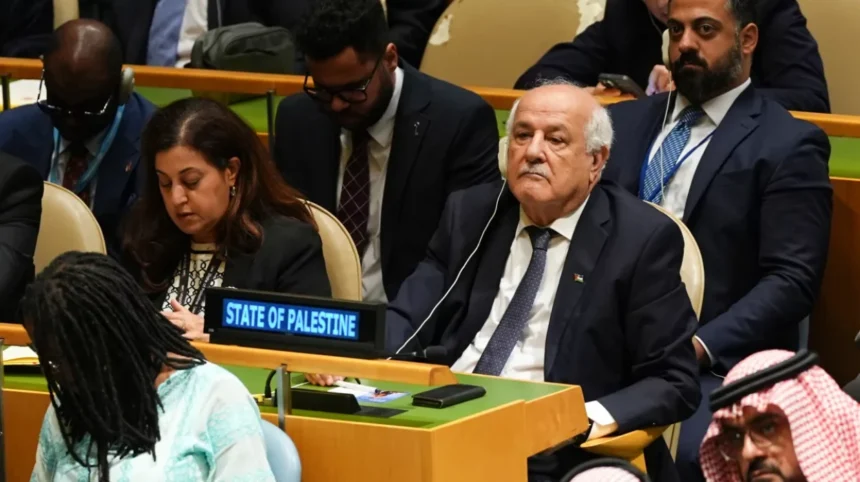
Beyond being a mere procedural step in regard to UN seating and representation, the Palestinian delegation’s decision to withdraw its candidacy for the vice-presidency position in the UN General Assembly amounts to a diplomatic slap in the face, showing just how assertive the US is willing to be in influencing international outcomes when Palestinian representation acquires any semblance of institutional relevance. This latest development constitutes yet another example of how procedure within the UN can carry political weight.
The main character in the story is Riyad Mansour, the Palestinian ambassador to the UN, whose name was attached to the vice presidency seat until the moment he decided to withdraw. It appears that such a decision was made following pressure from the United States, which stated that Palestinian officials need to withdraw from that particular office position. Ultimately, the candidacy was withdrawn, while the Lebanese ambassador was supposed to occupy the post.
A well-known public intellectual and former Human Rights Watch executive director, Kenneth Roth, in a Tweet said:
“The Trump administration is pressing Palestinian leadership to drop its bid for a senior position at the UN general assembly, which could allow Palestinians to chair high-profile debates on Israel’s genocide, apartheid, war crimes, and illegal occupation.”
Why the role mattered
The vice-presidency of the General Assembly is not one of the most influential positions within the UN organization, but it does have political significance. Being the holder of such an office allows the delegate to gain visibility in the assembly hall, procedural power during the meetings, and symbolic representation in the hierarchy of the world organization. The vice-presidency is especially significant for the Palestinians due to their lack of recognition within international organizations.
This is what made the U.S. reaction notable. The American government has always been against any measures that could strengthen the Palestinian position in international politics apart from negotiations. Here, the point is not about the signing of some agreement, passing of some resolution or voting for a status of a state. This concerns the possibility of taking up positions in the context of the United Nations.
It should be noted that such a development is also a reflection of a more general struggle over the right to define the story of the Palestinian problem within the United Nations. From the perspective of Palestinian authorities, taking up high-ranking positions can assist them in defining their legitimacy and keeping their issue in multilateral organizations. From the point of view of American policy, however, those positions can be considered as means of influence.
The U.S. pressure campaign
There have been reports that the Trump administration urged the Palestinian delegates to withdraw from their campaign for the vice presidency through diplomatic means. The attempt was said to have been made deliberately and directly, and there were threats that should the withdrawal not take place. This is significant in demonstrating that the move was more than just silent opposition.
This position, which was reported from the United States is part of a wider trend in US foreign policy concerning Palestinian moves in international diplomacy. The United States has repeatedly asserted that such actions will make negotiations harder and strengthen the positions of each side. This position usually manifests itself through interference whenever Palestinians seek to gain diplomatic recognition in international fora.
This move also highlights the asymmetry of global diplomacy, where the US continues to be the most powerful external power in many international platforms and whose influence counts whether there is a veto involved or not. This situation implies that Washington was able to use its power well, producing a procedural decision for the UN without an open showdown at the UN General Assembly.
Palestinian retreat and political meaning
For the Palestinian choice to withdraw the bid, more needs to be said than just regarding it tactically. The Palestinians’ choice reflects their inability to maneuver within the existing conditions. In other words, although they may seek recognition and membership within international forums, they will continue to be subjected to pressures by powerful actors who will turn their leadership contests into political negotiations.
The engagement of Riyad Mansour in this situation further complicates things because of the importance of his position as the head of the Palestinian diplomatic mission at the United Nations. Although he does not represent any real leadership qualities in practice, a vice presidential seat would have brought him further into the limelight – at least symbolically, but even that was denied to him through this move.
This example is a demonstration of the situation in which the Palestinian diplomacy sometimes has to balance principle and pragmatism. Seeking a UN Security Council seat may be perceived as an attempt to make a statement and to participate in UN institutions. However, when threatened by possible retaliation from Washington, the decision was reversed. This is the way diplomacy works in case of imbalanced power relations.
What the numbers say
This leadership hierarchy is part of what made the topic an interesting point of contention. The vice-presidential position is just one out of 16 that are held in the hierarchy of the Assembly, and they all assist in the process of running the business of the Assembly. Although their function does not include a policymaking ability over decisions in the UN, the positions do provide some amount of influence and prestige.
Why is this important? Many people might view this as simply another disagreement over a position with little significance, but the importance of ceremonies should never be underestimated when considering diplomatic affairs. In some cases, simply having visibility can make all the difference for political actors seeking recognition.
The reported deadline around May 22 added urgency to the development. Once the United States made its position clear and the timeline tightened, the Palestinians were left with a narrow window to decide whether to continue or withdraw. The eventual decision to drop the bid indicates that the pressure was not abstract; it was operational and immediate.
Regional and diplomatic fallout
The reported decision by Lebanon to take up the position of vice-president illustrates just how delicate the issue of UN representation in the region is. Even though an individual pulls out, another can fill the gap, but the change will nonetheless be politically charged. In the current situation, the fact that Lebanon took up the post implies that the position remained vacant for a short period of time despite its political nature.
The development can certainly be seen as yet another manifestation of the US strategy of leveraging international organizations in order to push its regional policies. For those who support the Palestinians, it may mean that the Americans will prevent their progress even when it comes to symbolic positions in organizations such as the UN. Others may argue that it is hard to pursue a confrontational policy in this context.
The broader UN context matters too. The General Assembly often serves as a stage for symbolic contests, especially on Palestine, where recognition, access, and procedural visibility can all become politically loaded. This is not the first time Palestinian diplomacy has intersected with pressure from major powers, and it will not likely be the last. What makes this case notable is the directness of the reported U.S. intervention and the fact that the target was an internal leadership role rather than a high-stakes vote.
Statements in context
The language used by the parties reflects their competing priorities. The U.S. side, according to reports, treated the bid as something that should be reversed and made clear that consequences could follow if the Palestinians did not comply. That framing suggests Washington viewed the matter as part of a broader policy fight, not a routine UN administrative issue.
Palestinian representatives, by contrast, appeared to treat the bid as an opportunity to strengthen their institutional presence in the UN system. Their eventual withdrawal signals that the diplomatic pressure outweighed the benefits of pursuing the role. The fact that the decision was reversed rather than defended to the end shows how tightly Palestinian moves remain constrained by external power.
The UN’s own role in the episode is comparatively neutral, but its procedures form the arena in which such pressure plays out. The institution can confirm who occupies which leadership post, but it cannot easily insulate internal arrangements from geopolitical interference. That is one of the enduring contradictions of the UN: it is meant to be a forum for equal membership, yet its outcomes are constantly shaped by unequal influence.
Bigger picture for Palestine
One must also recognize this event against the backdrop of the more extensive efforts made by Palestinians to gain international recognition. Through their diplomatic endeavors, Palestinians have sought to utilize the UN as an arena to make their point about international legitimacy and visibility. Each chance to be in a position of authority can be exploited to emphasize the point that Palestinians are a political entity with international significance.
On the other hand, however, the current situation demonstrates the limits of this particular approach. Should a big player decide to put up resistance, the Palestinians will find themselves with very limited options. But it would be incorrect to state that all of their endeavors were in vain.
For the Palestinian Authority, the withdrawal is likely to be read internally as a setback, but not necessarily a decisive one. In diplomatic terms, even losses can reinforce the narrative of obstruction and reinforce support among sympathizers. The danger is that repeated retreats can also project weakness, especially when they occur under visible pressure.
The U.S. response may also have consequences beyond this specific role. It reinforces the message that Washington will challenge Palestinian gains where it can, including at the UN. That could affect how Palestinian officials approach future procedural contests, coalition-building efforts, and public diplomacy.
This is not just a story about a seat at the UN General Assembly. It is a story about influence, leverage, and the limits of symbolic diplomacy in a system still dominated by power politics. The withdrawal of the Palestinian vice-presidency bid shows how a seemingly minor procedural office can become a proxy battleground for a much larger conflict.
The immediate outcome is clear: the Palestinians dropped the bid, and the vice-presidency appears to shift to Lebanon’s ambassador. But the deeper story is the one that will matter in the long term. It shows that even in the UN, where every member state formally has a place, not every state has equal freedom to claim prominence. For the Palestinians, this episode is another reminder that recognition may be easier to win in principle than to secure in practice.