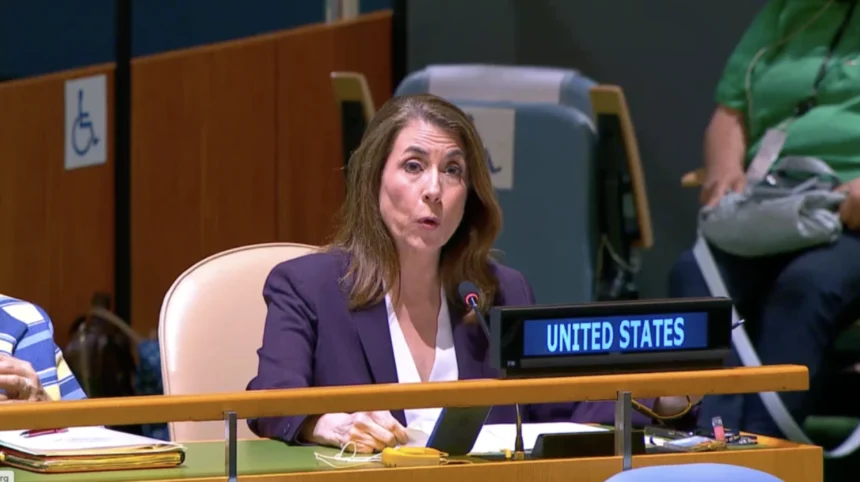
A new political declaration on HIV/AIDS has been approved by the UN, although its adoption revealed clear political divides within the General Assembly. The resolution was carried easily by 149 votes in favor, 8 against, and 14 abstentions. However, what made the adoption of the resolution noteworthy was the fact that both the US and Russia had voted against it. The declaration was supposed to reaffirm the international community’s pledge to eliminate AIDS as a public health threat by 2030.
UN vote highlights global divide
The vote occurred at the United Nations’ high-level meeting on HIV/AIDS when the political declaration was passed despite a number of dissenters among the member states. While there was widespread agreement regarding the content of the text, the dissidence of the United States and Russia deserves special mention due to the status of both nations as significant geopolitical powers. In this case, the declaration itself is based on deep concern that the international community is lagging behind its goal of ending AIDS by 2030. According to the source, the text specifically mentions the failure of the international community to reach the 2025 global targets for HIV.
Why Washington said no
The U.S. position centered on language it viewed as politically and scientifically problematic. U.S. Ambassador Tammy Bruce said the declaration diverged from the 95-95-95 targets and included what Washington called “divisive topics” and references to texts that the United States said were not part of consensus or were not directly connected to AIDS policy.
The same is true for the American objection when it came to trade and the manufacturing of medicines. The U.S. objected to any language that would encourage technology transfer for the purpose of production of medicines against HIV because such transfer has to be voluntary and mutually agreed. This is significant because of the fact that the American attitude towards this language has always been cautious.
In practical terms, the U.S. stance reflects a familiar pattern in global health diplomacy: support for HIV action in principle, but resistance to wording that links public health goals to wider political, economic, or social commitments. The result is a vote that is not a rejection of HIV action itself, but a rejection of the declaration’s policy framing.
Moscow’s objections and concerns
Russia’s rejection followed a different logic, though it also focused on language and sovereignty. The Russian side said the declaration included at least 20 unacceptable provisions and argued that the text interfered in domestic affairs while promoting what it called scientifically dubious notions.
The Russian objections included mentions of harm reduction, discrimination against drug users, and gender-based language. These themes are common to modern responses to HIV infection due to their concern with stigma, drug use, sexual behavior, and accessing healthcare. The opposition displayed by Russia hints at a larger political unease with human-rights based or progressive health language within multilateral agreements.
This also shows why HIV declarations at the UN can become far more than technical health texts. They often become battlegrounds over ideology, national policy, and the limits of international influence. In Russia’s view, the declaration crossed those limits.
The vote numbers matter
Perhaps the most obvious thing to note here is the size of the backing for this particular text. The vote of 149 in favor clearly illustrates that the vast majority of UN members supported the declaration, even though the text failed to secure unanimous support. Eight “no” votes and fourteen abstentions represent the presence of a coalition opposing the declaration; however, this is not sufficient to stop the adoption of the resolution. The countries that have voted against the adoption of the declaration were said to include the US, Russia, Israel, Burkina Faso, Burundi, North Korea, Niger, and Senegal. It can be stated that this political diversity makes it evident that there is no single point of view that has been motivating the opponents.
For news readers, the numbers tell an important story: the declaration passed decisively, but consensus on HIV policy remains fragile. A large majority supported the general direction, yet the final vote also revealed that certain issues — especially rights language, drug policy, and technology transfer — still divide member states sharply.
What the declaration seeks to do
The political declaration is intended to guide the international response to HIV/AIDS, shaping priorities around prevention, treatment, funding, equity, and human rights. Its broader mission is to keep the global effort aligned with the UN goal of ending AIDS as a public health threat by 2030.
However, the reports on the vote show that this is becoming more difficult to achieve. It shows the reality that the world has failed to meet its goals for HIV/AIDS set for 2025. This is important due to the fact that every time a deadline for achieving something fails, this means less treatment and more infections. The political declaration itself is also very important because such documents from the UN usually serve as reference points for donors, public health organizations, NGOs, and countries. Even if these documents are not mandatory, they influence the discussion of AIDS and development of AIDS programs.
Statements reveal policy fault lines
The statements from the U.S. and Russia point to two very different but equally significant objections. The U.S. emphasized consensus, trade, and voluntary cooperation; Russia emphasized sovereignty, scientific legitimacy, and resistance to what it saw as imported social and ideological assumptions.
This point is significant, as it explains how these two countries – in spite of their differences and confrontation on every other issue – agreed in voting for one option against another. There were distinct differences in what each government was concerned about in terms of content. However, there was a common perception that the statement was an attempt to overstep the boundaries of reason. It can be seen from the wording used by these countries that debates concerning health policy do not solely concern medicine itself.
Bigger picture for HIV response
This decision takes place against a backdrop of mounting challenges within the international AIDS community. While it is the very warning contained in the declaration about being off target for reaching the 2030 targets that speaks to the sense of urgency required in all areas, from the rhetoric through to the money, prevention and treatment, previous talks held by the UN in 2026 had already demonstrated disagreement with regard to any mention of civil society and key populations, indicating that the political strife evident in the final vote was long in the making.
The public-health stakes remain high because HIV is still a major global issue, and declarations like this help determine whether the response stays ambitious or becomes fragmented. The scale of the support for the text shows that most governments still want a strong international framework, even if a minority remains resistant to parts of it.
What this means now
The UN declaration’s adoption means the international community has renewed its formal commitment to the AIDS response, but the vote also shows that consensus is far from complete. The U.S. and Russia voting together against the measure is politically striking, but the stronger message is that the HIV debate continues to expose deep disagreements over health policy, human rights, and state sovereignty.
For policymakers, the key takeaway is that the fight against HIV will not be won by rhetoric alone. The declaration provides direction, but the real test will be whether countries can turn that direction into action on prevention, treatment access, and equity.
For journalists and analysts, this vote is best understood as both a diplomatic event and a warning sign. The world has a broad consensus on ending AIDS, but the details of how to get there are still politically contested, and those disagreements can slow progress when speed matters most.