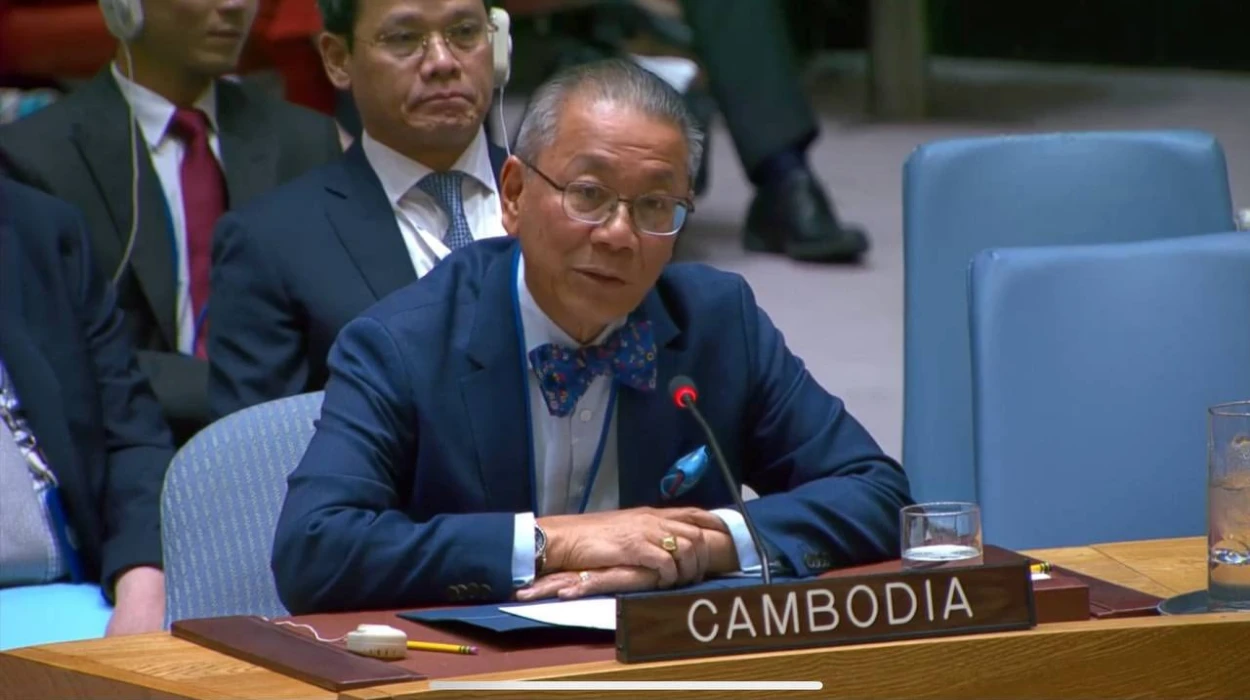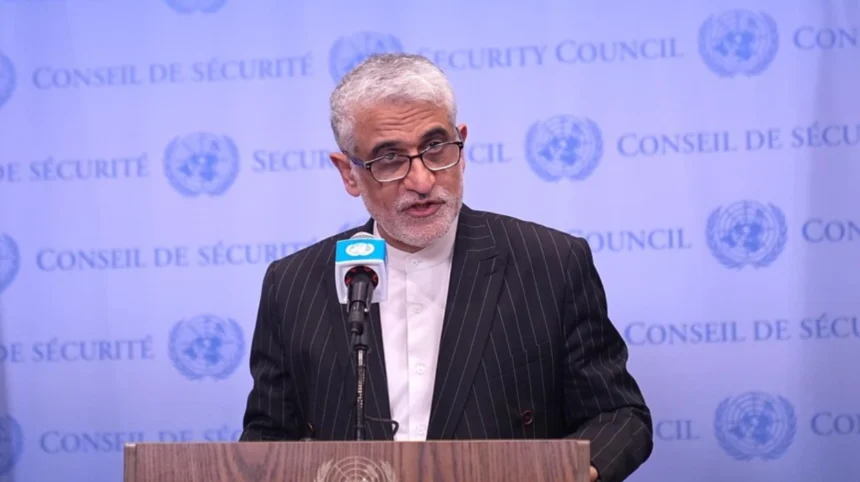
Iran’s ambassador to the UN spoke about piracy state sponsored piracy and hostage taking. The seized Iranian commercial vessels by the US & US naval blockade of Iranian ports was ‘unlawful aggression’. He believes these actions violate the UN Charter as well as international law of the sea.
Iran also claims its actions against vessels in the Strait are legitimate actions by a primary coastal state to protect existing navigational rights and prevent the use of the Strait for hostile military ends due to increased tension.
The events are occurring amidst a very fragile ceasefire that arose from direct US-Israeli military action against Iran that began in February 2026.
The Iranian Ambassador Iravani cited the specific vessels that were seized by the US. He mentioned examples of the seizure of the MT Majestic, and the MT Tiffany (or Tifani), and he also referred to the attack on Turkey’s Toska vessel in the Sea of Oman on April 19, 2026, as having violated “coercive” and “intimidating” actions against crews and unlawful seizure of allegedly “millions” of barrels of Iranian oil. In addition, he continued, these actions were “acts of aggression” as defined under Article 3 of UN General Assembly Resolution 3314 (1974).
What exactly prompted Iran’s “piracy” charge at the Security Council?
Iran claims the US has imposed a maritime blockade since approximately mid-April 2026, boarding and seizing Iranian vessels in the vicinity of international waters or its coast, detaining crews, and enforcing restrictions it claims are unsupported by any lawful sanctions framework, thus constituting collective punishment.
In letters sent to the Secretary-General of the UN and president of the Security Council, Iravani described these actions as “dangerous, escalating actions,” and in violation of principles regarding the right of free passage while at the same time, the US was condemning the disruption to navigation in the Strait of Hormuz.
This follows a ceasefire brokered by or expanding the US, resulting in a substantive increase in tensions thereafter. According to ship tracking data of Kpler and others, transit traffic before the outbreak of conflict averaged approximately 100 vessels per day through the strait; new data shows approximately 279 vessels associated with transit through the strait between late February and mid-April 2026; that there have been at least 22 vessels attacked/involved in conflict in the larger region.
This represents classic escalation; both parties continue justifying their actions as defensive while condemning their opposite party’s actions as criminal. The fact that this is happening before the UN Security Council adds weight to it.
How does the Strait of Hormuz fit into decades of maritime confrontations between Iran and the West?
The Strait of Hormuz has long served as both Iran’s strategic lifeline and its most potent asymmetric weapon. Geographically, the narrow passage about 21 nautical miles at its narrowest, with shipping lanes just two miles wide in each direction separates the Persian Gulf from the Gulf of Oman. Iran controls the northern shore, while Oman and the UAE lie to the south. This geography has shaped Tehran’s doctrine of “forward defense” through naval mines, anti-ship missiles, fast-attack craft operated by the Islamic Revolutionary Guard Corps Navy (IRGCN), and the ability to threaten closure.
Historical roots trace to the Tanker War phase of the Iran-Iraq conflict (1980-1988), when both sides attacked neutral shipping, prompting US naval escorts under Operation Earnest Will and eventual reflagging of Kuwaiti tankers. Iran laid mines and conducted hit-and-run attacks; the US responded with Operation Praying Mantis in 1988, destroying Iranian naval assets.
Iran’s legal position rests on its status as a coastal state with rights and obligations under customary international law and the 1982 UN Convention on the Law of the Sea (UNCLOS), even though it has not ratified the treaty. Tehran argues it can regulate traffic for security reasons in its territorial sea and take proportionate measures against threats.
Why has the UN Security Council struggled to address the Iran US piracy accusation effectively?
The Council has demonstrated its limits as an institution by failing to respond appropriately regarding the involvement of P5 Member States or their associated states directly. For example, the recent open debate in the Council about the “Safety and Protection of Waterways” held under the presidency of Bahrain, which started in April 2026, exhibited many heated exchanges – specifically the US representative accusing Iran for transforming the Strait into a “moat” that has enabled it to conduct acts of blackmail and piracy.
Similarly, various proposals to: a) establish resolutions that would demand unimpeded navigation in all international water ways, and b) to establish the cessation of thereby disrupting such navigation have been vetoed and blocked by the Council Member States of China and Russia, that see the actions of the US through the prism of unilateralism and sanctions overreach. These types of failures to achieve a unified position are not new: Although the Council has been able to pass numerous resolutions regarding Iranian nuclear issues and ballistic missiles, it has rarely passed a resolution that called for unified results on maritime incidents that involved Iran.
Lastly, the emphasis placed on the part of entities such as the International Maritime Organization (IMO), that ships and sea-farers not used as political leverage in connection with geopolitical disputes, is weak without adequate support and/or authority from the Security Council. Furthermore, non-State and/or hybrid actors, such as the Islamic Revolutionary Guard Corps-Navy (IRGCN), make it increasingly difficult to deter and/or attribute political action.
Does Iran’s defense of its Hormuz measures hold up under international law?
Iran’s assertion that its activities are
“based on its rights and duties under international law of the sea and its national laws”
deserves further examination. Coastal countries exert sovereignty over their territorial seas, but they are required to respect transit rights in the straits located within their land jurisdiction.
To cite examples, Iran has previously detained numerous vessels based upon its claims of the need to compel compliance with Iran’s laws, use threats of sea mines as a means of forcing compliance, and demanded payment of “tolls” as a prerequisite to allow passage. This pattern of diversion must be addressed since it reflects the same behaviors (i.e., “piracy” or “hostage-taking”) that Iran alleges the USA has engaged in against Iranian vessels.
Additionally, multiple peer-reviewed papers and reports from researchers examining Gulf maritime security (e.g., UN agencies, independent think tanks) consistently identify that the enforcement of sanctions and the impact of retaliation create gray areas of legal uncertainty between sovereign countries that overlap with issues of power.
Who ultimately benefits from framing the Hormuz crisis as “piracy” versus legitimate security?
Piracy is used for political ends by both sides – the US, along with its allies, employs the term to undermine the legitimacy of Iranian efforts against international shipping; show how their navies are necessary in the area; and to try to form alliances for anti-mining or escorting ships. Conversely, Iran uses the usage of piracy to highlight how hypocritical the West is and how Iran is defending the right of sovereignty against state-sponsored piracy.
The reality is an area with a contested choke point where there is a strategic need for shipping along with the lack of clear legal definitions.
At a systemic level, the continuing instability in the Strait of Hormuz is accelerating the worldwide efforts to diversify energy supply routes (growth in LNG; building more pipeline infrastructure; developing Arctic shipping routes; increasing the use of renewable sources of energy) and this may result in a diminished importance of the Strait of Hormuz in the long run. However, in the short run, disruptions will lead to greater inflationary pressures and fragmentation of nations across the globe.
What forward-looking implications does this UN Security Council confrontation carry for maritime order and regional stability?
The Iran US piracy accusation at the Security Council underscores the body’s eroding relevance in great-power maritime disputes. Without P5 consensus, outcomes default to bilateral naval deterrence, private security, or flag-state self-help raising costs and risks for commercial shipping. IMO calls for protecting seafarers ring hollow without enforceable mechanisms.
Looking ahead, several scenarios emerge. A sustained fragile ceasefire could see incremental de-escalation if backchannel diplomacy addresses vessel releases and sanctions relief. Conversely, tit-for-tat seizures risk miscalculation, especially with IRGC involvement and US forward-deployed assets. Broader policy relevance lies in rethinking chokepoint governance: perhaps enhanced multilateral confidence-building measures, updated transit protocols, or hybrid IMO-UNSC frameworks that separate humanitarian navigation from political disputes.