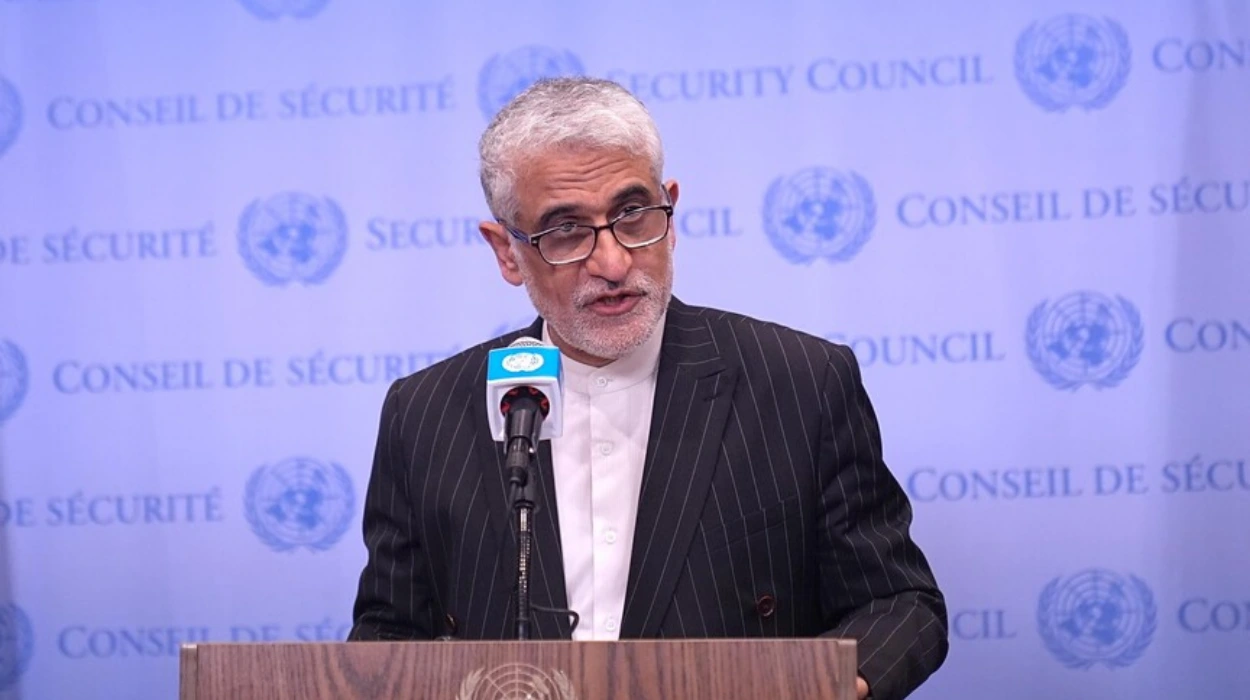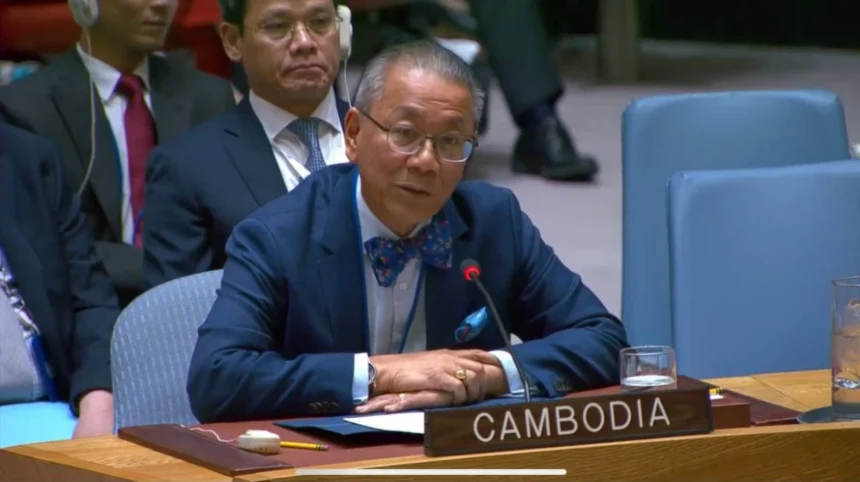
Senior Minister and Special Envoy Sok Siphana delivered a message that combined principle and pragmatism to the Security Council of the United Nations during Cambodia’s statement in the high level open debate on “Safety and Protection of Waterways in the Maritime Domain” on 27 April 2026. Cambodia’s maritime priorities before the Security Council are:
– To reach resolution of maritime disputes through constructive dialogue;
– To respect international law, especially UNCLOS;
– To enhance cooperation by combating transnational threats; and
– To protect and maintain global economic transport systems.
Siphana stated that having safe and secure waterways is critical to achieving peace and security, sustainable development and global economic stability. Cambodia’s statement before the Security Council occurred during a time of increasing tension in Cambodia’s region. Cambodia was recently made aware of Thailand’s decision to terminate the 2001 MoU 44 relating to overlapping maritime claims in the Gulf of Thailand. This development shifts the manner of bilateral negotiations regarding the resources to an adversarial framework under the provisions of UNCLOS.
What historical patterns have shaped Cambodia’s approach to maritime security?
Cambodia’s coastline along the Gulf of Thailand is roughly 435 kilometers and its exclusive economic zone (EEZ) covers about 55,600 square kilometers, much of it in relatively shallow waters averaging 50 meters deep. Yet geography places it at the intersection of competing interests. Sandwiched between Thailand and Vietnam, Cambodia has long navigated overlapping claims, historical grievances, and the spillover effects of regional instability.Post-Khmer Rouge reconstruction in the 1990s and early 2000s left the Royal Cambodian Navy under-resourced, with limited patrol vessels and surveillance capacity.
A 2007 working paper from the Cambodian Institute for Cooperation and Peace (CICP) by Chea Sotharith highlighted emerging challenges: potential sanctuaries for terrorists or smugglers, illegal fishing incursions, and pollution risks in a sea that serves as a vital artery for trade. The paper noted Cambodia’s interest in unimpeded navigation for merchant shipping while urging stronger enforcement against transnational crime.
Illegal, unreported, and unregulated (IUU) fishing has represented a persistent drain. Regional assessments, including a 2015 Asia-Pacific Fishery Commission (APFIC) study, identified Cambodia among countries with high proportions of unreported catches estimates ranging from 21% to over 200% in some analyses often linked to vessels from neighboring fleets exploiting weak governance.
A later World Resources Institute estimate placed annual gross revenue losses for Western Pacific countries, including Cambodia, Thailand, and Vietnam, between $2.4 billion and $4.5 billion due to IUU activities. Broader Pacific impacts have reached as high as $21 billion yearly.
How does Cambodia frame its Security Council maritime priorities in practice?
In April 2026, during a debate, Cambodia put forward three important priorities regarding maritime disputes. The first was the need to resolve all maritime disputes through peaceful dialogue and diplomacy without the use of force or coercion. The second was for all UN Convention on the Law of the Sea (UNCLOS) principles, including freedom of navigation, lawful transit passage, and safety of seafarers to be universally respected. The third was that the UN Security Council must move away from reactive, militarized approaches, and towards a more proactive approach to capacity building through maritime domain awareness, training for law enforcement personnel, security at ports, and sharing of information, which will assist developing coastal states.
This approach also reflects earlier calls by Secretary-General António Guterres for three pillars in his reports: upholding international law over the use of force, addressing root causes of issues such as poor governance of oceans and pollution on land, and promoting multi-stakeholder dialogue with states, regional organisations, shipping operators, civil society, etc.
By referencing the UNCLOS and the BBNJ (Biodiversity Beyond National Jurisdiction) soon after its ratification, the Kingdom of Cambodia is positioning itself as a responsible stakeholder in the global-facing ocean governance regime that is developing. Furthermore, with the ratification of the UNCLOS potentially giving Cambodia an additional basis in law to support its claims regarding areas in the Gulf of Thailand with difficult negotiations over hydrocarbon resources at best, will further strengthen Cambodia’s hand in disputes involving the Gulf of Thailand.
Who benefits and who loses when the Security Council engages maritime issues?
From our analysis of Power, it appears Power is not evenly distributed among individual member countries of the UN. The three Permanent Members of the UN (US, UK and France) that are able to project Maritime Power into blue-water (open ocean) Navies and have the capability to conduct Globally-based shipping activities are reaping the benefits offered by a Rules-based International Order.
China is an emerging Power, being a significant beneficiary of the Council’s Consensus-Based Decision Making Processes, as well as the avoidance of conflict in direct and explicit terms over claims in the South China Sea; China prefers to resolve its claims regarding the South China Sea by way of bilateral discussions.
Developing coastal Nations such as Cambodia receive legitimacy and/or promises of assistance with technical aspects of development; however, they are losing out on the Council’s attention when the Council focuses upon High Visibility “Flashpoints” as opposed to less visible issues that are of great concern to these developing nations (i.e. Gulf of Thailand). Additionally, the Local Fishing Community and Small-Scale Fishery Operations are being significantly impacted by Illegal, Unregulated and Unreported fisheries (IUU) which results in the loss of jobs and food security for these communities.
Can a preventive, law-based approach truly address maritime insecurity, or does it mask deeper power realities?
Critics of Cambodia’s priority and developments in Council discussions frame calls for dialogue and adherence to UNCLOS as idealistic compared to raw geopolitical realities. Militarized features and gray area tactics in the South China Sea have tested what constitutes UNCLOS limits, with countries with smaller claims (Vietnam and the Philippines) experiencing frequent invasions despite arbitral awards.
Opponents say that building up preventive capability is a placeholder for stronger powers consolidating de facto control over the region. Concerning IUU losses and dark fleet activity, critics claim that voluntary cooperation is weak in the absence of credible deterrents and enforcement.
While recent statutory ratification of UNCLOS and BBNJ represent positive results, implementing them will require a sustained level of political will for all parties; for example, monitoring systems need to be in place for monitoring the compliance of parties; there needs to be inter-agency coordination and there needs to be sharing of information within the region (with the help of external partners-Like ASEAN, IMO and UNODC all of whom have significant contributions).
What forward trajectory should Cambodia’s Security Council maritime priorities inform?
With a clear vision for the future, Cambodia appears headed towards a more practical hedging approach to its future efforts in GHT related concerns. Using the universal call for a rules-based order as a basis for embedding GHT concerns in a universal rules to avoid isolation from any dispute settlement process, while testing UNCLOS to fulfill its needs. Success in this area will depend on achieving operational effectiveness through the accomplishments of agency modernization in the maritime sphere, by becoming more proactive in ReCAAP and ASEAN maritime forums, and by using the BBNJ as a platform for sustainable resource governance.
As Cambodia plays a role on the SC, it demonstrates ongoing deliberation surrounding an SC role. The SC is at its best addressing issues of threats to international peace and security but struggles to provide adequate preventative and diffuse solutions encompassing issues of criminality, economics, and sovereignty. Thus, its contributing factor may continue towards agenda-setting and norm reinforcing rather than intervening to encourage states to invest resources in building coastal resilience, providing maritime domain awareness data sharing, and supporting UNCLOS uniformly.
The policy implication of Cambodia’s SCO should extend beyond Cambodia as both a stabilizing factor; and with the fracture of global relations as well the oceans under constant climate change, there exists great value to smaller nation’s resolve to push for an inclusive, law abiding approach to creating stability in our oceans.