The United Nations faces a key decision point as member countries prepare to cast their votes on a groundbreaking resolution recognizing the opinion handed down by the International Court of Justice (ICJ) concerning climate obligations. This new turn of events, taking place in May 2026, may bring about a drastic change in the way global climate governance is conducted because it would transform an advisory judicial opinion into a powerful political tool.
Derived from the decision reached by the ICJ in July 2025, this resolution, supported by vulnerable climate countries such as Vanuatu, seeks to ensure that due diligence is undertaken in relation to emission reductions, regulations regarding fossil fuels, and reparations for polluters. The significance of this cannot be understated, since the passing of this resolution would represent an incredible victory for climate justice.
Elisa Morgera, in a post on X, urged all United Nations member states to strongly support the resolution linked to the International Court of Justice advisory opinion on climate change obligations. Marking the Global Day of Action on the UN Climate Accountability Resolution, she emphasized the importance of reinforcing international accountability on climate commitments and ensuring states uphold their legal responsibilities in addressing the global climate crisis.
Origins of the ICJ Climate Justice Ruling
The tale originates way back in March 2023 when the United Nations General Assembly, led by Vanuatu, together with other small island developing states, passed a groundbreaking resolution calling upon the ICJ for an advisory opinion on their matter. This was in response to the uneven burden of climate change experienced by vulnerable countries in relation to the duties of states according to international law regarding climate change and the ramifications thereof due to harmful acts caused by greenhouse gas emissions. It received unanimous approval, receiving 130 votes in favor, eight abstaining, and none opposing.
The proceedings commenced in December 2024 in The Hague, marking the beginning of a historic event where not only 190 plus countries but also indigenous people, youth, and NGOs took part. The ruling from the International Court of Justice was handed down on July 22, 2025, as an advisory opinion. As explained by the court, there is a responsibility incumbent upon states that they must protect the climate system from the adverse effects of anthropogenic greenhouse gas emissions through international laws such as the UNFCCC, Paris Agreement, and principles of customary international law. In its advisory opinion, “due diligence” stressed the need to prevent any serious harm by taking all measures possible for keeping global warming under 1.5 degrees.
Core Elements of the ICJ Advisory Opinion
Further analysis revealed that the opinion of the International Court of Justice included an extensive list of responsibilities that goes beyond making policy statements. It is essential for the government to regulate private companies, particularly those handling fossil fuels, through the withdrawal of subsidies and cancellation of mining permits when appropriate, along with the imposition of emission limits in line with the most aggressive stance feasible. Nations that are high emitters of greenhouse gases and carry historical liabilities will be tasked with additional actions, such as facilitating technology transfer and financing for climate change adaptation in less developed nations.
The ruling’s language is unequivocal in linking climate inaction to international responsibility. For instance, it stresses that
“every State has a legal obligation to conduct environmental impact assessments”
for activities risking transboundary harm, a principle drawn from precedents like the Pulp Mills case.
It supports the “polluter pays” principle by emphasizing the nature of climate change as a violation of human rights, such as the right to life, health, and the right to a healthy environment, which have been increasingly acknowledged through international case law. It is for these reasons that Amnesty International called it a “game changer.”
The Emerging UN Resolution: Path to Accountability
Fast forward to February 2026, and Vanuatu presented a draft resolution in the United Nations General Assembly that is entirely based on the opinion of the International Court of Justice. The informal consultation process started in February, while the sponsorship process commenced in March. What was meant to be an end-of-March vote had been pushed to May 2026 due to diplomatic efforts. This draft resolution firmly stands in favor of the opinion of the ICJ, urging nations to align their policies on climate change with the 1.5°C pathway.
If passed, this would not create new law but embed the advisory opinion within a UN framework carrying moral and political weight. It calls for immediate action: updating Nationally Determined Contributions (NDCs) by early 2026 to reflect ICJ duties, enhancing transparency in emissions reporting, and mobilizing finance for loss and damage.
Amnesty International urged in February 2026,
“Global governments must use this new UN General Assembly resolution to turn the ICJ’s advisory opinion on climate change into real-world action.”
The Union of Concerned Scientists echoed this, emphasizing how the ruling clarifies pathways for domestic courts to hold polluters accountable.
Geopolitical Stakes and National Stances
The vote’s outcome hinges on delicate geopolitics. Small island states and the Alliance of Small Island States (AOSIS)—crediting Vanuatu’s leadership—form the vanguard, viewing the resolution as existential insurance against sea-level rise and ecosystem collapse. Developing nations in Africa and Asia, grappling with climate-induced famines and floods, largely align with this bloc, pushing for equity in burden-sharing. Human rights groups like Human Rights Watch, which tracked the process since 2023, advocate passage to operationalize reparations, potentially unlocking trillions in climate finance from historical emitters.
On the contrary, fossil fuel-dependent economies move with caution. Nations such as the US, China, and petroleum producers, including Saudi Arabia, took a neutral position at the time of the 2023 appeal due to the possibility of being sued. It is evident from post-opinion analysis that large contributors of greenhouse emissions are afraid of its aftermath; the case can spark similar legal battles, such as those won by Uruguay regarding tobacco and Bolivia regarding water privatisation. On the other hand, even the dissenters admit to the subtle nature of the resolution. As per a UN official speaking anonymously, the use of consensus in the resolution may draw more support.
Potential Impacts and Legal Ramifications
Passage would cascade through global arenas. Nationally, it pressures laggards like Australia and Brazil to tighten NDCs ahead of COP31 in late 2026, where ICJ compliance could become a litmus test. In courts worldwide, the opinion arms plaintiffs: youth-led suits in Europe and the US already cite it, while Pacific islands prepare claims against high emitters. Internationally, it fortifies the Paris Agreement’s rulebook, clarifying “progressive realization” of ambitions and integrating human rights obligations.
From an economic standpoint, cutting down on these subsidies, totaling $7 trillion yearly according to estimates by the IMF, will help allocate more resources towards renewable energy, hastening the move to net-zero status expected to generate 18 million job opportunities by 2030 according to the ILO. The issue of reparations will bring even more attention to the $100 billion annually promised climate fund, yet to be delivered, while the ICJ considers failures to achieve it violations. Implementation problems may arise, with “due diligence” still being subjective and lacking enforceability without a dedicated climate court.
Voices from the Frontlines
Stakeholders across the spectrum weigh in with fervor. UN Secretary-General António Guterres, post-ruling, declared the opinion a “clarion call for climate justice”, urging swift UN action. Vanuatu’s climate envoy, Ralph Regenvanu, framed the resolution as
“the bridge from words to accountability,”
emphasizing small states’ outsized role. Amnesty’s Agnes Callamard stressed,
“This is not just about emissions; it’s about the right to survival for billions.”
Even industry voices, like the International Chamber of Commerce, concede the need for “aligned regulatory frameworks” to avert chaos.
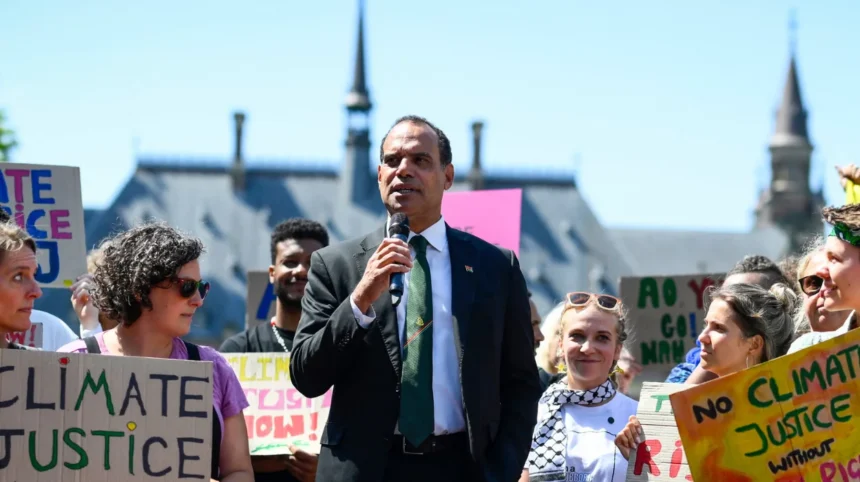
The youth activists, who filled the 2024 hearings, perceive the decision as vindication following their years of protesting with Fridays for Future. The indigenous leaders celebrate the court’s recognition of traditional knowledge in adaptation measures. With May 14, 2026, reports of final negotiations, hope coexists with pragmatism, with the need for a simple majority among the 193 UN members.
Looking Ahead: A Turning Point for Humanity
This is not merely a political move; it represents a bet for all humanity against the tipping points that may make global warming inevitable. If the ICJ decision is endorsed by this vote, then power shifts from those who damage our planet to its custodians. It does come with its own set of problems and risks, like political resistance and economic considerations, but it marks the beginning of a new age when law faces existential threats.