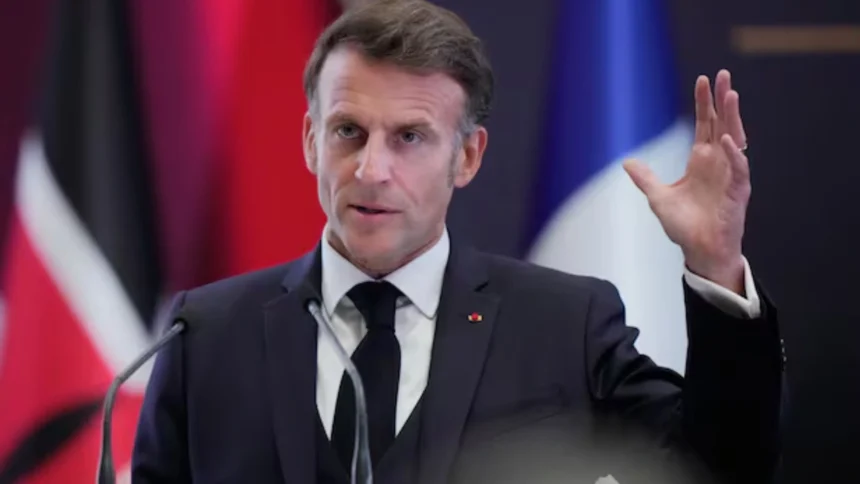
Emmanuel Macron, President of France, has revived the debate over global governance equality by demanding more representation of Africans in various international bodies, including the UN Security Council. The outspoken move was made at the launch of the Africa Forward summit in Nairobi on May 11, 2026, where Emmanuel Macron was seen alongside President William Ruto of Kenya and other African presidents.
His comments show the changing foreign policy of France under President Macron, one that puts the continent in the role of a “true partner” rather than a mere receiver of aid in deciding the future of the world. Macron was quick to recognize the grievances of the Global South by supporting the bid of Africa to secure itself a permanent seat at the UNSC.
The summit itself provided an opportunity for such a statement. It took place in the vibrant capital city of Kenya, where the heads of state came together to brainstorm on partnership models that were not donor-receiver oriented. Macron’s statement was a reaction to the one made by Ruto previously.
“Africa deserves permanent representation,”
Macron declared, echoing Ruto’s pointed observation that the continent’s demographic weight and contributions warrant a seat at the high table. This was no offhand comment; it built on France’s historical support for UNSC reform, dating back to 2005, when Paris first advocated for two permanent African seats alongside expansions for Germany, India, Japan, and Brazil.
Summit Dynamics and Macron’s Vision
In a more comprehensive exploration of the summit discussion, Macron presented his appeal amidst a greater story of mutual respect and prosperity. He pointed to recent achievements, like the addition of the African Union to the G20, as proof of progress that still falls short due to a need for reform within the UNSC.
“We must treat Africa as a true partner,”
he emphasized, pledging France’s diplomatic heft to champion these reforms at the upcoming G7 summit. This commitment extends beyond rhetoric; Macron explicitly supported advancing Africa’s agenda in financial powerhouses like the IMF and World Bank, where voting shares still reflect a post-colonial imbalance.
The presence of Kenyan President Ruto added further weight to the occasion’s importance. Hosting the event, Ruto himself was critical of the existing make-up of the UNSC, referring to it as a relic from 1945 which did not represent a multi-polar world. The decision of Macron to side with the latter’s position is symbolic of a fundamental shift in Franco-African foreign policy, with the recent tensions caused by French military withdrawal and neo-colonialist behavior now being addressed.
The words of the French leader were well-received in light of increased African initiative. The demographic trend on the continent—the youth bulge, expected to grow to 2.5 billion people by 2050—necessitates an impact on issues of peace and security, such as those stemming from climate change and terrorism. The endorsement is consistent with the Ezulwini Consensus, which was adopted in 2005 by the African Union.
France’s UN envoy had reaffirmed this compatibility just weeks earlier, in April 2026, stating that Paris backs
“the goal of the African states to achieve an ambitious reform.”
France’s Long-Standing Reform Advocacy
The stance France has taken regarding UNSC reform is not new, but it is getting more serious because of Macron. After being elected president in 2017, Macron has been calling for reforms to make the body more inclusive. During an address to the UN General Assembly in 2024, Macron suggested restricting vetoes in cases of large-scale atrocities.
“Veto must be limited in cases of mass killings,”
he stated then, linking procedural tweaks to substantive inclusion like Africa’s voice.
The current move in Nairobi by France is an example of proactive diplomacy. The French have been known to strongly favor the G4 proposal, which would include two seats for Africa, Germany, Japan, and India, while also rejecting any attempts to expand the veto system so as not to exacerbate deadlock. Macron’s statement during his summit on pursuing the issues within the G7 context highlights the strength of Paris as a permanent member of the UNSC.
The critics, on the other hand, argue that there is an element of insincerity involved. According to some African analysts, the move by President Macron is an attempt to counterbalance the growing influence of China, especially through its involvement in the Belt and Road Initiative. The decision by France to withdraw its troops from Mali and Niger between 2023 and 2024 added to the perception of retreat, making the diplomatic charm offensive highly relevant at this point in time.
Implications for Global Governance
Macron’s initiative could influence global trends. The addition of a permanent seat for Africa will bring diversity to decision-making, thus making it possible for consensus on difficult matters such as peacekeeping finance to be achieved. Currently, the five permanent members of the UNSC (known as the P5) hold veto power and are motivated by self-interest. For instance, Africa’s membership will add urgency to the Agenda 2030 agenda.
Economically, Macron’s IMF-World Bank initiative aims at making quota changes that have been pending since 2010. While the African continent holds only 5.9 percent of voting rights compared to Europe’s 30 percent voting rights, its share of the world’s poor people is 18 percent. “Stronger representation at international organizations” is, according to Macron, a necessity for ensuring free trade and debt relief.”
Challenges abound. Consensus among 54 African states on nominees remains elusive; Nigeria, South Africa, and Egypt vie for spots, risking intra-continental rifts. Geopolitically, P5 rivals like China may resist, fearing dilution of influence. Macron acknowledged these hurdles, committing France to “advancing Africa’s agenda” without preconditions.
Historical Context and Precedents
Macron’s Nairobi speech echoes prior French initiatives. In July 2025, France urged greater African UNSC roles during AU dialogues, building on 2024 UNGA momentum. A YouTube clip from the summit captured Macron stating,
“France supports Africa’s permanent UN seat,”
underscoring continuity. These efforts trace to Chirac-era promises, but Macron has personalized them, weaving reform into his “multilateralism renewed” doctrine.
Comparatively, Biden’s 2024 UN speech nodded to expansion without specifics, while Russia’s Lavrov dismissed it as a Western theater. Macron’s proactive stance differentiates France, leveraging its African ties—over 14 million French speakers on the continent—for soft power.