A stark warning has been issued by the UN that Israeli settlers could soon find their names on the global black list, as they have committed severe abuses against children in the occupied West Bank area. The inclusion of settlers’ names in the global black list by the UN shows that the issue is serious.
This particular blacklist is found in the annual report by the UN Secretary-General on Children and Armed Conflict, where the purpose of such an undertaking is to ensure that those who kill, maim, recruit, or abuse children during conflict are brought into attention. This year, there has been a change in focus from the state military to settlers.
Historic Context: Israel on the “List of Shame” Since 2024
Israel has already been named in the UN list of shame as early as 2024 due to grave violations against children caused by its military campaigns in Gaza and the West Bank. Israel was put in the list as a result of numerous violations such as killings, arbitrary detention, and attacks on hospitals and schools that were documented by UN monitors. In its 2024 report, UN cited over 3,800 violations against Palestinian children in Gaza.
The report stated:
“Violence against children in conflicts hit unprecedented levels in 2024, with most abuses committed in Gaza.”
This figure underscored the scale of harm inflicted on minors in active conflict zones.
The decision to potentially expand the blacklist to include settlers reflects growing evidence that non-state actors, often supported by Israeli security forces, are also responsible for systematic abuses. The UN has noted
“ongoing attacks by illegal Israeli settlers, often supported and joined by Israeli security forces, continue to instil fear, destroy homes and livelihoods, and force Palestinians out of their lands.”
Settler Violence: A Surge in Attacks Against Children
Data from UN human rights offices shows a sharp increase in settler attacks in the West Bank over the past two years. In 2024, there were more than 700 reported incidents of settler violence, resulting in dozens of Palestinian child injuries and several deaths. Many of these attacks involved beatings, arson, and intimidation tactics targeting families and children.
The UN Human Rights Office in Occupied Palestinian Territory reported:
“Settler attacks surging, displacing families and advancing annexation policies.”
This language highlights the strategic nature of settler violence, which often aligns with broader political goals of land consolidation.
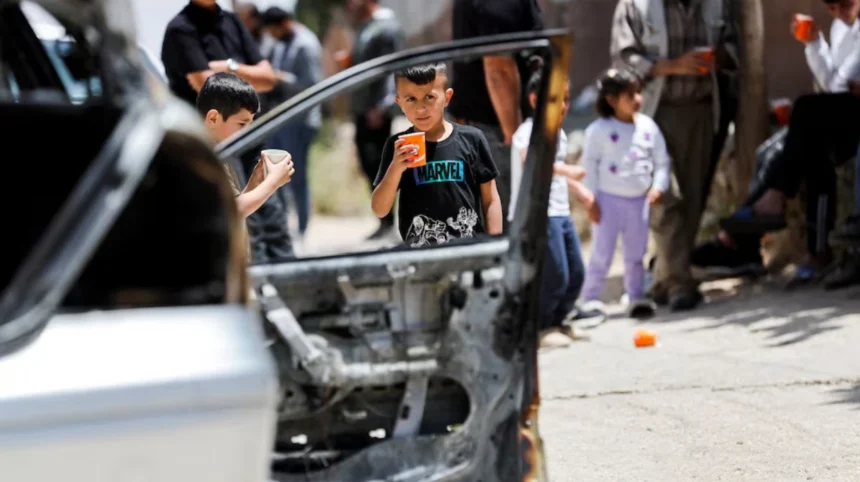
One case from early 2025 involved Israeli settlers burning down a home in the village of Huwwara, injuring three children. Palestinian medical sources confirmed fractures and severe burns. The UN described the incident as
“a clear violation of international humanitarian law and a war crime.”
UN’s Legal Framework and Blacklist Criteria
The UN blacklist is governed by Resolution 1612 (2005), which mandates the Secretary-General to include parties to conflicts that engage in six grave violations against children:
- Killing or maiming
- Recruitment or use as soldiers
- Rape or other sexual violence
- Attacking schools or hospitals
- Abduction
- Denial of humanitarian access
Whereas the traditional list consists of national armies as well as non-state armed actors, today the inclusion of settlers’ militias is being considered in view of the systematic nature of the violations committed. This can be attributed to the fact that in light of their organized character, settlers may be regarded as armed groups with state backing.
UN Special Representative for Children and Armed Conflict, Teresa Spence, stated:
“If settler groups are found to be systematically committing grave violations, they must be included to ensure accountability and protection for children.”
Palestinian and International Reactions
Palestinian authorities welcomed the UN’s warning, calling it a necessary step toward justice. The Palestinian Ministry of Social Development said:
“This is a historic moment where the UN acknowledges settler violence as a direct threat to children’s rights.”
Human rights organizations, including B’Tselem and Al-Haq, echoed this sentiment. B’Tselem’s director noted:
“Settler violence is not isolated; it is part of a broader strategy of displacement and control.”
However, the response from other nations varied widely. While the European Union applauded the UN for its steps towards accountability, the United States was more circumspect about the situation, advocating for “balanced approaches.”
Israeli Government Stance and Denials
The Israeli government has strongly rejected the UN’s recommendations, arguing that the blacklist is politically motivated. Israel’s UN envoy Gilad Erdan previously described similar listings as
“utterly shocked and disgusted by this shameful decision.”
Israeli officials claim that settler violence is handled under domestic law and that the UN’s focus ignores security threats from Palestinian armed groups. The Israeli Defense Forces (IDF) stated:
“We take all allegations seriously and investigate incidents where minors are involved.”
However, UN monitors have found that investigations are often incomplete or delayed. In 2024, only 12% of settler violence cases resulted in convictions, according to UN data.
Statistics: Violations Against Children in 2024–2025
The UN’s 2024 report provided the following breakdown of grave violations against Palestinian children:
| Violation Type | Number of Cases |
| Killing or Maiming | 1,200 |
| Arbitrary Arrest | 950 |
| School/Hospital Attacks | 780 |
| Sexual Violence | 320 |
| Abduction | 150 |
| Aid Access Denial | 500 |
Total: 3,900+ grave violations
In the West Bank alone, settler-related violations accounted for approximately 18% of all recorded child abuses, with a sharp rise in 2025.
Impact on Child Protection and Humanitarian Access
The increase in violent activities among the settlers has significantly interfered with the protection services for the children. Schools in the West Bank have been forced to close down because of settler attacks. Medical institutions have had difficulty accessing injured children as a result of the blockade and threats posed by the settlers. Humanitarian aid agencies have reported that there is a 40% delay in the supply of humanitarian aid to children.
UNICEF’s regional director warned:
“Children in the West Bank are losing access to education, healthcare, and safe play spaces due to settler aggression.”
Broader Implications for International Law and Diplomacy
The possible listing of the settlers in the UN list may alter existing precedents in international law. The listing will demonstrate that any non-state actors, supported by the state, may face accountability according to the Children and Armed Conflict doctrine. Such a step may also have an impact on foreign policy relations. States, which have failed to take action against settler violence before, may face certain pressure from the UN side.
Legal experts argue:
“This is a milestone in expanding accountability beyond state actors to include organized non-state groups.”
What Happens Next?
The UN is expected to finalize its decision in the coming months, following further investigations and testimonies from affected families. If settlers are added to the blacklist, the UN will call for targeted sanctions, investigations, and protective measures for children.
Palestinian civil society groups are urging the international community to act swiftly. A coalition of NGOs issued a joint statement:
“The time for diplomacy is over; children need immediate protection.”