In what is sure to ignite new controversy surrounding East Jerusalem’s disputed status, Israel has approved the building of a new defense facility where the former UNRWA East Jerusalem headquarters once stood. In what can be described as a sudden transition from the humanitarian organization’s presence to a military-civilian base, the project has been announced by the Israeli Defense Ministry and Jerusalem Municipality. The crux of the matter from a legal and political perspective is whether Israel’s conversion of the UNRWA East Jerusalem headquarters into something else violates international law and the operations of the United Nations in an occupied territory.
From UN compound to defense nerve center
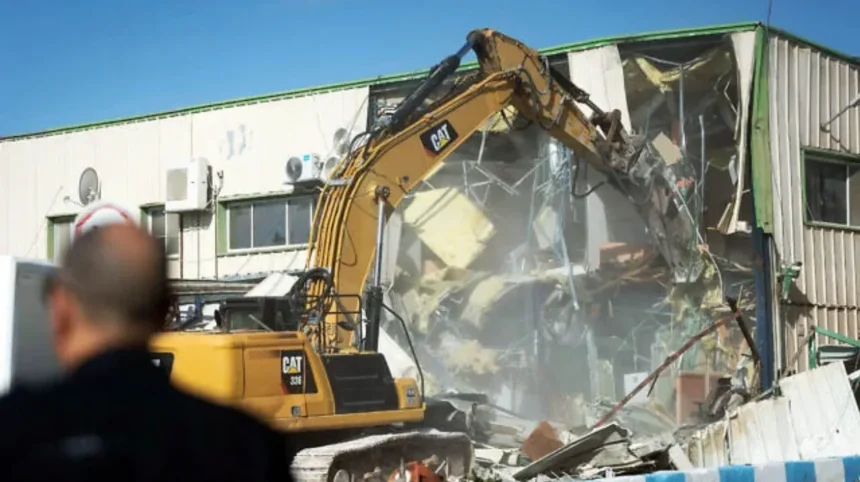
The area where the UNRWA East Jerusalem office was located, which used to be the center from which the agency provided essential services to Palestinians living in the region, is now being expropriated by the Israeli government and cleared out. The demolition of UNRWA facilities took place early in the year 2026, with bulldozers taking down the buildings that had functioned as office spaces and administrative hubs for several decades. While Israeli government officials characterized it as a “taken” measure, the UNRWA termed it a land grab.
However, now the Israeli cabinet has approved the building of a defense compound, which will consist of a military museum, an Israel Defense Forces recruiting office, and a Defense Minister’s office. According to the official announcements by the mayor of Jerusalem, Moshe Lion, and the minister of defense, Israel Katz, the construction of this complex is an intentional gesture of sovereignty because “the creation of this compound affirms the presence and authority of the State of Israel in its capital.”
Itay Epshtain, international lawyer specializing in public international law and law of armed conflict, offering expert legal analysis on the international law implications in a post on X, also confirmed the Israel announcement.
The transformation of the UNRWA headquarters in East Jerusalem from a humanitarian site to a militarized infrastructure facility highlights the larger pattern in the Israeli policy regarding East Jerusalem, whereby spaces belonging to Palestinians and even international organizations have been systematically absorbed into the Israeli security/ideological apparatus. For the critics, it is not just an organizational move; rather, it represents a symbol of how Israeli national security discourse can even incorporate spaces of international neutrality.
Security narrative vs international law
The rationale behind the decision by the Israeli government to convert the UNRWA East Jerusalem headquarters into a defense center is based on a discourse of security. It is contended that by concentrating defense establishments in Jerusalem, there will be an increased emphasis on making the city the “undivided capital.”
In one of the plan’s public endorsements, Defense Minister Israel Katz said the complex would demonstrate “sovereignty, Zionism, and security,” framing the repurposing as a natural evolution of Israel’s control over the site. The Jerusalem Municipality and the Defense Ministry described the project as a “defense compound” that will not only house offices and museum spaces but also serve as a recruitment and orientation center for young Israelis considering military service.
But this story contradicts a well-established set of international legal views and UN policy positions regarding occupied territories. According to the UN, East Jerusalem was an occupied territory after 1967, and under international law, the occupier is not allowed to make any permanent changes to the status of the territory or use the land taken over for any political symbolism. UNRWA and UN officials have consistently argued that any attacks on their premises constitute a violation of the principle of neutrality and protection of UN missions.
UNRWA itself has stated that the agency’s work is “strictly humanitarian and non?political” and that its facilities should be shielded from military or coercive uses.
Lawyers and human rights activists have highlighted the possibility that the demolition of the UNRWA headquarters in East Jerusalem and construction of a defense facility on the same premises could amount to violation of the Fourth Geneva Convention, which regulates occupation and treatment of civilians and protected places. By converting a place designated by the United Nations into a military installation, the Israeli government is creating confusion between humanitarian sites and the machinery of the state security establishment, thus increasing the chance that these sites could be considered legitimate military objectives in future wars.
Humanitarian consequences and UNRWA under pressure
The demolition of the UNRWA headquarters in East Jerusalem takes place amid increasing hostility towards the UNRWA from Israeli authorities and certain Western states. UNRWA is said to have in its midst people associated with militant organizations without any proof to back up the claim. The United Nations has always maintained that UNRWA maintains its neutrality and recruits people on the basis of international norms.
The loss of the UNRWA East Jerusalem headquarters, however, is not only a symbolic blow but a practical one. The compound had functioned as a logistical center for coordinating education, health, and humanitarian aid programs serving hundreds of thousands of Palestinian refugees in the West Bank, East Jerusalem, and Gaza. The displacement of these operations to alternative locations—often in less secure or less central areas—has already begun to strain the agency’s ability to respond swiftly to crises. Senior UN officials have warned that the cumulative impact of closures, expropriations, and funding pressures on UNRWA could create a “humanitarian vacuum” in the region.
The building of the military facility on the UNRWA East Jerusalem headquarters’ land is an indication of the strategy to marginalize the UNRWA, and thus the problem of Palestinian refugees. The occupation of the UN organization’s physical space signifies that the issue of Palestinian refugees will be tackled through the development of more Israeli facilities in the occupied territories, rather than negotiations.
Regional and diplomatic reactions
The proposal to transform the UNRWA headquarters building in East Jerusalem into a defense facility has led to quick criticism from Palestinian authorities and some regional entities. The Governorate of Jerusalem, which speaks on behalf of Palestinian administrative concerns in the city, made a statement saying that Israel was
“trying to erase the Palestinian character of Jerusalem and impose an Israeli military presence.”
Some regional news sources, including Turkish and Arabic-language stations, have expressed similar sentiments about the project, arguing that Israel is trying to establish its control over the city’s east.
International diplomatic reactions have been more measured but nonetheless critical. Western governments that have traditionally supported UNRWA funding have expressed concern over Israeli actions that could be interpreted as undermining the neutrality of UN operations. In private briefings circulated to key donors, UN officials have reportedly warned that the conversion of the UNRWA East Jerusalem headquarters into a defense complex risks
“normalizing the politicization of humanitarian spaces”
and could set a dangerous precedent for how occupying powers interact with UN facilities elsewhere.
Supporters of Israel’s policy, on the other hand, argue that Israel has the right to decide how its own laws will be applied in what Israel considers its sovereign land. In light of this approach, the UNRWA East Jerusalem headquarters’ land is not just a neutral international property anymore, but a territory that Israel owns legally and has the right to use for security reasons. This approach adds fuel to fire in regard to the controversy surrounding not only the issue of property but the legal status of the region itself.
What the plan means for East Jerusalem
At the city level, the transformation of the UNRWA East Jerusalem headquarters into a defense complex is likely to deepen the sense of segregation and asymmetry already felt by many Palestinian residents. The construction of a military museum and a recruitment office in the middle of East Jerusalem sends a powerful visual and psychological message: that the city’s eastern neighborhoods are being absorbed into the symbolic and institutional fabric of the Israeli state. This has implications not only for daily life but also for how the city is perceived in any future negotiations over borders and sovereignty.
For UNRWA personnel as well as for the wider UN organization, the destruction and reuse of the UNRWA East Jerusalem headquarters complex highlights a disturbing trend of the erosion of an area of land that was previously believed to be sacrosanct. If UN property can be seized and made into military installations, then the already shaky doctrine of humanitarian neutrality in other regions will have even more precedence set against it in occupied territories. According to legal scholars and human-rights activists, such a precedent could lead to a situation where other nations use UN compounds as military bases.
At the same time, some Israeli officials argue that the new complex will contribute to what they describe as “national?psychological resilience”—a phrase they use to capture the sense of confidence and control that comes from visibly asserting sovereignty in East Jerusalem. The project is expected to be framed domestically as a symbol of strength and continuity, even as it is criticized abroad as a provocation in a deeply contested city.
The long?term implications
The construction of a defense complex at the site where the UNRWA East Jerusalem Headquarters stood is not likely to be considered an isolated event but rather one that belongs to a broader trend of Israeli domination over East Jerusalem, encompassing such activities as settlement expansion, land confiscations, and increasing security measures against Palestinians. How this particular event will be perceived in the international community will have repercussions for future actions taken against UNRWA or other organizations.
Critics argue that turning the UNRWA East Jerusalem headquarters into a base for a defense complex would serve to legitimize the process of militarizing areas that have been traditionally neutral. Without any substantial reaction from the diplomatic or legal arenas to this development, there will be a likelihood that similar properties owned by the United Nations or other international organizations could also be appropriated for military purposes in other conflict-prone zones. Palestinians see the transformation of the UNRWA East Jerusalem headquarters as a sign of how vulnerable such institutions are becoming.
Ultimately, the decision to build a defense complex on the site of the UNRWA East Jerusalem headquarters is about more than bricks and mortar: it is about memory, sovereignty, and the future of East Jerusalem itself. Whether the world will treat this project as a legitimate exercise of national?security prerogative or as a violation of the delicate web of international rules governing occupied territories will have lasting consequences for the region’s stability and the credibility of the United Nations system.