The death of Ratko Mladic in United Nations’ custody on 27 August 2026 represents the end of a man who will forever be known in connection with some of the gravest crimes that have been committed in Europe since the Second World War. The former Bosnian Serb army general, who was convicted of genocide in relation to the 1995 Srebrenica massacre and other crimes of war and crimes against humanity, died aged 84 during his life imprisonment term in the UN Detention Unit, based in The Hague. The news about the death of Mladic, which were first released by the Serbian media, and then officially confirmed by a UN representative, comes to an end of the judicial process that had started in 2011, when Mladic was arrested, and concluded in 2021.
The Man Behind the “Butcher of Bosnia” Label
Born in March either in 1942 or 1943 in the region that today makes up Bosnia and Herzegovina, Ratko Mladic graduated from the Yugoslav People’s Army and went on to become the commander of the Bosnian Serb Army (VRS) in 1992, just after Bosnia declared its independence from the state of Yugoslavia. In the following three years, Mladic’s troops managed to take control of almost 70% of Bosnia’s territory and to besiege Sarajevo, bombarding the town on a daily basis with shellfire and sniper shooting, which resulted in 10,000 deaths, including almost 5,000 civilian casualties.
The wave of fear and panic that followed and the practice of ethnic cleansing led the people to give Mladic the nickname “Butcher of Bosnia”, an epithet that Mladic would carry both during the court process and in future history. After the war, Mladic became a controversial character in the region. He lived quietly in Belgrade under the protection of nationalist circles since the ousting of Serbian President Slobodan Milosevic in 2000. It took ten years before Mladic was arrested in Serbia and extradited to The Hague. This event was celebrated by Western governments and human rights activists as another step towards accountability; for Bosnian Muslims, however, it was a painful memory of Mladic’s deeds.
The Srebrenica Genocide: Europe’s Worst Atrocity Since WWII
At the heart of Mladic’s conviction lies the Srebrenica genocide of July 1995, which the International Criminal Tribunal for the former Yugoslavia (ICTY) described as Europe’s worst single atrocity since World War II. After Bosnian Serb forces overran the UN-declared “safe area” of Srebrenica, more than 8,000 Bosnian Muslim men and boys were systematically executed and buried in mass graves over four days. Some of these graves were later exhumed and the bodies relocated to remote mountain sites in an attempt to conceal evidence of the killings.
The ICTY found that Mladic “significantly contributed” to this genocide as part of a joint criminal enterprise aimed at the forcible expulsion of Bosnian Muslims, Croats, and other non-Serbs to create a ethnically homogeneous “Greater Serbia.” The tribunal determined that he acted in concert with late Serbian President Slobodan Milosevic and Bosnian Serb political leader Radovan Karadzic, forming a criminal conspiracy that orchestrated the broader campaign of ethnic cleansing across Bosnia. For survivors like Munira Subaši?, whose husband and son were killed after Srebrenica fell, Mladic embodied the brutality of the entire war.
“For me Mladic is a symbol of all horrible crimes that happened during the war – our girls were raped, and boys killed, only because they were Muslim,”
she said, adding,
“Germans had Hitler, Serbs have Mladic. There is no difference between the two.”
The Siege of Sarajevo and Other Crimes Against Humanity
Other than Srebrenica, Mladic was accused of a host of other crimes conducted between 1992 and 1995, including the long-standing siege of Sarajevo that is a crime against humanity according to the ICTY. According to the ICTY, during the siege 4,548 soldiers from Bosnia were killed as well as 4,954 civilians since his forces attacked the city with heavy artillery, tanks, mortars, and heavy machine guns daily. The persecution was not limited to the capital since in the other municipalities of Bosnia, his forces engaged in persecution, extermination, murder, deportation, and forcible transfer of non-Serb population, all of these as an act of ethnic cleansing.
Mladic was also found guilty by the ICTY of terror and unlawful attacks on civilians in Sarajevo as well as of taking UN peacekeepers hostage in 1995 because his forces chained them to possible NATO bombing targets in order to stop aerial bombings. The detainees in the concentration camps run by Mladic suffered unimaginable torture, including suffocation of some of them after being made to consume salt and denied any access to water, starvation of some of them, rape of some of them, forced jumping from bridges and shooting of these prisoners, and mass shootings after making them leave the camps due to chemical gas.
The Long Road to The Hague: Arrest, Trial, and Conviction
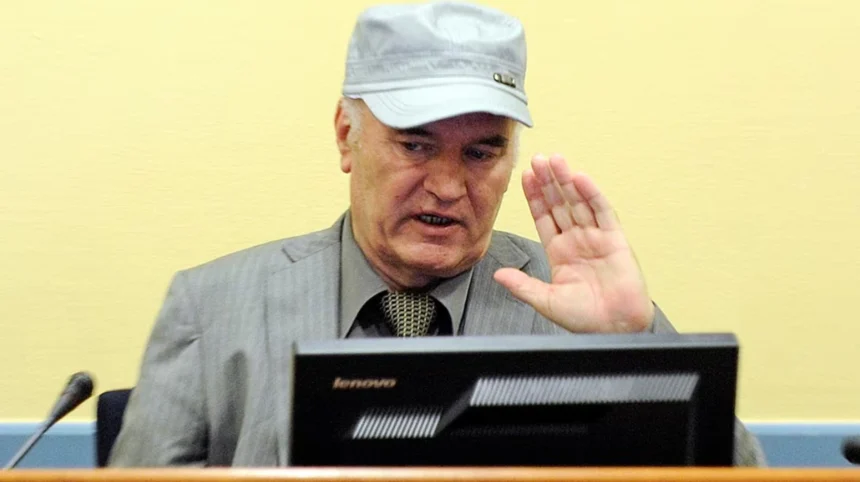
Mladic’s path to justice was neither swift nor straightforward. Indicted by the ICTY in 1995, he remained at large for 16 years, during which time he became a symbol of impunity for war crimes in the Balkans. His arrest in May 2011 in Serbia, under pressure from the European Union and international community, marked a turning point. He was transferred to The Hague and made his first appearance before the ICTY on 31 May 2011, where he immediately challenged the court’s legitimacy.
“I do not recognise this court,”
he declared at a 2014 hearing, a stance he maintained throughout the trial.
However, after years of legal hearings, Trial Chamber I of the ICTY passed the sentence on 22 November 2017 and found Mladic guilty of one charge of genocide, five crimes against humanity and four violations of the laws or customs of war. Among other things, Mladic was charged with genocide and persecution, extermination, murder and forcible transfer of persons in Srebrenica; persecution, extermination, murder, deportation and forcible transfer of persons in municipalities across Bosnia; murder, terror and attacks against civilian population in Sarajevo; and hostage taking of UN personnel. The court sentenced him to life in prison, which Mladic received with indignation. “You are all liars!” he screamed.
Mladic appealed the verdict, but in June 2021, the International Residual Mechanism for Criminal Tribunals (IRMCT), which took over residual functions from the ICTY, rejected his appeal and upheld the life sentence. The ruling made his conviction final, cementing his place in history as one of the most senior military figures to be held accountable for genocide in the post-World War II era.
Final Years: Health Decline and Denied Release
Mladic’s health situation worsened during the years after his last conviction. In particular, by August 2026, a UN doctor evaluating his health condition claimed that the individual “may die at any time,” possibly within weeks, due to numerous strokes and other medical problems. Nonetheless, the application for the compassionate release of Mladic was refused by the IRMCT because letting the man free would not be “in the interests of justice.” Such position showed that the tribunal considered the severity of the crimes to prevail over humanitarian factors even under the threat of death.
Mladic was held at the UN Detention Unit in The Hague from 2011 until his death. His death has been reported by both the state broadcaster of Serbia RTS and Informer TV, with the individual being declared dead due to the strokes that happened to him recently. At the same time, the UN mechanism did not publish a detailed statement regarding the health problem of Mladic at the moment of reporting. However, the official death of Mladic was confirmed by a UN spokesperson for Reuters on 27 August 2026.