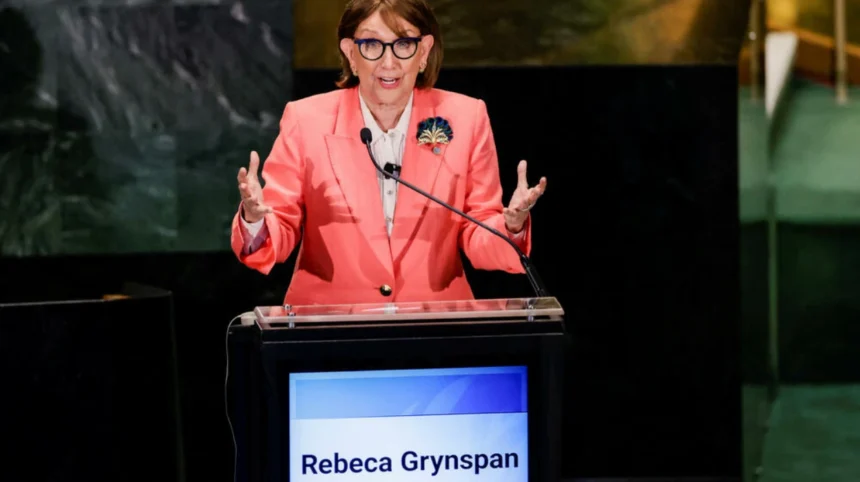
Costa Rican economist and former vice-president Rebeca Grynspan has emerged as the early favorite to become the next Secretary-General of the United Nations, positioning herself as a historic candidate who could break two of the world body’s most significant glass ceilings. If confirmed, she would be the first woman and the first Jewish person to lead the UN in its eight-decade history, bringing a personal narrative shaped by her parents’ refugee experience and a career spanning national executive office and senior UN leadership roles. In the first informal Security Council “straw poll” on July 30, 2026, Grynspan received 10 “encourage” votes, one “discourage”, and four “no opinion” from the 15-member Council, placing her ahead of Guyana’s Carolyn Rodriguez?Birkett (9) and Argentina’s Rafael Grossi (7).
A historic candidacy in a competitive field
The race for the post of António Guterres, who finishes his mandate on 31 December 2026, has reached its crucial stage with seven official candidates being involved, which includes four females and three males from Latin America, the Caribbean and Africa. The selection procedure is carried out by the Security Council, which has to nominate one of the candidates recommended to the General Assembly with at least nine votes and without any vetoes among the five permanent members of the council: the United States, Russia, China, the United Kingdom, and France.
It is expected that additional straw polls will be held by the Council in August, with the final decision being made in September – December 2026, after which the General Assembly will nominate the tenth Secretary-General of the organization, taking office on 1 January 2027. The leading position of Grynspan is due to her regional advantage and to increasing pressure on the UN to elect its first female head. It is believed that Latin America and the Caribbean are the next in turn according to the informal rotation.
Within that context, Grynspan’s combination of national executive experience as Costa Rica’s vice-president from 1994 to 1998 and senior UN management experience as head of UNCTAD since 2021 has made her a compelling figure for many member states.
Personal history and political identity
Background Information on Grynspan is very essential in understanding her candidacy story. She was born in 1955 in Costa Rica and is the daughter of Polish-Jewish refugees who escaped persecution from the Nazis in the 1930s in Europe and came together at a displaced persons camp in Cyprus and migrated to Costa Rica. The parents of Grynspan lost their family members to the Holocaust and the move to Costa Rica that embraced human rights influenced their outlook.
As she told UN ambassadors during her candidacy presentation,
“Peace is what made it possible for my parents, two refugees from the Second World War, to find respect and dignity in a small country, Costa Rica. I am the daughter of this peace, a demonstration of what peace makes possible.”
The connections of Grynspan with Israel are very strong because her sister immigrated to Israel at a young age, and her brother and sister both were part of the Israeli Defense Forces. Grynspan has received education at the Hebrew University in Jerusalem and is still in touch with Jewish organizations such as the World Jewish Congress and B’nai B’rith. Costa Rica has an estimated number of 2,500 Jews; hence, for this tiny Jewish community, the candidacy of Grynspan is something that they are proud of. “This would be a great pride for us,” commented Amir Grunhaus, a Jewish Costa Rican who lives in New York.
Professional trajectory and UN credentials
Grynspan has a career background of economics, public services, and multilateral diplomacy. The economist attended universities in Costa Rica and Sussex, where she graduated. Grynspan was an economics lecturer and researcher before she became part of the government. She worked as Costa Rica’s Vice President (1994-1998), and she held various cabinet positions like Minister of Housing, Minister Coordinator for Economic and Social Affairs, and Vice Minister of Finance. Later, she was in charge of the Ibero-American Conference and also worked with the UN Development Programme as a technocrat politician.
In 2021, Guterres appointed Grynspan as the Secretary-General of UNCTAD (the United Nations organization dealing with trade, investment, and development-related issues). Thus, Grynspan became the first female leader of this organization. In her leadership at UNCTAD, she advocated for the integration of developing countries into the global economy and supported consumer protection and entrepreneurship while opposing the policies detrimental to developing nations. Grynspan participated in the negotiations of the Black Sea Grain Initiative in 2022, a treaty by Russia, Turkey, Ukraine, and the UN allowing Ukraine to export its grains from the port safely despite the war in Ukraine.
Policy platform: peace, reform, and future
Grynspan’s campaign is built around three core priorities: peace, reform, and future. In her interactive dialogue with member states, she asserted,
“I believe I can lead this organization through these turbulent times, and to do so around three priorities: peace, reform, and future.”
She framed peacemaking as the UN’s primary purpose and pledged to make it her first priority, warning that the world faces an increase in armed conflicts and “devastating new forms of warfare.” She argued that the international frameworks that once constrained nuclear, chemical, and biological weapons are eroding, and called for a more proactive approach to conflict prevention.
On reform, Grynspan has acknowledged widespread criticism that the UN needs to be more focused, useful, and responsive. She has emphasized the need to restore confidence in the multilateral system at a time of financial shortfalls, eroding trust, and geopolitical fragmentation. She has also championed the role of women in the UN’s work, stating,
“Women are not an afterthought. We are half of the population. We have to be thought not in our vulnerabilities but in our capacities.”
Her platform includes closer collaboration with civil society, particularly women’s organizations, to maximize the UN’s impact.
On the Middle East, Grynspan has called for a ceasefire in Gaza and for UN humanitarian agencies to have “unrestricted access to Gaza.” Following the October 7, 2023, Hamas attacks, she expressed horror at the loss of life in Israel and Gaza and called for the protection of civilians and respect for international law. At the same time, her tenure at UNCTAD has drawn criticism from pro-Israel voices for reports that attributed much of the Palestinian territories’ economic distress to Israeli occupation measures while giving limited attention to Hamas governance, corruption, or internal Palestinian factors. This record could complicate her support from the United States and some Western capitals, even as she seeks to position herself as a unifying figure.
Strategic advantages and potential liabilities
Several factors contribute to Grynspan’s initial advantage in the straw poll. Her suitability as a candidate for the post in light of Latin American and Caribbean suitability corresponds with the assumption that these regions would follow the incumbent into leadership of the organization. As a woman and a member of a marginalized community, she represents a candidate suitable for those advocating for the appointment of a female Secretary-General. Her insider status within the UN and executive background at the national level qualify her for the role as both diplomat and manager.
On the contrary, there are several liabilities with respect to Grynspan’s candidacy. First, there is the possibility of a P5 veto due to the sensitivity of the file of the Israel-Palestine dispute and questions of reform of the UN. Her report by UNCTAD concerning the economy of Palestine can become a stumbling block during closed talks. There are many other competitors in the region of Latin American and Caribbean countries, among which are Rodriguez-Birkett of Guyana and Grossi of Argentina (IAEA).
What the straw poll reveals—and what it does not
The first straw poll is a non-binding, informal exercise designed to gauge preliminary support among Security Council members. The results show Grynspan with a clear lead, but the four “no opinion” votes she received indicate that her support is not yet consolidated. In subsequent rounds, the Council will use colored ballots to detect whether any permanent member is casting a veto, without publicly attributing it. The final outcome will depend on whether Grynspan can convert “no opinion” voters into supporters and whether any P5 member ultimately blocks her candidacy.
For now, Grynspan’s message is one of continuity and change: continuity with the UN’s founding ideals of peace and multilateralism, and change in terms of leadership style, gender representation, and institutional reform. As she told the General Assembly,
“I can lead this organization through these turbulent times, and to do so around three priorities: peace, reform, and future. Peacemaking is the purpose of this organization. It will be my first priority.”
Outlook and implications
Should Grynspan get the nomination and appointment from the General Assembly, she will have to step in during very uncertain times for the international community with wars going on in the Middle East and Ukraine, budgetary constraints on the UN, an increasing multipolar world, and challenges to the liberal international order. It will depend on whether she is able to navigate through all of these crises as much as on whether she gets sufficient political latitude by the Security Council and the UN membership as a whole. For Costa Rica, a country with a proud history of being neutral and building peace, Grynspan’s candidacy has already raised its diplomatic standing. For the UN, if she wins, it will be a truly historic achievement, demonstrating a clear turn towards gender equality and inclusiveness in symbolism. The question is whether she is able to deliver the substance on top of that.