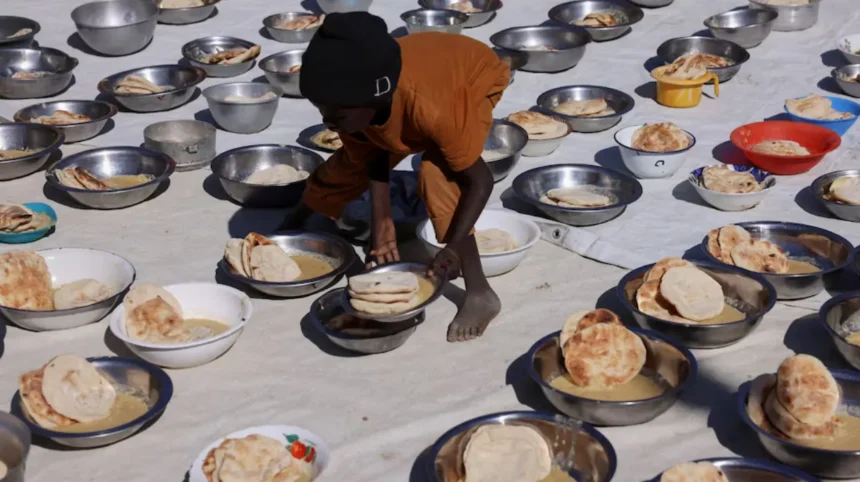
The main message in the recently published State of Food Security and Nutrition in the World report by the UN can be expressed in one sentence: hunger reduced again in 2025 and the reduction is registered in all continents. According to Reuters, this is the first reduction of hunger rates on all continents in history, including Africa, although the reduction rate in the latter was described as quite small. As the report claims, the total number of hungry people is estimated at 645 million people in 2025, accounting for 7.8% of the world population. This is compared with 673 million people or 8.2% of the global population in 2024, while the share was 8.6% in 2022. However, the general positive trend masks deep regional disparities.
According to the UN and WHO sources, hunger rates remained high in Africa and western Asia, while the most significant progress was made in Asia and Latin America. The highest level of hunger was found in Africa where almost 309 million people were undernourished, making almost one fifth of the total population on the continent.
What the numbers show
The report provides the best overview of the magnitude of the issue. According to it, global hunger decreased by 15 million individuals between 2023 and 2024 and was on a descending trend through 2025. According to the FAO’s Hunger Map 2025, 28% of the global population experienced moderate to severe food insecurity in 2024, thus indicating that the problem is more complicated than the term “hunger.” As for the UN report, it states that the improvements have been the most significant in certain areas of Asia and South America due to favorable policies and better food availability. Reuters reported FAO chief economist Máximo Torero that the improved food availability in regions such as South America and India contributed to the global decrease. However, according to the WHO, the burden has been “uneven” across the globe despite the general improvement.
Why the progress happened
The latest UN report points to a mix of policy and economic factors behind the improvement. It says food price inflation, while still persistent, has become more manageable in some places, and that country responses have been more effective in mitigating the damage to food security and nutrition. The report also highlights sustained investments, stronger policy coordination and more transparent food systems as reasons the downturn in hunger can continue.
The WHO’s summary of the report adds that recent gains were helped by the affordability of healthier diets in some countries, although that remains a major concern globally. In practical terms, this means that the world’s food problem is not just about producing enough calories, but about whether households can buy nutritious food consistently. That distinction matters because it explains why some regions improve while others remain trapped in chronic insecurity.
Africa and western Asia remain exposed
Despite the global decline, the UN message is unmistakable: the situation in Africa is still worsening in too many places, and western Asia remains under severe strain. In its 2025 launch remarks, UN Deputy Secretary-General Amina Mohammed said,
“Yet, we are far off track,”
underscoring that the world is still not close to meeting the hunger target under the Sustainable Development Goals.
She added that
“more than 670 million people go to bed hungry,”
a reminder that the headline improvement does not erase the scale of the crisis.
In the very same statements, it was highlighted that in Africa alone there are 307 million undernourished people, more than one fifth of the total population, indicating how much responsibility rests on just that region. This regional concentration is the very reason that even after the establishment of the Millennium Development Goals in the year 2000, the UN has continued to highlight hunger as a developmental emergency instead of a temporary crisis. In the summary of the report by the WHO, it is stated that the situation related to hunger and food security has worsened in Africa while it has improved in certain parts of Asia and South America. The Chinese translation of the same report says that the situation of almost all sub-regions of Africa and western Asia keeps on worsening.
Climate and trade risks
The UN is warning that the recovery is vulnerable to external shocks. Its report says previous editions have already identified major drivers of food insecurity as economic shocks, extreme weather events, the COVID-19 pandemic and conflict. This year’s report goes further by examining how food price inflation and the affordability of healthy diets interact with those wider pressures.
According to Reuters, FAO Chief Economist Máximo Torero has raised the alarm about climate-related shocks such as El Niño and any other weather shock as well as supply chain disruptions associated with the trade route and geopolitical issues. This alarm becomes crucial since food systems have become very interconnected with shipping routes, fertilizer markets, and international trade, meaning that a disruption in one area will immediately push up prices in another. The general message from the United Nations on the situation is that while there have been some improvements, they are still fragile. The UN has noted that the rise in food prices is “not insurmountable,” although it needs continued investment, improved policy coherence, increased transparency, and innovations in food systems.
UN’s policy message
The report is not only statistical; it is also a policy warning. It frames hunger reduction as a matter of rights, resilience and governance, not simply humanitarian relief. That explains why the UN keeps linking hunger to the right to food, the right to health and the right to a dignified life.
The report also makes clear that progress depends on more than emergency aid. The UN says governments need stronger social protection, better nutrition-focused policies and more resilient agricultural systems if they want to sustain the decline. It also stresses that national responses to food price inflation have shown what works, suggesting that policy choices can soften the blow even when global conditions worsen.
At the same time, the SDG framing is sobering. The report is the UN’s annual global monitoring tool for SDG 2, which aims to end hunger, food insecurity and malnutrition in all forms. A slow decline in hunger is not enough on its own if the world remains “far off track” to eliminate hunger by 2030.