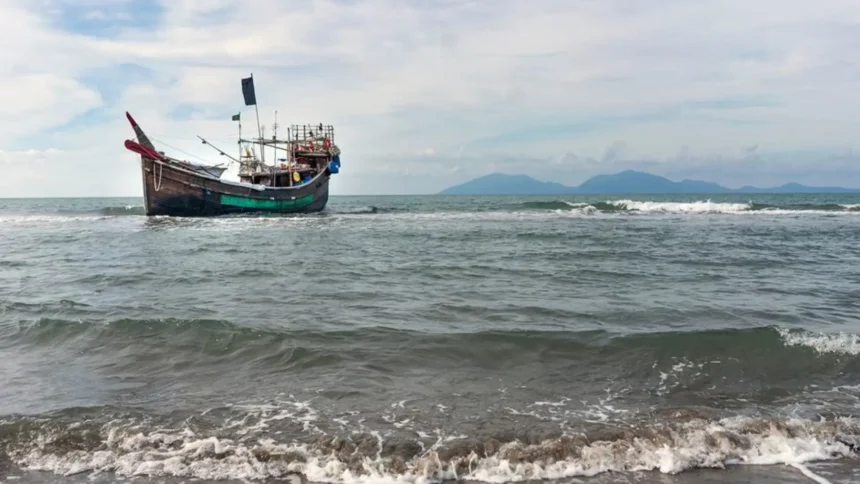
The United Nations has raised alarm over a devastating maritime disaster off Myanmar’s coast, where more than 500 people are feared dead after two boats reportedly capsized in separate but closely linked incidents. The tragedy, described by UN agencies as a double shipwreck, has once again exposed the lethal risks faced by Rohingya refugees and migrants trying to escape persecution, displacement, and hardship across the Bay of Bengal.
The sheer magnitude of the loss is alarming. It was reported that the two ships had an estimated 500 passengers, and the UN stated that the increasing apprehension is that most, if not all, might be dead. The situation is not only causing anxiety about the safety of those involved but is also raising awareness of the greater humanitarian disaster driving people to take dangerous sea journeys.
What happened in the reported double shipwreck
However, the evidence at hand shows that there were two boats loaded with Rohingyas who may have sunk recently. At the moment, further investigations are being made and the details of what happened have yet to be revealed. However, the fact that there has been international concern regarding the situation is due to the fact that there will be a large number of deaths in these tragedies. These cases have initially been reported by UN bodies who have expressed concerns about the fate of those who were on board these boats. It should be noted that in these declarations, the UN does not consider those people who disappeared to have died; however, the chances for that seem to be very high.
This is one of the reasons the event has been described as a “double Myanmar shipwreck tragedy.” The phrase captures not just the fact that two boats were involved, but also the sense that the humanitarian disaster unfolded across more than one vessel, making the toll even more severe and the search for clarity more difficult.
Rohingya at the center of the crisis
Most of those feared lost were Rohingya, a persecuted Muslim minority from Myanmar who have long faced discrimination, violence, statelessness, and displacement. For many Rohingya families, the sea route remains a desperate option, even though it is widely known to be dangerous. They often board overcrowded, aging boats operated under poor conditions, with little certainty of rescue if something goes wrong.
The disaster highlights a trend that occurs annually. Every year, Rohingya people embark on dangerous voyages across the waters of the region looking for safety, food, reunion with their family members, or even a basic respect towards them. There have been multiple warnings issued by United Nations and other humanitarian agencies concerning the extremely dangerous nature of such sea voyages among the most dangerous in Asia. The recent reports indicate that some of the passengers could be coming from Cox’s Bazar in Bangladesh, where one of the largest settlements of refugees in the world can be found.
UN agencies sound the alarm
The United Nations framed the incident not merely as a maritime accident but as a symptom of a larger crisis. In its reporting, the UN said there was “growing concern” for around 500 people believed to have been aboard the two boats. That wording reflects both caution and urgency: caution because the facts are still being verified, and urgency because the likely toll is catastrophic.
“There is growing concern for some 500 people believed to have been aboard two boats that reportedly capsized off Myanmar’s coast,”
the UN reported.
UN refugee and migration agencies, including the International Organization for Migration and the UN High Commissioner for Refugees, have also been drawn into the case through broader reporting on the disaster. Their response has centered on the humanitarian drivers behind these journeys and the need for better protection, rescue coordination, and safer alternatives for displaced people.
“More than 500 people are feared dead after two boats carrying members of Myanmar’s persecuted Rohingya minority reportedly capsized,”
one report summarizing UN-linked information said.
The framing from the UN is significant because it places the disaster in the context of displacement rather than treating it as an isolated accident. That distinction shapes how governments, aid groups, and media outlets interpret the event. It also shifts the focus from the immediate wrecks to the broader system that repeatedly puts vulnerable people in harm’s way.
Why the sea route remains so deadly
The Bay of Bengal and its surrounding areas are known for being dangerous places to cross through, particularly in bad weather conditions and when traveling by overcrowded or badly maintained vessels. The boats used to carry Rohingyas are typically fragile, poorly powered, and overloaded. Once the boat starts to take water and becomes unstable, the chances of survival decrease rapidly. Human trafficking and smuggling syndicates are also involved in these crossings. Fleeing refugees and migrants are made to pay exorbitant amounts of money to facilitators, who promise safety but cannot guarantee much more than this. In most instances, passengers have no knowledge of their route or dangers beforehand.
That is why this disaster has drawn such strong attention from aid groups. It is not simply a maritime emergency; it is part of a recurring protection failure. When people who have already fled violence and deprivation are forced into unsafe boats, the underlying causes are political, humanitarian, and structural, not accidental.
Rescue efforts and uncertainty
At the moment, the main problem lies in the verification of what has happened so far. The description of the sinking gives it as a suspected or alleged event; hence, no definitive figures on casualties yet exist. Such a state of affairs is quite normal for any maritime disaster when it comes to refugees since the vessel may drift away, disintegrate, or even go missing without leaving any trace behind. Moreover, search and rescue operations do not seem to be conducted extensively, and the number of survivors has not yet been established. However, the fact that “more than 500 people feared dead” speaks volumes of the magnitude of the tragedy.”
The use of “feared” is also journalistically important. It shows that agencies are reporting cautiously and responsibly, avoiding a final declaration before evidence is complete. At the same time, it communicates the gravity of the situation in plain terms that leave little doubt about how severe the consequences are likely to be.
Regional and humanitarian stakes
The implications of the tragedy can be far-reaching as well, going much beyond the places where the incidents occurred. This could put greater pressure on the governments in the region to improve their efforts in intercepting and dealing with the humanitarian aspects of the displaced Rohingyas. This may also pave the way for a debate as to whether the policies in place actually save lives or compel them into undertaking even more dangerous travels. Whatever the case, this is a reminder to all the countries that are part of the Rohingyas’ journey that there are implications associated with their displacement.
Humanitarian organizations are likely to use this case to argue for a stronger focus on protection, legal pathways, and rescue capacity. The core concern is simple: if people continue to board unsafe boats because they have no viable alternatives, more such tragedies are likely.
What the numbers mean
The number “more than 500” is not just a statistic; it is an indicator of the scale of possible loss in one incident or closely linked incidents. In practical terms, that means an entire small community may have vanished at sea. It also means families may be left without answers for days or weeks, often with no bodies recovered and no certainty about who survived.
That uncertainty is especially painful for refugee families. In many such cases, relatives learn only fragments: a phone call that stopped, a boat that never arrived, a name missing from a list. Those gaps make the human cost harder to measure than a normal disaster, because the record of the dead and missing is incomplete from the start.
Numbering is important because it ensures that this case will be included as one of the most deadly maritime disasters to hit Rohingya refugees in recent times. Without any conclusive figures, the numbers provided by UN agencies are already sufficient to label the disaster as a huge humanitarian emergency. The case is significant because it is a combination of some of the world’s biggest problems, including forced migration, oppression of minorities, trafficking, unsafe migration, and limitations of regional response measures. It is not a single case; rather, it is the latest in a series of consequences of a long-running crisis.