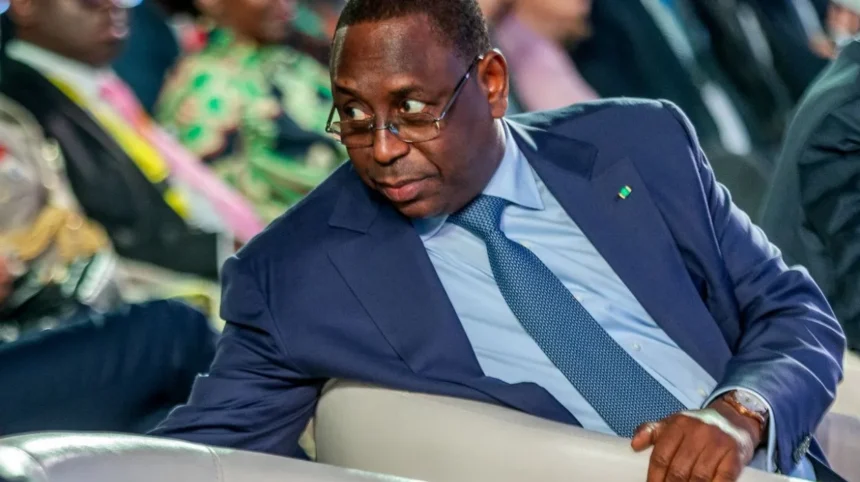
Former Senegalese president Macky Sall is presenting himself as a reform-minded contender for the next UN secretary-general, arguing that the organisation must restore trust, become more efficient, and deliver results that governments can defend before their citizens. His campaign has gained fresh momentum as Senegal’s current president, Bassirou Diomaye Faye, has now endorsed the bid, giving Sall crucial backing from home after months of political hesitation.
Campaign context
Sall’s candidature comes at a time when the UN finds itself under scrutiny to show that it still holds any significance amidst the ongoing wars, divisions, and doubts cast on multilateral organizations. He joins other four confirmed candidates who include Rebeca Grynspan, Michelle Bachelet, Rafael Grossi, and María Fernanda Espinosa. Upon his election, he will be only the third African UN secretary-general following the Egyptian Boutros Boutros-Ghali and Ghanaian Kofi Annan, and will be the first in the post from Africa in the last two and a half decades. The UN is expected to elect its tenth UN Secretary General for this year starting on 1 January 2027. Sall was nominated officially by Burundi on 2 March 2026, as per UN selection page.
Reform message
Sall’s central message is that the UN must move away from bureaucracy and toward effectiveness. On his campaign site, he says the organisation should be “streamlined, modernised and refocused… on its core mission”. In his public vision for the UN, he argues for “rationaliser, simplifier, optimiser,” or rationalising, simplifying, and optimising the institution so it can produce results that member states can justify at home.
That language is not just rhetorical. He has repeatedly framed reform as a practical necessity, insisting that the UN should cut duplication, improve coordination among agencies, and strengthen accountability for every dollar spent. His broader pitch is that trust in the UN will return only if the institution becomes more transparent, less bureaucratic, and closer to the realities faced by ordinary people.
What he proposes
A more detailed analysis of Sall’s reform agenda indicates that there is an extensive reform program, which goes beyond mere managerial reforms. Specifically, Sall is calling for the adoption of socio-economic indicators in the early-warning system of the UN, giving regional organizations an actual operational function in crisis management and adopting an integrated security and development approach to combat terrorism. Furthermore, Sall advocates for the reform of the Security Council, where he demands the introduction of permanent African seats within the body, which he claims is not merely a question of representation but a matter of legitimacy as well.
His program goes beyond regional reform issues and encompasses the development finance area on a global level. Sall believes that development financing should be based not only on aid but also on partnership, investments, trade, and better access to financing. Moreover, he linked his reform proposals to the post-2030 development agenda.
The campaign platform further includes a push for digital modernisation, transparency in procedures, and stronger gender and geographic equity across the organisation. In short, his reform plan is not just about trimming budgets; it is also about rebalancing who gets heard and how global decisions are made.
The trust argument
At the core of Sall’s argument lies a political point about credibility. In Sall’s view, the United Nations must be capable of delivering results that the government members could justify to their citizens, which, in turn, means that the organization has drifted from the expectations of the people. That explains why Sall focuses so much on the issues of efficiency, fairness and results instead of using the typical institutional vocabulary. That, in turn, helps to explain his choice of words concerning reform. Sall has mentioned that “the UN needs consistency, fairness and efficiency” for gaining back its credibility, thus hinting at the combination of good management and political balance. By positioning himself as a mediator, Sall tries to assure both great and small countries.
Support and resistance
Sall’s campaign has been helped by visible backing from Senegal’s current leadership, which dramatically changed the tone of the race. According to the Senegalese foreign ministry, Faye instructed the government to “fully mobilize” support for Sall and described the candidacy as “Senegal’s candidacy in the service of Africa”. That endorsement matters because it turns the campaign from a personal bid into something closer to a national and continental cause.
Still, resistance has not disappeared. Earlier reporting noted that Sall had not secured full support from either his own country or the wider African bloc, and around 20 African Union member states had declined to back him in March. That makes the final stretch politically delicate, especially because the race for secretary-general is shaped as much by regional consensus as by personal credentials.
Africa and symbolism
In case Sall wins the election, the symbolic value of his candidacy will be beyond his own political career. There has been no African secretary-general in charge of the UN operations for almost three decades. Consequently, the candidate’s candidacy is bound to be burdened by the demands for higher African participation in international politics that have existed for a long time already. Sall’s supporters will emphasize his practical experience in negotiating conflicts, dealing with challenges of development, and participating in political negotiations on the level of the Global South. His personal biography allows him to make this claim. Sall has been serving as the president of Senegal from 2012 to 2024 and was the chairperson of the African Union from 2022 to 2023. While campaigning, Sall has made his experience work for him, emphasizing forty years of political experience.
Why this race matters
The secretary-general contest is happening at a time when the UN is under pressure to prove that it can still mediate wars, protect human rights, and coordinate development effectively. That makes the race more than a personality contest; it is a referendum on what kind of institution the UN should become over the next five years. Sall’s platform is notable because it combines institutional reform, African representation, and a message of pragmatic governance.
His pitch also reflects a broader dissatisfaction with multilateral processes that many governments see as slow and disconnected from results. By repeatedly returning to the idea of a UN that is simpler, more transparent, and more responsive, Sall is positioning himself as a candidate of repair rather than disruption. That may appeal to states seeking stability, but it also raises the question of whether structural reform can move fast enough to match the scale of current global crises.