The walkout by U.S. diplomats during France’s remarks at the United Nations Security Council was more than a symbolic gesture. It reflected a widening diplomatic rupture between Washington and Paris, one that has been sharpened by disagreements over human rights, the conduct of international institutions, and the Trump administration’s increasingly combative posture toward allies and multilateral bodies. What might have looked, at first glance, like a brief diplomatic protest has instead exposed a deeper transatlantic strain playing out in public at the UN.
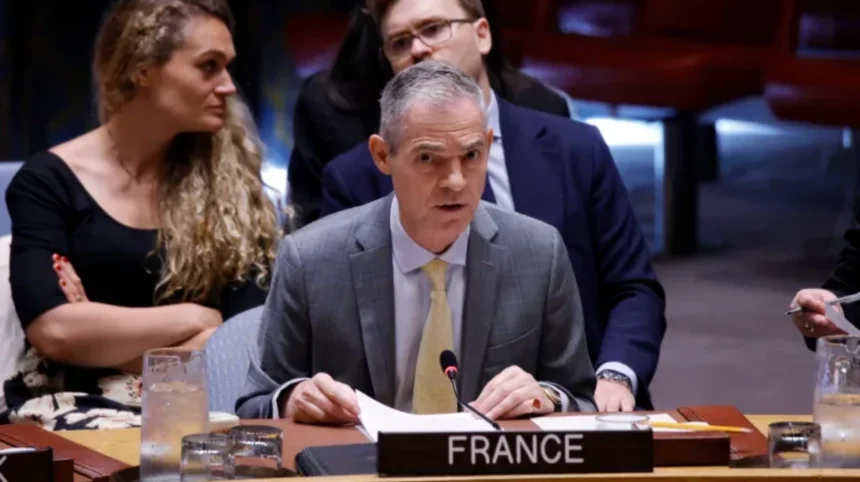
The event occurred when the Security Council was having a meeting about Ukraine, with the United States walking out of the room as France started making its statement. What made the event significant is the fact that walking out of the Security Council is not common, especially for two important allies from the West, both being members of the council. In this case, the walkout was because of France’s condescending comments about the Trump administration regarding its attitude to the human rights structures in the UN.
The trigger behind the protest
At the heart of the row was the question of Volker Turk, the UN human rights chief. The United States had opposed the four-year extension of his mandate, which prompted France’s UN mission in Geneva to publicly criticize this decision. The tone of the French criticism was unusually harsh, and their diplomats went so far as to say that the United States was no longer playing the role of a defender of human rights on the world stage.
The debate very quickly ceased to be focused on one specific appointment and turned into a much broader discussion about morality, diplomacy, and the United Nations itself. In essence, it was not just one disagreement about one candidate. Rather, it was a way for Paris and Washington to assess each other’s attitude toward the UN and its institutions.
The tension intensified online before it spilled into the Security Council chamber. U.S. Ambassador Mike Waltz responded on X with a forceful attack, saying France had no basis to lecture others while backing a rights official the U.S. viewed as hostile to democratic governments and lenient toward authoritarian states. That exchange set the tone for the walkout that followed.
What the U.S. said
The U.S. reaction after the walkout was firm and deliberate. Deputy U.S. representative Dan Negrea defended the protest in the Security Council and made clear that the United States saw France’s remarks as unacceptable. He accused France of engaging in what he called “disingenuous grandstanding”, framing the criticism as performative rather than substantive. His language showed that Washington wanted the protest to be understood not as a lapse in diplomatic decorum, but as a political response to what it viewed as unfair moral lecturing.
Negrea also said the U.S. would continue to walk out until France renounced what he described as its
“condescending and disrespectful rhetoric”.
This statement is important in that it indicates that this issue is not going to be an isolated event. It means that there is the possibility of the American side making the walkout a recurrent form of protest depending on the tone of the French side. In diplomatic terms, this means that a once-off gesture could turn into institutional confrontation. The position of the Americans in this case did not only defend itself from criticism. Negrea also indicated that the Americans had supported the French side in times of war and danger, implying that the French side was not reciprocating the gesture in any way.
France’s position in context
There was no explicit mention of the walkout by France’s delegation in the hall, and this was significant in itself. Instead of addressing this matter directly, Ambassador Jérôme Bonnafont talked about the efforts of his country in supporting the independence and efficiency of the United Nations as an organization. It was important because it helped France to show that it was trying to protect the organization and not having some kind of a conflict with Washington personally. However, the earlier remarks of the French were very clear. According to France, the United States had changed its course and instead of advocating for human rights became associated with the position that weakened the credibility of the human-rights system at the UN.
France’s stance also reflected a wider European concern that the Trump administration was increasingly hostile to multilateral institutions and impatient with international oversight. In that sense, the French criticism was not only about Volker Türk. It was also about the direction of American diplomacy under Trump and the implications that direction had for the UN system.
Why the UN setting matters
The fact that this occurred inside the Security Council gives the episode added weight. The council is the most visible and politically charged arena of the UN, and a walkout there sends a message that goes far beyond routine disagreement. Security Council diplomacy usually relies on restraint, even when divisions are deep. By leaving the chamber, the U.S. delegation broke with that restraint and made the dispute visible to the broader diplomatic world.
The meeting itself was on Ukraine, which is another reason the incident attracted attention. The Security Council was supposed to focus on one of the world’s most serious conflicts, yet the discussion was interrupted, in effect, by a separate dispute over human rights and diplomatic tone. That juxtaposition shows how interconnected UN issues have become and how quickly one controversy can spill into another.
The walkout also highlighted the symbolic value of physical absence in diplomacy. A chair left empty at the council table is not just a procedural detail; it is a message. In this case, it communicated that Washington was unwilling to sit through what it saw as a hostile and hypocritical critique from a close ally. That is a dramatic escalation in a forum that usually depends on presence, even amid disagreement.
Wider US-France tensions
The conflict should be seen in the broader perspective of the tensions existing between Donald Trump and Emmanuel Macron. The relations between the two politicians have been rather tense for quite some time, with both periods of cooperation and frequent conflicts related to the issues of trade, NATO burden sharing, global governance, and role of Europe in international politics. Now the list of points of discord includes the sphere of human rights, which have become part of the diplomatic discourse of the UN.
Overall, this particular case is a good illustration of the pattern according to which the Trump administration has reacted negatively to criticism of its policies voiced by its allies. Instead of accepting the criticism and moving on, the US authorities decided to make a diplomatic protest against France. It is an example of a confrontational approach to the alliance management and unwillingness of the government to tolerate moralizing from its partners. In addition, the situation with the human rights resolution is connected to the issue of credibility for the French authorities. By criticizing the US president in such a way, Paris tried to present itself as a defender of human rights and norms of international institutions.
The significance of the walkout
The walkout matters because it reveals how fragile even the closest international relationships can become when political rhetoric hardens. The U.S. and France are not adversaries; they are strategic allies, nuclear powers, and permanent members of the Security Council. Yet this episode showed that alliance does not prevent public humiliation, counter-accusation, or a deliberate display of displeasure.
It also shows how human-rights debates have become more politicized inside multilateral institutions. Instead of being handled as technical or principled disagreements, they are now tied to national prestige and broader geopolitical alignments. That makes compromise harder and raises the chance of theatrical confrontations like this one.
The U.S. vow to repeat walkouts if France continues its tone is especially important. It suggests the dispute is not simply about one vote or one speech. It is about whether the two countries can maintain a working diplomatic relationship while openly contesting each other’s legitimacy on a matter as fundamental as human rights.
The first and foremost question is whether this will be just an instance of diplomacy at work or whether it will mark the beginning of a prolonged conflict in the public sphere at the UN. In case the U.S. goes ahead with its threat of walking out, future sessions of the council may well see another confrontation. This will further curtail the scope for any form of a behind-the-scenes agreement and will bring the transatlantic dispute even more into the spotlight. Another problem is that public conflicts may harm the already fragile authority of the UN institution.
When the permanent members of the security council conduct their session to publicly express disagreement with one another, the institution’s capability to show any form of unanimity comes into question. While the Volker Türk conflict may not have many consequences in the long-term, the practice of conducting walkouts may stay with us longer. In that regard, the incident in the UN chamber has been much more than just a spat between two delegations.