The latest move by UN Secretary-General António Guterres is less a breakthrough than a carefully managed attempt to keep Cyprus peace efforts alive. His plan to convene a new multi-party meeting on the island’s division comes after years of stalemate, and it signals that the UN still sees room for a negotiated way forward even if the gap between the two sides remains wide.
A renewed UN push
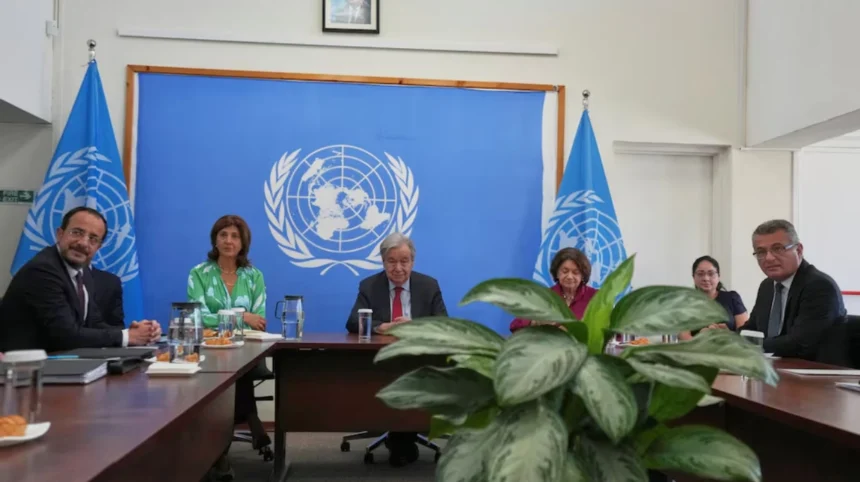
Guterres said to the media in Nicosia on Wednesday that he would be calling for a “five plus one” conference after proper preparation on confidence building, methodology, and substance. This kind of conference involves not only the two Cypriot groups but also Greece, Turkey, and Britain, who are the guarantor states in accordance with the arrangement that made Cyprus independent. It is important when Guterres makes his first visit as the secretary general of the UN to Cyprus because this is the end of his term in 2026. There seem to be some effort made by UN officials and diplomats to take advantage of a small window of opportunity that has been opened up recently on the Turkish Cypriot side.
Why Cyprus remains divided
The division of the island began in 1974 with the invasion of the northern part of the island by Turkey following a coup in Nicosia instigated by the Greek military junta at the time. This intervention turned out to be an irreversible division, where the southern region would be under the control of the internationally recognized Republic of Cyprus while the north would be administered by the Turkish Cypriot state recognized only by Turkey. The division of the island is not only geographical but also political and constitutional in nature. This is because the power-sharing government between the Greek and Turkish Cypriots disintegrated in 1963, and a UN peacekeeping mission was established in 1964.
What Guterres is trying
The UN chief is not presenting a final settlement plan. Instead, he is trying to create enough process, trust and method to restart substantive negotiations after nearly a decade of deadlock. That approach reflects the reality that the sides remain divided not only over the end goal but also over the rules of engagement.
Guterres said,
“I decided that I would convene another five plus one meeting, after adequate preparations on confidence building, methodology and substance,”
António Guterres told journalists in Nicosia. He also said,
“I will do everything I can to support the Greek Cypriots and Turkish Cypriots in this very important moment,”
António Guterres said after meeting the Greek Cypriot leader.
Those remarks are important because they suggest the UN is still acting as a facilitator, not an imposer. The mission, according to Guterres’s envoy Maria Angela Holguin, is to “encourage the people and the leaders to look forward to a negotiation”.
The parties’ positions
The main point of disagreement is over the nature of the settlement. The President of Greek Cypriot Republic Nikos Christodoulides demands resumption of the talks on the basis of the existing UN-sponsored approach, according to which a bi-zonal, bi-communal federation will be established. This stance continues to correspond with UN resolutions and the Greek Cypriot view of reunification of the country as an element of a single sovereign state. As for the Turkish Cypriots, their views have somewhat changed since the elections of Tufan Erhurman, who ran his campaign on discussing a possibility of the federal solution rather than the two-states solution preferred by his predecessor.
However, Erhurman stated that he would not participate in any talks without prior agreement on the conditions of equal politics and negotiations. Turkey represents the hardest case among external players. President of Turkey Recep Tayyip Erdogan publicly announced his vision of coexistence of two states on the island, which is rejected by the Greek Cypriots, Greece and UN traditional approach to the negotiations.
What has changed recently
There are signs, though limited, that the atmosphere is better than it was a year ago. In March 2025, Guterres described the Cyprus discussions as having made “meaningful progress,” with both sides agreeing to a set of confidence-building measures including new crossing points, demining, a youth committee, and environmental and solar energy initiatives. In July 2025, the UN said four previously agreed trust-building measures had been implemented, while work continued on others.news.
Those steps are not enough to solve the dispute, but they matter because past peace efforts repeatedly collapsed in part due to a lack of trust. Guterres has been pressing both sides to move from symbolic gestures to practical cooperation, especially on crossing points and measures that ease life for ordinary people on both sides of the divide.news.
The latest initiative also follows the election of a pro-unification Turkish Cypriot leader, which created a more favorable political environment than the one that existed under the more rigid two-state line. That does not mean a deal is close, but it does explain why the UN is moving now.
The bigger diplomatic stakes
While often considered a local issue, the Cyprus conflict has wider regional ramifications, straining the relationship between Greece and Turkey, the two NATO allies, and Turkish-EU relations. Moreover, it represents one of the longest-lasting frozen conflicts in Europe, which is why each new UN initiative to breathe life into the stalled process attracts international interest. There are tangible implications to the island’s divided nature, in terms of governance, trade, mobility and identity. The Greek Cypriot south belongs to the European Union as an EU member state, whereas the Turkish Cypriot north acts as a breakaway entity that is dependent on Turkey.
Thus, every new round of negotiations becomes a challenge not only on account of boundaries, but also of sovereignty and security considerations. The mere presence of the UN in the region serves as evidence of the ongoing nature of the conflict. UNFICYP’s mandate has just been extended until January 2027 once again in February 2026.
The primary issue here is whether the 5+1 meeting to be held will lead to the creation of a real negotiating process or just another case of procedural diplomacy. According to Reuters, the UN Secretary-General Guterres wanted the meeting to be conducted only after sufficient preparation work in regard to confidence building, methodological and substantive issues, which indicates the fact that the UN attempts to avoid another failure like previous ones. The second issue is whether Christodoulides and Erhurman will be able to come to an agreement about the basic principles of the negotiations.
Still, this effort matters because Cyprus diplomacy has often advanced only in small, uncertain steps. Guterres is betting that even a modest process can preserve momentum, keep both sides engaged and stop the island from sliding back into complete stalemate.news.