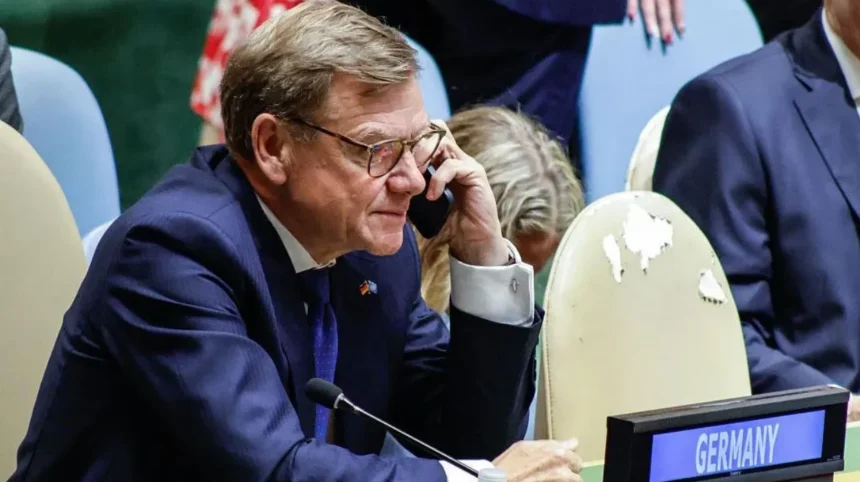
Germany’s long-anticipated bid for a non-permanent seat on the United Nations Security Council for the 2027–2028 term ended in a surprising and stinging loss. In a vote at the UN General Assembly, Germany failed to secure one of two available seats in the Western European and Others Group (WEOG), coming in third behind Austria and Portugal.
The German government, led by Foreign Minister Johann Wadephul, called the outcome a “bitter defeat” and pointed the finger at Russia for stirring up opposition against Berlin’s candidacy. This marks the first time Germany lost a competitive bid for a Security Council seat ever. It’s sparked a lot of debate in Germany about their foreign policy, global influence, and how effective they are in multilateral institutions.
The Vote That Shocked Berlin
How the Numbers Fell
The election took place during the 80th session of the UN General Assembly in New York. Two seats were up for grabs in the WEOG category for the 2027–2028 term. The final tally showed:
- Austria secured the first seat with strong support across regions.
- Portugal claimed the second seat with a commanding vote count.
- Germany, long considered a favorite, finished third with significantly fewer votes.
Other countries elected in the same round included Kyrgyzstan (Asia-Pacific), Trinidad and Tobago (Latin America and the Caribbean), and Zimbabwe (African Group). The results surprised many diplomats who had assumed Germany’s economic weight and political clout would guarantee victory.
Wadephul’s Blame Game: Russia’s Alleged Campaign Against Berlin
“Russia Stirred Up Sentiment Against Us”
In his immediate post-vote remarks, Foreign Minister Johann Wadephul did not mince words. He accused Moscow of actively campaigning against Germany’s candidacy.
“It is no secret that Russia has stirred up sentiment against Germany over our support for Ukraine,”
Wadephul stated, suggesting that Russian diplomatic pressure influenced votes in the Global South.
Wadephul also pointed to Germany’s unwavering backing of Ukraine and its close ties with Israel as factors that may have cost Berlin crucial votes.
“We firmly support Ukraine; Russia does not want such a voice on the Security Council,”
he emphasized, framing Germany’s loss as a direct consequence of its principled stance in the face of Russian aggression.
The German foreign minister’s comments fit into a bigger story coming from European leaders. They say Moscow uses its diplomatic connections to isolate countries backing Ukraine, especially at the UN. Russian officials haven’t replied to these exact claims, though. Moscow typically criticizes Germany’s role in the conflict, though.
Late Entry: A Strategic Miscalculation?
“We Entered the Race Too Late”
Beyond Russia’s alleged interference, Wadephul acknowledged an internal strategic error: Germany’s delayed entry into the candidacy race.
“We entered the race too late,”
he admitted, a candid assessment that has already sparked criticism within Germany’s political establishment.
Germany only started campaigning seriously in early 2026, way behind Austria and Portugal who began forming alliances years ago. They both put in a lot of work on bilateral outreach, especially in Africa, Latin America, and the Asia-Pacific region—where Germany had weaker connections.
Because of this late start, Germany didn’t have enough diplomatic support to get the necessary two-thirds majority in the UN General Assembly. They couldn’t secure early commitments from important voting groups, leaving Berlin rushing to catch up at the end.
Foreign Policy Stances That Backfired?
Ukraine and Israel: Double-Edged Swords
After the votes, Germany’s stances on Ukraine and Israel got lots of attention. Wadephul connected Germany supporting Ukraine to opposition from Russia. He also suggested that Germany’s position on Israel might have upset some Muslim-majority countries.
“Our commitment to Israel may have cost us votes in certain regions,”
Wadephul suggested, though he stopped short of calling it a policy error. Germany supports Israel’s existence and pushes for humanitarian ceasefires in Gaza, but this approach upsets both pro-Palestinian and pro-Israeli groups. Austria and Portugal took a different path. They used neutral language to position themselves as mediators, not sides, in the conflict. This might appeal to a wider range of UN members, especially those in the Non-Aligned Movement.
Domestic Fallout: Merz’s International Ambitions Crippled
A Blow to Chancellor Friedrich Merz
Chancellor Friedrich Merz’s defeat holds major political weight in Berlin. He assumed office in 2025 vowing to boost Germany’s global standing, so this foreign policy setback weakens his claims of Germany’s dependability on the world stage. It’s yet another hit to his promises of influence.
Opposition leaders seized on the result.
“This is a humiliating failure for Merz’s foreign policy,”
said one SPD spokesperson, adding that the government’s lack of preparation and overreliance on economic power without diplomatic groundwork had backfired.
The Greens, part of Merz’s coalition, expressed disappointment but defended Germany’s principled stance.
“We would rather lose a seat than compromise our values on Ukraine,”
said Green Party foreign policy spokesperson. The FDP, meanwhile, called for a complete overhaul of Germany’s UN strategy, including earlier campaigning and more region-specific outreach.
What This Means for Germany’s Global Standing
Questions About Influence and Credibility
The Security Council defeat sparked questions about Germany’s role in international institutions. Even though it’s Europe’s largest economy and a top UN agency donor, Berlin seems less influential in areas where soft power and coalition-building count most. So, its declining sway raises eyebrows.
Euronews characterized the loss as a wake-up call:
“Germany’s global standing is being questioned like never before,”
noting that the country’s reliance on economic leverage alone is insufficient in diplomatic contests.
The outcome shows that Germany needs to boost its long-term diplomatic ties, especially in the Global South. Voting there is getting more shaped by history and development aid rather than just economics. The defeat also sparks worry about Germany’s ability to shape global security agendas. If they had won a Security Council seat, Berlin could’ve pushed for reforms, promoted links between climate and security, and influenced crisis responses in Africa and the Middle East.
Russia’s Diplomatic Strategy: A Broader Pattern
Moscow’s Campaign Against Pro-Western Nations
Wadephul’s claims about Russia fit a bigger pattern of Moscow’s aggressive diplomacy. Recently, Russia has pushed hard against Western candidates in UN elections, especially those backing Ukraine. They’ve also waged campaigns against Ukraine, along with Poland and the Baltic states.
Analysts suggest that Russia is using the UN as a battlefield to weaken Western cohesion.
“Moscow is weaponizing diplomacy,”
said one European diplomat.
“They’re targeting countries that support Ukraine, hoping to isolate them in multilateral forums.”
The German defeat might just be the start. If Russia keeps boosting its ties with African, Asian, and Latin American nations, other pro-Ukraine countries could face similar issues in upcoming UN elections.
The Path Forward: What Germany Must Do
Lessons for Future Campaigns
German officials and analysts are already calling for a strategic overhaul. Key recommendations include:
- Earlier campaigning: Germany must begin UN bids years in advance, not months.
- Regional investment: Berlin needs to strengthen ties in Africa, Latin America, and the Asia-Pacific through development aid and cultural diplomacy.
- Balanced messaging: Germany may need to soften its rhetoric on contentious issues like Israel to avoid alienating key voting blocs.
- Coalition-building: Berlin must work more closely with EU partners to present unified candidacies and avoid splitting votes.
Wadephul himself acknowledged the need for change:
“We will learn from this and come back stronger,”
he promised, though critics doubt a quick recovery is possible.
A Defining Moment for German Diplomacy
Germany’s UN Security Council defeat is more than just a single election loss; it defines the country’s identity in foreign policy. This result makes Berlin face some uncomfortable truths about its global influence, the limits of its economic power, and the realities of diplomatic competition in a multipolar world. As Germany adjusts its strategy, the big question is whether it can become a leading multilateral force again. If not, other powers might step in. What’s certain is that the stakes for Germany’s role in global governance are higher than ever.