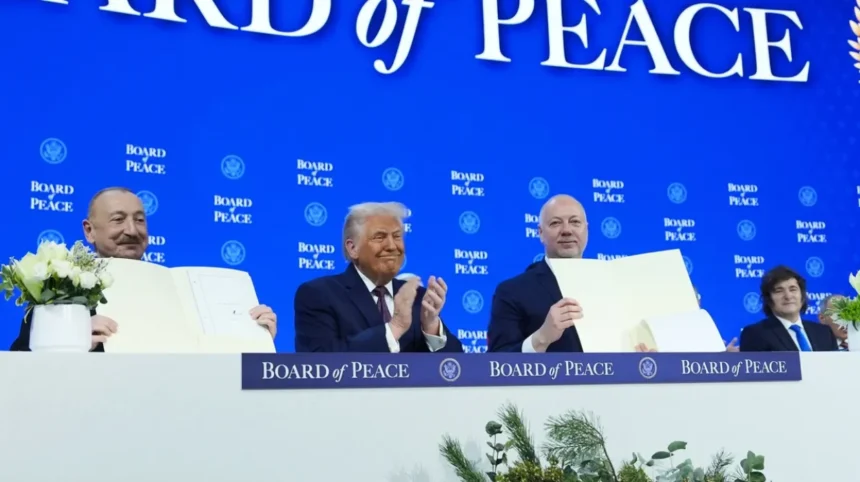
One such change in the Gaza equation after the war has come to light, as the international entity responsible for the implementation of the ceasefire brokered by the U.S. in Gaza prepares to request the United Nations Security Council to compel Hamas to disarm through diplomatic means. This Board of Peace has been set up specifically to oversee the implementation of the ceasefire as well as the UN-backed peace process. Now, this entity wants Hamas to give up its arms, and it regards such a step as a sine qua non for any future reconstruction and Israeli withdrawal efforts from Gaza, along with a move towards self-governance for Palestinians. This approach, revealed in an internal report being shared with diplomats, departs from vague formulations related to “security arrangements.”
The Board of Peace’s position is simple but loaded:
“Demilitarizing Gaza is not optional if reconstruction, a phased Israeli withdrawal, and a path toward Palestinian statehood are to have any meaning.”
According to officials who are close to the monitoring committee, the ongoing existence of the heavy arms in addition to an alternative military structure within Hamas poses threats to Israel’s security and also makes it impossible for the Palestinian leadership to claim legitimacy of their rule in the future. The committee intends to relay its decision to the Security Council through a recommendation that will require the council to issue a public announcement regarding Hamas’ disarmament and disbandment of its military wing.
Alan Shatter, former Irish Minister of Justice & Defence, public intellectual in a tweet said:
“The first Board of Peace report to the UN Security Council depicts Hamas disarmament as the “single factor” needed to unlock reconstruction in Gaza, Israeli withdrawal and a pathway to Palestinian statehood. Pity that instead of RTE daily platforming the Hamas orchestrated Flotilla circus, it neither reports nor asks any searching questions about Hamas sabotaging the Gaza UNSC peace plan agreed by Israel.”
The Context: Ceasefire, Reconstruction, and What Has Not Happened
For putting the significance of this decision into perspective, it is important to first look at the history of the U.S.-mediated ceasefire agreement that put an end to the last stage of the Israel-Hamas conflict in 2025. The ceasefire deal was sanctioned by the UN Security Council and had the following components: cessation of violence, phased withdrawal of Israeli troops from Gaza, and international humanitarian aid for rebuilding the area. One key provision of the resolution mandated that all military organizations in Gaza dismantle their armaments; however, this clause has stayed on paper and there has been no plan put in place for its realization. It is here that the Board of Peace report is trying to make its point.
The ceasefire agreement has been mostly followed over the last few months; however, the reconstruction process has come to a halt. Humanitarian assistance has started flowing into the area; yet, the rebuilding of infrastructure, such as hospitals, schools, water systems, and housing, has not commenced at the rate that had been planned due to both security and political issues.
The report’s internal assessment notes that
“without a verifiable process for the disarmament of armed groups, especially Hamas, confidence in the stability of Gaza remains low and investment in reconstruction is correspondingly cautious.”
In other words, the money is ready, but the conditions are not.
What “Disarm” Actually Means in This Proposal
While the term “disarm” may have a range of meanings in diplomatic parlance, the use of this term in the current report has a particular meaning in mind. It should be pointed out that the Board of Peace does not simply ask Hamas to stop attacks and put away weapons, but to go through a process of disarmament by which Hamas should give up or destroy its weapons, disintegrate its secret manufacturing facilities for weaponry, and transform its military branch into an unarmed political entity.
“The goal is to eliminate Hamas’s ability to function as a parallel army inside Gaza,”
one senior aide to the board’s chairman told a small group of diplomats, according to sources briefed on the document.
Moreover, the report makes it clear that decommissioning will not happen all at once, but rather as part of an ongoing process under international supervision, and possibly tied to partial actions like the removal of Israeli troops from the area, relaxation of some controls on the movement of people and goods, and the transfer of security responsibilities to a Gaza-wide security force. The security force is seen as a neutral body, backed by the United Nations or international supervisors, which would replace the internal security force of Hamas.
For the Board of Peace, this model is not just a technical detail but a political necessity:
“A Gaza where Hamas remains armed while claiming to represent the people cannot be a Gaza capable of credible peace.”
The Board of Peace’s Main Arguments
In laying out its case to the UN Security Council, the Board of Peace marshals several interlocking arguments, each aimed at different constituencies within the council and the broader international community. First, on the security front, the report argues that Hamas’s continued access to heavy weapons creates a constant risk of renewed hostilities and undermines the credibility of any ceasefire.
“So long as Hamas can rebuild its arsenal in secret, the ceasefire will always be provisional,”
the document warns. This point is expected to resonate with permanent Security Council members that have pressed for “irreversible” de?escalation measures.
Second, the board links disarmament to the practical realities of reconstruction. Major donors and international financial institutions have made it clear that large?scale rebuilding will be tied to security guarantees. The report notes that
“the presence of an armed non?state actor with a history of military activity in Gaza complicates risk assessments and complicates the release of reconstruction funds.”
By pushing the council to explicitly require Hamas to disarm, the Board of Peace is trying to remove this obstacle and unlock the billions of dollars pledged for Gaza’s physical and economic recovery.
Third, the report frames disarmament as a prerequisite for any meaningful political progress toward Palestinian statehood. It argues that a viable Palestinian state cannot be built on top of a patchwork of competing armed factions, each with its own security apparatus and loyalties.
“Statehood cannot be delegated to a movement that insists on maintaining its own army,”
the analysis states. For some Western diplomats, this line of reasoning is designed to bolster the position of the Palestinian Authority and other political actors willing to accept a unified security doctrine in exchange for recognition and international support.
Hamas’s Likely Reaction and Its Stated Position
Predicting Hamas’s response to this pressure is easy enough to do, even without knowing what the UN Security Council will decide regarding the recommendations made by the Peace Board. This organization has always been opposed to any attempt to deny it access to its military capabilities, claiming that doing so would mean the loss of the “right to resist” Israeli occupation. In past discussions with other parties, Hamas representatives were adamant that any negotiation on arms should include a clear plan toward the formation of a sovereign Palestine, the evacuation of Israeli troops from all occupied territories, and the end of the Gaza blockade.
Privately, the group has also expressed concern that enforced disarmament, without parallel Israeli concessions, would leave Palestinians defenseless and deepen their dependence on external actors. The Board of Peace’s report acknowledges this skepticism and warns that
“a one?sided approach to disarmament risks hardening Hamas’s stance and encouraging clandestine rearmament.”
Consequently, the suggestion is expressed in terms that would ensure that pressure and motivation are both balanced out; that the deadline is set for Hamas to either hand over or get rid of weapons, while at the same time there is movement being made towards withdrawing of Israeli forces, opening of checkpoints, and basic services restored.
Israel, the West, and the Regional Chessboard
The initiative by the board has to be seen in the wider context of the geopolitical chess game. Israel and its main Western supporters, led by America, have always seen the militant posture of Hamas as the most significant barrier standing in the way of a lasting peace deal for Gaza. The very concept of a militarily equipped Hamas ruling Gaza is unacceptable to the Israelis. It follows, then, that the initiative from the Board of Peace will be warmly welcomed in Washington and Jerusalem alike.
Israeli security officials have long argued that
“Hamas must be neutralized as a military threat before any meaningful political process can begin,”
and they may now see the UN?backed board as a useful vehicle for making that demand multilateral rather than purely bilateral.
However, at the same time, it seems quite likely that those Arab and Global South countries which have representatives on the UN Security Council would oppose such a resolution that seems to specifically target Hamas’ disarmament without addressing any other security concerns, for example, regarding the number and nature of Israeli troops present in Gaza or even regarding the issue of settlements. Instead, such countries may try to insist that Hamas’ disarmament should be linked to Israel’s withdrawal from the area, the lifting of the blockade, and the negotiations on two-state peace settlement. This possibility has been taken into account by the Board of Peace in its report.
The Practical Implications on the Ground
In case the UN Security Council passes a resolution that clearly calls for the disarming of Hamas in accordance with the recommendations of the Board of Peace, this may affect Gaza on many fronts. It will mean thorough investigations on smuggling points, checkpoints, and weapon trading markets to make sure that the weapon stocks get disposed of in an orderly manner, possibly by having the international observers oversee the disarmament process in the region. It is also possible that the council can pass sanctions against key Hamas members involved in thwarting the process, which has been seen to be effective in other conflicts, although not necessarily so in Gaza.
For ordinary Palestinians, the biggest immediate impact may be felt in the pace of reconstruction and the easing of restrictions. The report suggests that
“every verified step Hamas takes toward disarmament should be matched with a tangible improvement in the lives of Gaza’s people.”
This could mean more open crossings, faster clearance of rubble, and greater access to electricity, water, and medical supplies. Over time, the hope is that a demilitarized Gaza would become a more attractive environment for private investment and regional cooperation, reducing dependence on humanitarian aid alone.
Yet there are also risks. Some analysts warn that an aggressive disarmament timetable could provoke a backlash from Hamas hardliners or trigger violence as the group struggles to retain political relevance without its military shield. The Board of Peace’s own analysis concedes that
“the challenge is not just to take Hamas’s weapons away, but to ensure it has a political future that does not depend on those weapons.”
In practice, this may require a complex mix of political inclusion, economic opening, and security guarantees that no single actor—not the UN, not the U.S., not even the Board of Peace—can deliver alone.
A Turning Point or a Paper Victory?
Whether this decision on the part of the Board of Peace turns out to be a true shift in direction or merely a rhetorically effective yet ineffective United Nations resolution will largely depend on how willing the Security Council and major member nations are to support this effort. The core of this report is based on the idea that the current ceasefire and its future reconstruction, as well as the creation of the Palestinian state, have been hijacked by the problem of Hamas arming itself. The appeal to the council to push Hamas to disarm can be seen as a way to address this issue head-on.
For the people of Gaza, the stakes are simple but immense. Are they moving toward a future in which weapons give way to roads, schools, and hospitals, or are they stuck in a cycle where ceasefires are temporary truces and disarmament remains a diplomatic abstraction? The Board of Peace’s answer is clear:
“Without credible disarmament, there can be no credible peace.”
How the UN Security Council and the world respond will determine whether those words remain on paper or begin to shape the ground beneath Gaza’s fractured streets.