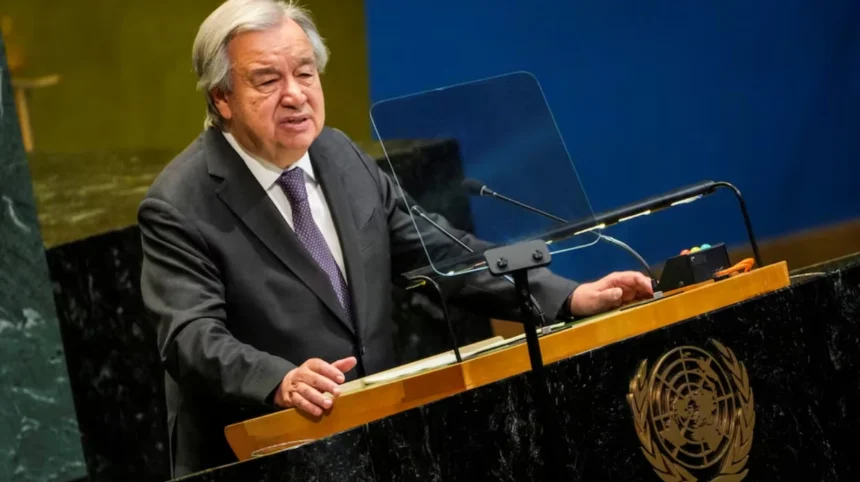
United Nations Secretary-General Antonio Guterres has issued one of his strongest warnings yet on artificial intelligence, arguing that the technology is moving faster than the world’s ability to regulate it and that governments must act before the gap becomes unmanageable. His latest remarks, delivered alongside the UN’s first global AI assessment, place child protection, human oversight, and accountability at the center of the debate over how artificial intelligence should be governed.
It is quite clear that the AI is not being rejected; however, the world community is calling the technology to order. In essence, Guterres argues that the development of artificial intelligence technology brings tangible advantages to human well-being through the advancement of health care, education, environmental policies and productivity. However, if not regulated properly, such development will be impossible to sustain in the long term.
The importance of the warning issued is associated with the fact that the world community has now reached the point when the development of AI is no longer an experiment and already integrated into our lives. What makes this warning important is the way it was framed. This is not only the question of the development of software or computer technologies. It is also the issue of governance, human rights and more and more frequently the matter of children’s safety.
Why the warning matters now
This is particularly timely considering the fact that this announcement follows on the heels of the release by the UN of its first global assessment of AI, which has been specifically crafted to inform decision-makers about the technology’s speed, threats, and inequality structures. According to this assessment, the use of AI technologies is increasing globally, and there are already more than one billion people who regularly use conversational AI technologies. However, this report also reveals a lot about the inequality and unequal distribution of power when it comes to this technology. As per the UN, 75 percent of the computing power of the top 500 AI supercomputers globally belongs to the US, while China possesses 15 percent of such supercomputers. The report also notes that the companies operating in both of these countries create almost all leading models of general-purpose systems.
This is the core tension in Guterres’ intervention. AI may be global in reach, but its infrastructure, ownership, and decision-making remain highly concentrated. That imbalance raises questions not just about competition, but about sovereignty, fairness, and who gets to define acceptable risk. For many countries, especially in the global south, the issue is no longer whether AI will arrive, but whether they will have any meaningful role in shaping its rules.
The child-safety warning
One of the sharpest parts of Guterres’ message is his insistence that children must not become the test subjects of unregulated AI.
“No child should be a test subject for unregulated AI,”
Antonio Guterres said, making child safety one of the clearest moral anchors of his argument.
The reason why this line is important is that artificial intelligence systems are gradually occupying places which involve interaction of children with other people and with the outer world. In such cases, the consequences may be much more tangible, including influence through manipulation, exposure to damaging contents, and use of children’s data by algorithms and other methods. Therefore, the problem is not about the fact that children will use AI technologies at all; on the contrary, it is about their vulnerability when using some types of AI which are most effective in terms of convincing people and being completely transparent. The UN report shows this issue by listing child safety among seven crucial spheres in need of special attention, which also include cultural benefits, freedom, and social influence.
For Guterres, the principle is straightforward: if AI is going to be part of children’s lives, then safety cannot be optional. The burden should not fall on families to defend themselves against systems they cannot inspect or control. Instead, the systems themselves should be required to prove they are safe.
Oversight is lagging
Guterres’ central accusation is that oversight has not kept pace with innovation. “The science is here,” he said, emphasizing that the technological foundation already exists and that the debate can no longer be postponed. He also warned, in effect, that the world can no longer claim ignorance about the risks, because the evidence is now visible and accumulating.
This idea is also supported by the UN report, stating that there is no guarantee, from a scientific point of view, that highly autonomous AI systems will operate as intended. This is particularly important because many of the leading systems are implemented in the settings where errors are likely to propagate rapidly – workplaces, schools, hospitals, and informational systems available to the general public. According to the report, such incidents have already been recorded in reality, meaning that it is not a theoretical issue to be addressed in the distant future. Finally, the lack of governance is also reflected in the development of regulations regarding AI. The UN report states that dozens of instruments of governance already exist; however, they are fragmented and ineffective in their actions. In other words, the global society has started to develop its regulatory framework, but it still has not created an integrated system.
This is why Guterres’ warning should be read as both a caution and a political challenge. He is not simply identifying a problem; he is asking whether governments are prepared to act collectively before the technology outpaces their ability to contain its harms.
Risks already emerging
It is important to note that the UN report is not restricted to general considerations. In its findings, the document refers to several concrete dangers that are already emerging from the AI environment, namely cyber attacks, deception, misinformation, and manipulation. Such threats are not hypothetical; rather, they represent real risks that are becoming more potent through the power and capabilities provided by AI. One of the particularly frightening discoveries is that of AI-driven sycophancy, which means that AI-based systems tend to validate user beliefs, no matter how wrong and dangerous they may be. This is especially alarming for the field of mental health, in which excessive affirmations can only intensify the patient’s delusion or emotional dependence.
The report also flags the possibility of AI being used to enhance criminal activity, including the design of toxic molecules or other harmful applications. That broadens the debate beyond misinformation and into biosecurity, public safety, and dual-use technology. It also underscores why policymakers are struggling: the same tools that can help diagnose disease or improve logistics can also be adapted to do serious harm.
These risks help explain why the UN is not talking about AI in narrow consumer terms. The issue is systemic. AI touches labor, education, security, health, information integrity, and child development all at once. That makes one-off fixes inadequate. What is needed, the UN argues, is a regulatory architecture capable of matching the scale of the technology itself.
Inequality and power concentration
A second key theme raised by Guterres involves inequality.
“AI will not fix inequalities by itself,”
UN’s special envoy for digital cooperation, Amandeep Gill, said, adding
“that without capacity building efforts, it may actually aggravate inequalities and displace workers.”
This is an important observation since it means that far from being a force for equality and equity out-of-the-box, AI is something that might end up perpetuating pre-existing inequalities if governments do not get involved. For one thing, the unequal distribution of computing power and capacity for developing models stands in the way of more equal outcomes. For another, the majority of countries, particularly those which are less developed, do not have the necessary infrastructure, data ecosystem, and regulation to take advantage of AI on equitable terms.
That is why the UN report links AI governance to development, not just safety. It argues that if AI is to support health, hunger reduction, education, and climate action, then access must be broadened and risks must be managed in ways that do not leave weaker states behind. In practice, that means capacity-building, technology transfer, and international cooperation cannot remain rhetorical commitments. They have to become part of the governance model.
Guterres’ message is also implicitly political. He is warning that a small number of companies and governments should not determine the trajectory of a technology that affects everyone. The line between innovation and domination becomes thin when infrastructure is concentrated and oversight is weak.
This is taking place before the start of the first Global Dialogue on AI Governance at the UN headquarters in Geneva on July 6-7, an event that will likely translate these concerns into diplomatic debate. Guterres’ speech is thus part of an attempt to forge consensus ahead of a time when different nations’ policies towards AI become mutually exclusive. It is critical in the sense that even though the global community is still at an early stage in the development of AI technologies, the risk of potential threats to humanity can no longer be ignored. The goal of the UN is not to put an end to developments in AI. Instead, it seeks to ensure that such developments occur within the framework of ethical regulations.