The United Nations has warned that attacks on humanitarian workers reached a record level in 2025, exposing the increasingly dangerous conditions under which aid agencies deliver food, medicine and emergency assistance. At least 907 humanitarian workers were killed, wounded or kidnapped worldwide, according to figures from the Aid Worker Security Database, while the growing use of armed drones added a new and unpredictable dimension to the threat.
The UN called the development an “appalling” one, but the numbers indicate that it is something much worse than just a brief dip in security conditions. They reveal the erosion of the very foundations of the norms of protection civilians and humanitarian workers should enjoy during armed conflict. Humanitarian workers are now facing not just the usual risks, such as gunshots, shelling, and kidnapping, but also drone attacks, administrative detention, disinformation and obstruction. The threat is particularly acute in places experiencing the fiercest warfare. Gaza stayed the most dangerous place for humanitarian workers for the third year running, whereas Sudan registered its worst death toll for humanitarian workers for the year. Other places posing significant threats included Ukraine, the Democratic Republic of Congo, South Sudan, Syria, Ethiopia, Haiti, Chad and Cameroon.
Record Attacks, Historic Death Toll
907 casualties were reported in 2025 which marked an increase compared to the previous year when 833 casualties occurred. Of this number, there were 350 killed, 322 injured and 235 kidnapped. In addition, 280 humanitarian workers were detained or arrested by government officials resulting in a total of 1,187 victims of major security incidents once detentions and arrests are included in the overall casualty figure. Casualties in numbers were lower compared to 2024 where 387 casualties were reported. Nonetheless, 2025 had the second highest casualty rate since systematic records began. It means that reduction in casualties does not mean that aid efforts are now safe because violence is still at high levels along with increased injuries and kidnappings.
The data shows how difficult is the challenge of counting casualties of attacks against humanitarian personnel. One UN briefing to the Security Council mentioned 326 humanitarian workers killed in 21 countries in 2025, while the Aid Worker Security Database reports 350 casualties. The disparity might be caused by different definitions, verification methods and personnel counted. Nevertheless, both of them give one and the same result: casualty rate is exceptionally high.toronto.citynews
The longer-term trend is even more alarming. More than 1,010 humanitarian workers were killed between 2023 and 2025, nearly three times the number killed during the previous three-year period. More than 560 of those deaths occurred in Gaza and the West Bank, 130 in Sudan, 60 in South Sudan, and 25 each in Ukraine and the Democratic Republic of Congo.
Most victims were national or locally recruited staff. This is significant because local workers are often the first to respond and the last to leave when international organizations evacuate personnel. They are embedded in the communities they serve and frequently continue operating despite active fighting, damaged infrastructure and collapsing public services.
Gaza Remains Deadliest
Gaza remained the most deadly area for humanitarian personnel in 2025 with 186 deaths of aid workers recorded. The Aid Worker Security Database indicated that 68 percent of those deaths were caused by aerial bombing, which reflects the extent of danger created by air force strikes in densely populated areas. However, the number of deaths in Gaza should also be considered against the backdrop of the larger conflict which started following the Hamas attack on Israel in October 7, 2023. According to the UN Palestinian refugee agency (UNRWA), at least 393 agency employees have been killed during the war.
The UNRWA has requested an official mechanism to look into the death of agency employees and find responsibility for the strikes on its infrastructure and personnel. The large scale of deaths has also increased controversy regarding compliance with international humanitarian law. On one hand, UN officials and humanitarian agencies have called for an independent investigation, on the other hand, Israel stated that it takes actions to prevent civilian casualties.
The Gaza crisis has also demonstrated how the destruction of humanitarian infrastructure can multiply risks. Aid workers often operate from damaged compounds, travel along roads exposed to bombardment and work in areas where hospitals, shelters and communications networks have been severely affected. Even when personnel are not directly targeted, the collapse of the surrounding civilian environment can make humanitarian work almost impossible.
Sudan’s Drone and Gunfire Threat
Sudan recorded a record 71 humanitarian-worker deaths in 2025, most of them caused by small-arms fire. Fatalities have risen for five consecutive years as the country’s war has expanded and disrupted access to civilians facing displacement, hunger and disease.
The war has also served as a prominent instance of how armed drones are transforming the threat environment. In the first four months of 2026 alone, armed drones were responsible for 80 percent of civilian fatalities in Sudan, as reported by the United Nations Office for the Coordination of Humanitarian Affairs.
Drone strikes have targeted markets, hospitals and other civilian facilities, thus posing an additional threat to humanitarian activity. While the threat of conventional front lines is easily visible, the threat of drone warfare might be present far away from any actual battlefield. Aid convoys might get targeted on the way to their destination, humanitarian compounds might come under scrutiny and attack and humanitarian personnel might receive little to no warning before being targeted. The relatively inexpensive nature of drones also means that they will be available to a broader range of non-state actors. Hence, the employment of drones has created an operational quandary for humanitarian organizations. Humanitarian organizations must reach out to people living in isolated areas, but the very act of doing that exposes them to the risk of surveillance and air strikes.
Armed Drones Expand the Battlefield
UN humanitarian chief Tom Fletcher said armed drones were becoming one of the most serious emerging threats to humanitarian teams. He described them as
“the new face of an old danger”,
arguing that technological change had not altered the legal responsibilities of parties to armed conflict.
Fletcher also said,
“The technology may change, but the laws of war do not.”
His statement captures the central legal issue: the use of a drone does not remove the obligation to distinguish between civilians and combatants, nor does it permit attacks on humanitarian workers or civilian facilities.
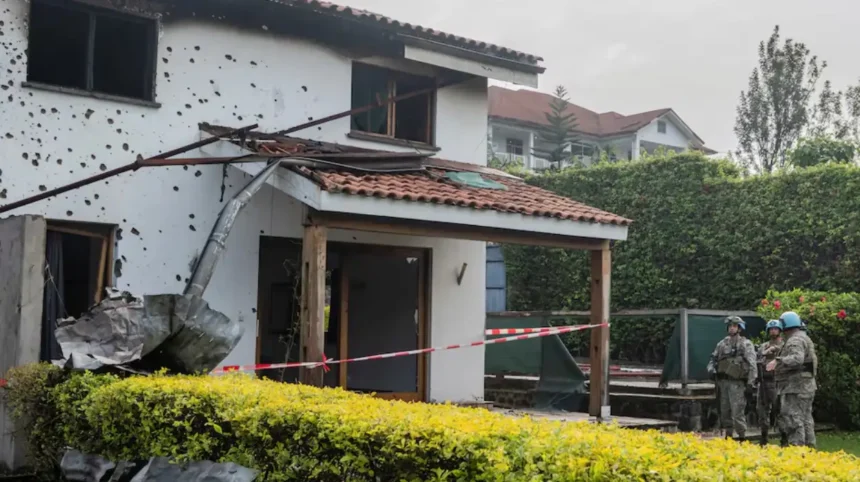
In the Democratic Republic of Congo, a drone strike in Goma in March 2026 killed at least three people, including French UNICEF staff member Karine Buisset. The incident demonstrated that humanitarian workers can be killed even in urban environments where aid agencies and civilian facilities are known to operate.
Ukraine has also experienced a sharp increase in risks linked to drone warfare. Four humanitarian convoys were hit in attacks during one week in May 2026, according to UN reporting. In Colombia, attacks involving weaponized drones reportedly quadrupled between 2024 and 2025. Insecurity Insight recorded 15 attacks on aid convoys involving explosive-equipped drones in 2025, compared with eight such incidents during the combined three-year period from 2022 to 2024.
These developments have implications beyond immediate casualties. Drone attacks can undermine deconfliction arrangements, damage confidence between aid organizations and armed actors, and encourage agencies to restrict movement. In places where humanitarian access already depends on fragile negotiations, a single attack can close routes for weeks or months.
State and Non-State Responsibility
State actors were still the principal known perpetrators of violence committed against aid workers in 2025; however, the number of violent attacks by non-state armed actors and criminal groups also increased. Road journeys continued to be the deadliest environment, causing 27 percent of violent acts, whereas offices, compounds and project sites accounted for another 20 percent. These numbers prove false the notion that aid workers are vulnerable when traveling through active combat zones only.
Humanitarian facilities are usually well-marked and are supposed to be protected according to the rules of international law. Violence against offices, compounds and project sites implies that sometimes the humanitarian status is not respected – or that armed actors do not mind paying a price for attacking the premises of relief agencies. Incidents of kidnapping by non-state actors and criminal groups more than doubled in 2025 and totaled 235 cases. In addition to that, there was an emerging trend of state detentions and arrests. About one third of all detentions by states were committed in Yemen; Yemen, South Sudan, the Democratic Republic of Congo, Myanmar and Palestine combined accounted for 75 percent of such incidents.
This combination of violence and state restrictions is narrowing the space for humanitarian action. Workers may be attacked by armed groups, detained by governments, accused of political activity or targeted by disinformation campaigns. The effect is the same: aid agencies face greater difficulty maintaining neutral, independent and impartial operations.
UN Calls for Accountability
On World Humanitarian Day, Secretary-General António Guterres said,
“Serving others has become more dangerous than ever.”
He called the violence against aid personnel “appalling” and urged governments and armed groups to respect international humanitarian law, protect relief personnel and ensure accountability for perpetrators.
Tom Fletcher said,
“More than 1,000 aid workers have been killed in just three years and that is utterly unacceptable.”
He argued that condemnation alone was insufficient and called for real consequences against those responsible for attacks.
The Security Council has already adopted Resolution 2730, which calls for the protection of humanitarian and UN personnel, their premises and their assets. It urges states to conduct “full, prompt, impartial and effective” investigations, prosecute those responsible and cooperate with national, regional and international courts.
Yet implementation remains weak. UN security official Gilles Michaud warned that some governments publicly support humanitarian law while failing to apply it in practice. The absence of consistent investigations and prosecutions has created a pattern in which attacks are condemned but rarely punished.
The International Committee of the Red Cross reported that at least 31 Red Cross and Red Crescent staff members and volunteers were killed in 2025. ICRC representative Elyse Nicole Mosquini said,
“We are losing our humanity in war.”
She called for stronger protection, investigations and support for personnel exposed to violence.
Pakistan’s representative at the Security Council similarly warned, “Impunity only invites repetition.” Pakistan urged prompt, impartial and effective investigations into attacks on humanitarian workers.