President Joseph Aoun’s Monday appeal for extending the mandate of the United Nations Interim Force in Lebanon (UNIFIL) is much more than a mere diplomatic effort; it is a strategic maneuver that seeks to secure the tenuous south border of Lebanon within an international security architecture in light of the imminent withdrawal of UNIFIL towards the end of 2026. In an environment where there is little margin between deterrence and escalation, President Aoun’s position makes it clear that he prefers stability to uncertainty by seeing the peacekeeping operation not as a stopgap measure, but rather a structural support for state governance, protection of civilians, and overall agreement with Israel.
The President’s Position: Extending UNIFIL or Finding an Equivalent
At the heart of Aoun’s message is a clear hierarchy of options.
“Our first option is to extend UNIFIL’s mandate,”
he told a parliamentary delegation, according to a presidency statement released on Monday. That formulation is deliberate: it places UNIFIL at the top of Lebanon’s policy menu while leaving room for alternatives if the Security Council proves unwilling to renew the mission in its current form. The president did not stop at preference; he articulated the functional value of the force in everyday terms, arguing that
“UNIFIL’s presence helps keep residents in their villages and towns, and strengthens stability in cooperation and coordination with the Lebanese army.”
This is not just rhetoric. In the southern communities, the deployment of blue helmets has been linked historically to a certain element of predictability—patrolling, communication systems, and reporting mechanisms—for which the security forces locally may not be able to account for due to resource and political constraints. Aoun’s insistence on working in partnership with the Lebanese army is similarly strategic, as it attempts to prevent the impression that UNIFIL operates in place of the state and instead functions as a force multiplier for the army.
Crucially, the president anticipated the most likely obstacle—political resistance in the Security Council—and offered a fallback. If the mandate is not extended, he urged adopting
“a formula that ensures the continued presence of international forces in the south, within the required legal framework,”
to support stability alongside the Lebanese army. In other words, the institutional label matters less than the function: an internationally mandated presence that can operate legally, coordinate with Beirut, and help manage the security environment along the border.
Why the South Cannot Afford a Security Vacuum
Aoun’s push comes against a backdrop of sharply elevated incidents along the southern frontier. Between June 21 and August 11, 2026, UNIFIL recorded
“more than 1,700 instances of violations of Lebanese airspace,”
predominantly by drones but also including helicopters and fighter jets, alongside “more than 100 airstrikes” and
“more than 1,800 projectiles fired by the IDF”
into multiple locations in south Lebanon. In a single weekend from August 8–10, the mission logged 455 projectiles and 97 airspace breaches, among the heaviest barrages in months. Notably, UNIFIL reported no projectiles fired by Hezbollah during the same June–August window, a detail that shapes the narrative around who is driving the current escalation.
In this context, a sudden withdrawal of UNIFIL after December 31 would risk creating precisely the kind of vacuum that Human Rights Watch has warned against. HRW has argued that the Security Council
“will share much of the blame if UNIFIL’s departure creates a security vacuum that opens the door to further abuses,”
calling for an international force to remain to protect civilians and deter abuses by both the Israeli military and Hezbollah. Aoun’s language mirrors this concern without naming specific actors: he framed the goal as achieving
“a breakthrough that ensures the continued international presence in the south… in a way that preserves stability and strengthens the role of the state and the Lebanese army.”
The Mandate Clock: From 1978 to a 2026 Deadline
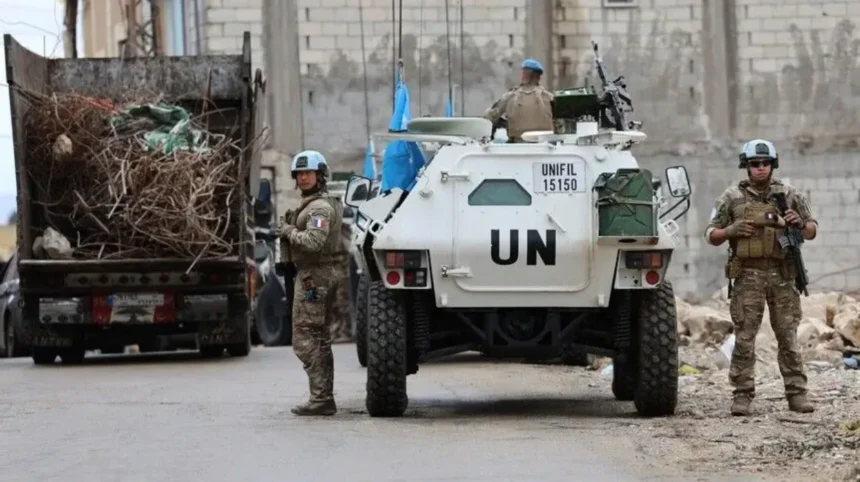
The significance of the matter calls for consideration of Aoun’s appeal within the context of UNIFIL’s evolution. Founded in 1978, the operation has been an unbroken, though flawed, part of Lebanon’s security architecture throughout almost fifty years of existence. However, UNIFIL’s continuation has been put into question since the Security Council, pressured by the United States in August 2025, has made a decision to extend the mission until December 31, 2026, giving the green light for the process of its gradual withdrawal to start afterwards. According to Resolution 2790 (2025), even during the withdrawal period, the UNIFIL would remain empowered to assist with protection of civilians and humanitarian deliveries.
Nonetheless, the political message has been quite clear: the mission’s long-term future remains uncertain. It comes into conflict with the present security concerns of Lebanon. Indeed, with more than 7,500 peacekeepers from around fifty countries currently serving in the South of Lebanon, UNIFIL is one of the largest and the most conspicuous UN operations in the world. Its soldiers have been paying the price: UNIFIL officials reported 89 peacekeeper casualties since 2006 under the mandate provided by Resolution 1701. For Beirut, the issue becomes not whether UNIFIL is perfect, which its critics doubt, but whether its elimination in these circumstances will complicate an already difficult situation further.
Domestic Consensus: Parliament Backs an International Presence
The stance of Aoun is by no means an isolated one in the Lebanese political arena. This week, 86 out of Lebanon’s 128 members of parliament, clearly a majority, have written an official letter to the UN Security Council calling for UNIFIL to stay and expand its mandate, which it was delivered at the visit of the UN Special Envoy Jean Arnault to Beirut. The call is for the mission to continue working in a way that preserves stability, provides protection to the civilians and helps the Lebanese government in extending its jurisdiction on the whole territory.
In the country, where consensus is hard to find, such an unprecedented level of parliamentary support highlights the importance of the security file of southern Lebanon for national considerations. The parliamentary initiative also demonstrates a realization that the issue of south Lebanon cannot be regulated bilaterally or through any informal agreements. In the context of the framework agreement between the two countries being in the early stages of implementation and mistrusts running high, the internationally sanctioned presence allows for absorbing shocks, verifying compliance and providing a channel of de-escalation in the case of any incidents.
International Signals: US Support and Diplomatic Friction
In international circles, indications point to the possibility of reaching a compromise. US Special Envoy Tom Barrack stated on Tuesday that the US will agree to a one-year extension of UNIFIL despite the postponement of a vote in the Security Council concerning the future of UNIFIL because of objections by the US and Israel against the wording in the draft resolution.
This development is important as it implies that even if the US may have some objections in terms of the wording of the mandate, it is not against extending the UNIFIL operation for another year. It must be noted, though, that the diplomatic conflict cannot be overlooked. According to reports, previous drafts were resisted for fear of wording that might limit the movement of the Israeli military or imply a certain culpability. It is clear from the phrasing of Aoun that he seeks to address such concerns through emphasizing stability and the cooperation of the Lebanese Army.
The Strategic Logic: State Authority, Civilian Protection, and Implementation
Beneath the immediate security arguments lies a deeper strategic logic. Aoun’s repeated invocation of the Lebanese army is not accidental; it is a bid to align UNIFIL’s role with the state’s long-term project of consolidating authority in the south. By framing the mission as a partner that
“strengthens stability in cooperation and coordination with the Lebanese army,”
he seeks to preempt accusations that Beirut is outsourcing sovereignty.
Instead, the story is one of capacity building. UNIFIL creates the necessary environment for the army to function better and the state to take more responsibilities. This holds true for the protection of civilians and the implementation of the framework agreement. Since thousands of violations have been documented lately, there is a very strong possibility of misinterpretation. The presence of an international entity will be helpful in verifying the incident, and communicating with all the parties involved in order to avoid any bigger conflict.
Aoun’s call for
“a formula that ensures the continued presence of international forces in the south, within the required legal framework”
is, in effect, a request for the international community to remain invested in preventing that spiral.
Risks of Premature Withdrawal: Lessons from Recent Escalations
These risks are very concrete and tangible, with the most recent increase in airspace violations and projectiles serving to prove this point. It is clear from the statistics released by UNIFIL that there have been more than 1,700 airspace violations and 100 airstrikes and nearly 1,800 IDF projectiles launched in the period from late June to mid-August.
Human Rights Watch’s warning that the Security Council
“will share much of the blame if UNIFIL’s departure creates a security vacuum that opens the door to further abuses”
is a direct challenge to the assumption that withdrawal can proceed on schedule without consequences. Aoun’s stance can be read as Lebanon’s answer to that challenge: if the international community is serious about protecting civilians and stabilizing the south, it must be willing to adapt the mission’s mandate to current realities rather than adhere rigidly to a timetable conceived under different conditions.
What Comes Next: Scenarios for the South
These three possibilities have come to the forefront of the discussion. The first option is simply an extension of the mandate of UNIFIL for one year. The second possibility is that of a combination wherein the mandate of UNIFIL comes to an end as scheduled, while a new mechanism is put in place to perform its core functions. The last and most dangerous possibility is that of drawing down of UNIFIL in January 2027.
Aoun’s public positioning makes clear which path he prefers.
“Our first option is to extend UNIFIL’s mandate,”
he said, while simultaneously preparing the ground for alternatives if necessary. That dual-track approach—advocate for renewal, plan for contingency—reflects both the urgency of the security situation and the uncertainty of the diplomatic landscape.