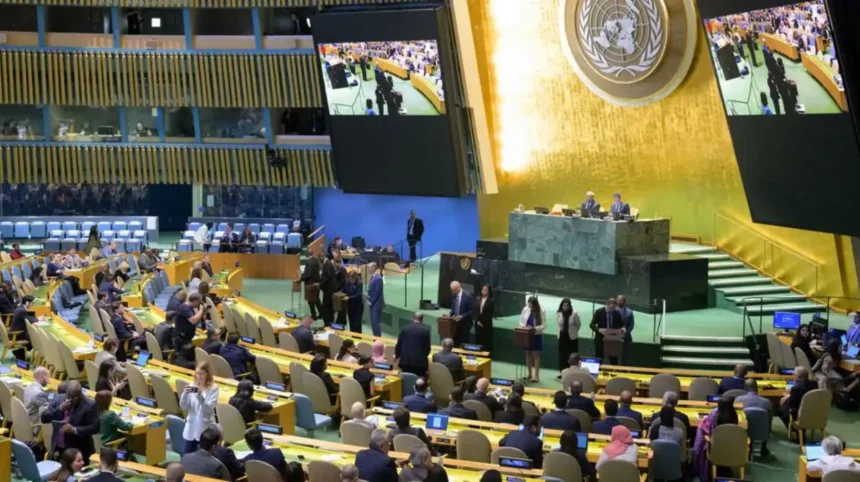
Colombia, Latvia, the Democratic Republic of the Congo, Bahrain, and Liberia were voted by the UN General Assembly on Tuesday to serve two-year terms on the 15-member U.N. Security Council beginning on January 1, 2026.
The only U.N. body with the authority to make legally binding decisions, such as approving the use of force and imposing penalties, is the Security Council. Its five members—the US, China, France, Russia, and the UK—have permanent veto power.
Five new members are added annually, while the remaining ten members are elected. South Korea, Sierra Leone, Algeria Guyana, and Slovenia will be replaced by Bahrain, Colombia, the Democratic Republic of the Congo, Latvia, and Liberia, all of whom were elected on uncontested slates.
Seats are distributed to regional organizations in order to guarantee geographic representation. However, candidates must still receive the approval of more than two-thirds of the General Assembly, even if they are standing without any opposition in their group. 186 votes went to Bahrain, 183 to the DRC, 181 to Liberia, 180 to Colombia, and 178 to Latvia. On Monday, the General Assembly chose Annalena Baerbock, a former German foreign minister, to lead the 193-member body for its 80th term, which starts in September.
Non-permanent members are elected each year to replace half of the seats, obtaining a two-thirds majority vote from the General Assembly. Any state that is a member of the UN, except for the permanent members, is most often elected. When a member state considers running for election, they often begin the campaign years in advance to secure endorsements from other countries in their region and support from other international countries in their campaign.
Non-permanent members serve for one two-year term and cannot be re-elected for immediate re-election, which provides for rotation and diversity of representation on the council. This structure strikes a balance between and enables the global representation of states while acknowledging the need for maintaining council effectiveness as it performs its paramount responsibility of maintaining international peace and security.
The process for electing non-permanent members is still being debated in Council reform discussions, especially as it applies to intelligence discussions as it relates to the veto system, but the process for the electing non-permanent members is an important aspect of UN governance.