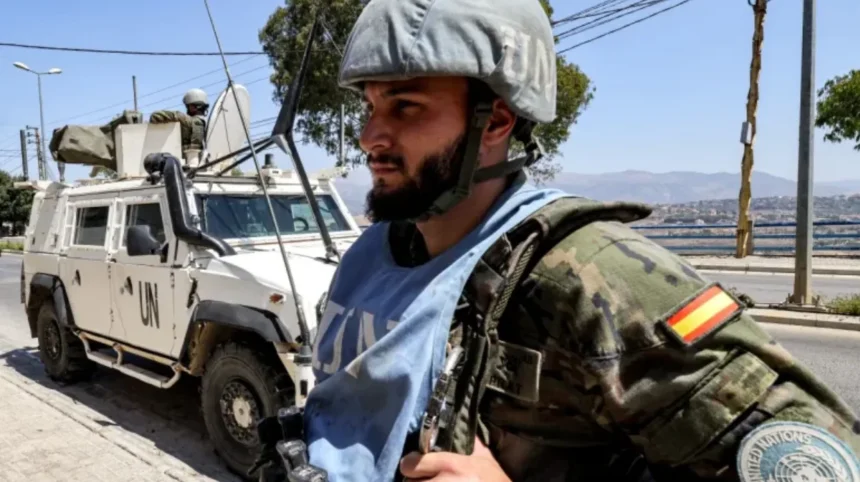
Germany is sharpening its bid to reposition Europe at the centre of security arrangements in southern Lebanon as the UN peacekeeping mission UNIFIL nears the end of its mandate. At the heart of this diplomatic drive is Foreign Minister Johann Wadephul’s renewed call for an EU force in Lebanon to replace United Nations peacekeepers and prevent what Berlin fears could become a destabilising security vacuum along the Lebanese–Israeli border.
Wadephul’s rhetoric is clear and calculated.
“The pullout of UNIFIL in December would lead to another blow being struck to the few international stabilizing structures remaining in the south,”
he cautions. Furthermore, Wadephul makes it very clear that the stability of the border region depends on Europe stepping up and taking responsibility, thus signaling the broader strategy of moving the European Union from an auxiliary diplomatic power to a more active security actor in the Middle East. In press statements and in diplomatic negotiations, the German foreign minister sees this as a test of European determination.
“In the next few months, we shall see whether the EU has the ability to become a strategic actor, or whether it always reacts to other actors, be it the US, the UN, or regional countries.”
UNIFIL’s Departure and the Spectre of a “Security Vacuum”
In order to comprehend Berlin’s apprehension, it is necessary to recall what the role of UNIFIL is within the Lebanese theater. Since the beginning of UNIFIL operation in 1978, and particularly from the strengthening of UNIFIL after the Second Lebanon War in light of UN Security Council Resolution 1701, the UN peacekeeping force has been acting as a monitor between Israel and southern Lebanon. The force’s uniformed personnel – at certain times more than ten thousand men – have been patrolling the area between the blue line defined by the United Nations and the Litani River in collaboration with the Lebanese Armed Forces to ensure cessation of hostilities and to restrict the presence of the armed groups in proximity to the border.
UNIFIL’s jurisdiction has never been total. Despite the fact that Hezbollah, which can be considered the strongest military and political non-state entity of Lebanon, has kept its arms, presence, and influence in proximity to the southern parts of Lebanon, UNIFIL has been serving as a deterrent and a medium of communication.
With the conclusion of the mandate and the reduction in the number of troops, the German authorities, as well as many commentators, assert that this international “watcher” might affect the calculation of both parties in question. In light of the absence of patrols of the United Nations Interim Forces in Lebanon, Israel will be more ready to take unilateral steps in the case of firing of rockets or infiltration into their territory – from creating buffer zones to entering the territory of Lebanon.
It is against this backdrop that Wadephul invokes a “security vacuum”. He is not merely concerned about a gap in numbers of foreign troops, but about the loss of a structured, internationally recognised mission that has underpinned the fragile status quo since 2006. For Berlin, allowing that architecture to disappear without a replacement risks a rapid, unplanned recalibration of forces and deterrence in one of the Middle East’s most volatile frontiers.
Wadephul’s Vision: An EU Force to Enable Israeli Withdrawal and Contain Hezbollah
In his latest remarks, Wadephul goes beyond generic expressions of concern. He articulates a concrete objective for a future European mission: enabling an orderly Israeli withdrawal from parts of southern Lebanon while ensuring that Hezbollah does not exploit the vacuum to move back to the border.
He describes the prospective European presence in explicitly dual terms. On the one hand, he stresses that such a mission should help create conditions under which
“Israel can safely pull its troops out of southern Lebanon,”
reducing the risk that Israeli forces remain entangled in a protracted, low?level confrontation or pre?emptive posture. On the other hand, he insists that Europe must help prevent Hezbollah from “returning with its terror” to positions close to the frontier, a phrase that frames the group not as a political actor but primarily as a security threat to both Israel and Lebanon’s state institutions.
Given these considerations, Wadephul argues for the European Union to investigate how it can intervene in its own name, and not merely by expanding on what the United Nations does. Wadephul makes it clear that this must be more than a mere token effort; it must be a carefully planned intervention by Europeans which is legally sound, has well defined rules of engagement, good coordination with the LAF, and the political will from EU governments. In calling for the European Union to “ensure that no security vacuum results from the European mandate following the UNIFIL mission,” he asks member states to put flesh on their foreign policy talk of “strategic autonomy.”
Franco–German Initiative and Europe’s Strategic Ambition
It is important to note that Wadephul’s call is not an isolated move, but fits into a broader Franco-German strategy to develop a common policy with regard to Lebanon and regional security. Both Berlin and Paris have always been among the most active member states in Middle East policy-making within the European Union, having also provided troops for UNIFIL. The current Franco-German initiative with respect to Lebanon aims at putting the country forward as an area where European diplomacy, development aid and security can converge. Under this new approach, Germany will serve as a driving force behind the politics and a prospective contributor to the operation.
Traditionally, the German participation in UNIFIL was connected with its participation in the maritime element of the mission, providing vessels and a few hundred people to monitor the Lebanese territorial waters, stop arms smuggling and assist in strengthening the capacities of the Lebanese Navy.
France, for its part, has long held a significant troop presence and symbolic weight within UNIFIL. French officers and contingents have played key roles in the mission’s command structure, and Paris has consistently argued that European states must remain engaged in Lebanon to prevent spillover from regional conflicts. The Franco–German initiative therefore offers a political anchor for any EU mission, but it will still require wider buy?in from member states—particularly those with experience in peacekeeping and capacity?building.
European policymakers also see Lebanon as a test case for the EU’s much?discussed but unevenly implemented aspiration to act as a global security provider. If Europe can design, mandate, and deploy an effective follow?on presence in Lebanon, it will strengthen the argument that the EU is capable of stepping into roles traditionally dominated by the UN or NATO. Failure to act, or a poorly coordinated mission, would instead reinforce doubts about Europe’s coherence and reliability.
Lebanese State, Hezbollah, and the Question of Sovereignty
The domestic situation within Lebanon creates additional problems for any potential establishment of an EU force. The official position of the Lebanese government regarding international involvement in the south is positive, since all previous governments were in favor of the stay of UNIFIL forces. Moreover, the Lebanese Armed Forces have been using the international aid in the form of training and political and material resources to spread their operations into the area that has always been held by the non-state actors. For Beirut, it will be too problematic to stop all the international involvement in its internal affairs and to rely only on the military capacity of the LAF.
At the same time, any new foreign mission must navigate Lebanon’s overlapping sensitivities about sovereignty and internal balance. Hezbollah, which positions itself as a resistance movement against Israel and a defender of Lebanon, is likely to view an EU?mandated presence with suspicion. It may portray a European force as an extension of Western and Israeli interests, particularly if the mission’s stated goals include constraining its movements near the border and facilitating Israeli withdrawal under conditions favourable to Tel Aviv.
Lebanese political parties and institutions will likewise scrutinise the terms of engagement. For the presidency, the government, and the army command, the key question will be whether an EU force strengthens the state’s hand or locks it into arrangements that limit autonomy. The rhetoric used by external actors will matter. Emphasising support for Lebanese sovereignty, the primacy of the LAF, and the temporary, stabilising nature of any mission may help build domestic legitimacy, but it will not eliminate the underlying tension between foreign security guarantees and national self?determination.
Contested Narratives: Vacuum Versus Opportunity
Not all analysts and policymakers subscribe to the notion of an “impending security vacuum” warned of by Germany. In fact, some have argued that in some ways the presence of UNIFIL has sometimes been more conducive to masking reality than changing it. According to such critics, the deployment has not had much effect on the strategic calculus of Hezbollah, that the rules of engagement preclude more forceful action, and that the presence of a sizable international force actually frees up national actors from addressing underlying security and governance challenges.
In this respect, UNIFIL’s pullout would facilitate a different kind of arrangement, perhaps one that would entail increased cooperation among Israel, the US, and some chosen European countries, but without reproducing the scenario of another bulky infantry force deployment. Advocates of this position often call for greater diplomacy and conditional aid directed at the disarmament of non-state entities and empowerment of Lebanese institutions.
Wadephul’s position pushes against this logic. He clearly sees the risk of sudden change outweighing the potential benefits of a clean break from UNIFIL. His emphasis on allowing Israel to withdraw safely while blocking Hezbollah from returning to the border reflects a belief that international presence still matters in shaping tactical realities on the ground. In Germany’s narrative, continuity—albeit under a different flag and mandate—is a safer path than abrupt transition.
In practice, the debate between “vacuum” and “opportunity” will shape how far EU member states are willing to go. Those sceptical of large foreign deployments may favour a minimalist mission focused on training and equipment, while governments more aligned with Germany’s risk assessment may support a more robust presence. The final design of any EU force will likely represent a compromise between these competing strategic instincts.
What an EU Mission Might Look Like
Although details remain under discussion, the broad contours of the German?backed EU concept are emerging. Unlike UNIFIL, which fielded large battalions of soldiers in observation posts and patrols, an EU mission is more likely to prioritise a lean footprint with a strong advisory and capacity?building focus. Military trainers, border?management specialists, and liaison officers would work with the LAF and internal security forces to improve monitoring, rapid response, and de?escalation mechanisms along the Blue Line.
The experience of Germany in UNIFIL shows that it is possible to incorporate sea and land components in any European package. While naval forces can continue their operations in Lebanese waters, controlling arms traffic and providing assistance to the Lebanese Navy, land units may help the LAF to secure presence in villages and points of strategic importance near the border. This way, Europe will be able to keep a comprehensive overview of any movements in and around the southern border of Lebanon and its coastline. Several criteria should be taken into account for the success of the operation.
First of all, it is necessary to establish clear rules of engagement and mission definition in order to escape ambiguity, which often prevents international operations from becoming efficient. Coordination with Israel and the USA is vital not only because of preventing contradictions in the operations but also to avoid a situation when the mission turns out to be an obstacle for some security partners.