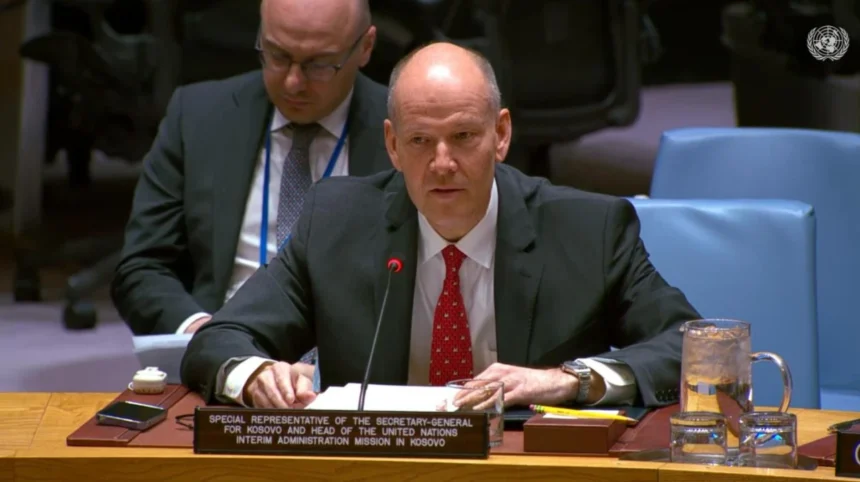
The significance of Peter Due’s mistrust warning lies in its timing, arriving just months after Kosovo’s December 2025 legislative elections exposed underlying fragilities in the country’s political and ethnic landscape. As head of United Nations Interim Administration Mission in Kosovo, Peter Due addressed the United Nations Security Council in April 2026, emphasizing that trust between communities remains the central variable determining stability in Kosovo’s north.
While the elections saw broad participation and ultimately confirmed the political dominance of Albin Kurti and his Vetëvendosje movement, the aftermath revealed a more complicated reality. Allegations of electoral manipulation led to a recount across thousands of polling stations, reinforcing skepticism among Kosovo Serb communities. This mistrust has not remained confined to political elites but has filtered into local governance and everyday interactions, particularly in northern municipalities where ethnic divisions remain deeply entrenched.
Recount controversies and political uncertainty
The recount process, although procedurally necessary, exposed vulnerabilities in Kosovo’s electoral framework. Reports of irregularities, including suspected manipulation in favor of certain candidates, fueled narratives of institutional bias. Even though the final results reaffirmed the electoral outcome, the process left a residue of doubt that continues to shape perceptions among minority communities.
For northern Kosovo Serbs, these developments reinforced longstanding concerns about political marginalization. The skepticism surrounding the recount has complicated efforts to re-establish confidence in central institutions, particularly in areas where trust in Pristina has historically been limited.
Return of Serb mayors and fragile normalization
A notable development following the elections was the return of Serb mayors to municipal offices in the north, marking a partial reversal of earlier boycotts. This shift has been interpreted as a positive step toward institutional normalization. However, the effectiveness of these local administrations remains constrained by broader mistrust and administrative challenges.
Language barriers, bureaucratic inefficiencies, and competing loyalties continue to hinder governance. These issues, as highlighted by Due, are not merely technical but reflect deeper questions about legitimacy and inclusion within Kosovo’s political system.
UNMIK’s evolving mandate in a divided political environment
The role of UNMIK has undergone significant transformation since its establishment under United Nations Security Council Resolution 1244. Originally tasked with administering Kosovo, the mission now operates primarily as a facilitator of dialogue and a guarantor of stability. Peter Due’s mistrust warning underscores the continued relevance of this mandate, even as its scope and resources have narrowed.
Dialogue as a central instrument of trust-building
UNMIK’s current strategy places emphasis on community-level engagement, aiming to bridge divides through dialogue initiatives that bring together representatives from different ethnic groups. These efforts are designed to create spaces where grievances can be addressed and mutual understanding can develop.
Due’s remarks suggest that such initiatives are not supplementary but central to maintaining stability. In a context where formal political processes are often contested, informal dialogue mechanisms provide an alternative pathway for conflict management.
Operational constraints and financial pressures
The effectiveness of UNMIK’s initiatives is increasingly shaped by resource limitations. A broader liquidity crisis within the United Nations system has led to reductions in staffing and operational capacity, constraining the mission’s ability to expand its activities.
Despite these challenges, Due has emphasized the mission’s continued importance. The tension between limited resources and expansive expectations highlights a structural dilemma: UNMIK is expected to maintain stability in a complex environment while operating with diminished means.
Northern Kosovo as a persistent geopolitical flashpoint
The north of Kosovo remains a focal point of regional tension, where local dynamics intersect with broader geopolitical considerations. Peter Due’s mistrust warning reflects concerns that unresolved issues in this ??????? could have wider implications for stability in the Western Balkans.
Competing governance models and ethnic divisions
The governance of northern Kosovo is characterized by overlapping authorities and competing political narratives. While Pristina asserts sovereignty over the entire territory, Belgrade continues to exert influence over Serb-majority areas, creating a duality that complicates administration.
This dynamic is particularly evident in debates over the establishment of an association of Serb-majority municipalities, a proposal that has become a central point of contention. For Kosovo Serbs, such an association represents a mechanism for safeguarding rights and autonomy. For the central government, it raises concerns about territorial integrity and state cohesion.
Security incidents and the legacy of 2025 violence
Events in 2025, including clashes in areas such as Banjska and Ibër-Lepenc, underscored the volatility of the security environment. These incidents involved not only local actors but also drew in international forces, including Kosovo Force, highlighting the potential for escalation.
The persistence of such incidents reinforces the importance of preventive measures and early-warning mechanisms. UNMIK’s role in monitoring and reporting contributes to these efforts, providing a layer of oversight that complements the presence of security forces.
Stalled dialogue between Belgrade and Pristina
The broader political context of Kosovo is shaped by the relationship between Belgrade and Pristina, where dialogue has been largely stalled since 2023. Peter Due’s mistrust warning highlights how this stagnation exacerbates local tensions, particularly in the north.
Impact of diplomatic deadlock on local stability
The absence of progress in high-level negotiations has created a vacuum that is felt most acutely at the local level. Without clear political agreements, issues such as governance, security, and economic integration remain unresolved, contributing to a climate of uncertainty.
This uncertainty is compounded by competing narratives promoted by both sides. Each government frames the situation in ways that reinforce its own legitimacy, often at the expense of building mutual trust.
Role of international actors in mediation
International actors, including the European Union and the United Nations, continue to play a mediating role. However, their influence is constrained by the lack of consensus among key stakeholders. While initiatives aimed at restarting dialogue persist, tangible progress has been limited.
UNMIK’s involvement complements these efforts by focusing on grassroots engagement, providing a parallel track that addresses immediate community concerns while broader negotiations remain stalled.
Strategic implications for Kosovo’s future stability
The trajectory of Kosovo’s north will depend on the interplay between local dynamics, national politics, and international engagement. Peter Due’s mistrust warning serves as a reminder that stability is not solely a function of security arrangements but also of social cohesion and institutional legitimacy.
As Kosovo navigates the post-election period, the ability of its institutions to rebuild trust across communities will be critical. UNMIK’s role, though reduced in scale, remains central to this process, providing a platform for dialogue and a measure of continuity in an otherwise fluid environment.
The broader question is whether the current framework can evolve to address the deeper sources of mistrust that continue to shape the region. With political negotiations stalled and external pressures mounting, the path forward will likely require a combination of renewed diplomatic efforts and sustained engagement at the community level. The balance between these approaches may ultimately determine whether Kosovo’s north moves toward gradual normalization or remains a persistent point of tension in the Western Balkans.