Pope Leo XIV’s visit to the World Food Programme headquarters in Rome carried both symbolic weight and practical urgency, placing the world’s hunger crisis squarely at the center of an international humanitarian stage. The pontiff’s appearance before the UN agency’s Executive Board session was not just a ceremonial stop, but a carefully timed message about moral responsibility, global solidarity, and the worsening difficulty of delivering aid in an age of conflict and bureaucracy.
The visit comes against the backdrop of a continued struggle for the WFP, dealing with harsh challenges in different crises regions, where the lack of food, displacement, and wars have made millions dependent on humanitarian aid. In this context, Leo XIV took the opportunity to re-emphasize a traditional papal point: hunger is not an abstract policy challenge but a human one, which demonstrates the values of the global system.
A papal visit with global symbolism
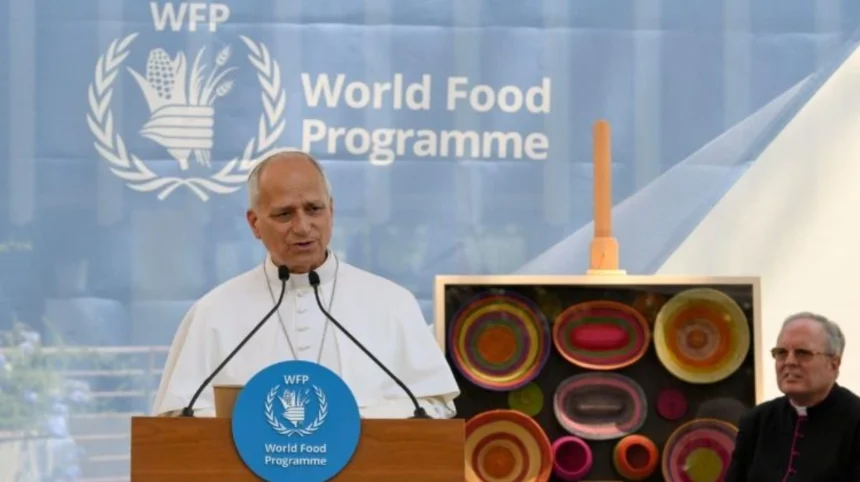
The appearance of the Pope at the World Food Programme headquarters in Rome on June 22, 2026, instantly brought a spiritual and moral dimension to an organization which normally operates behind the scenes. As per the reports, he was greeted by Cindy Hensley McCain, ex-executive director of the WFP; Carl Skau, the interim executive director; and Carla Barroso Carneiro, executive board president. Bishop Andrea Carlevale was also among those who greeted the Pope as he reached the facility.
It was significant in itself. World Food Programme is among the most prominent instruments of the international humanitarian aid response framework, and the focus of the Pope’s concern on its efforts is a clear indication that hunger is an issue that is not just a matter of technocracy or money, but also ethics and politics. In choosing to visit the headquarters instead of sending out a distant message, Pope Leo XIV ensured that his message was directly linked to the logistics of food aid and emergency support.
The tour itself helped to give further symbolic significance to the day. The Pope was to attend the installation of the Nobel Peace Prize, take some time for reflection and prayers at the Wall of Memory, sign the visitor’s book, speak to those assembled in the auditorium, and afterward greet the workers and their families in the garden. All of these things helped to make the visit one of witnessing and recognizing the work done by the WFP.
Hunger as a moral crisis
At the heart of the Pope’s message was the argument that hunger is not merely a development challenge, but a moral indictment of the international order. His earlier remarks at the FAO already framed the issue in strong terms, and the WFP visit extended that same line of thought into a humanitarian setting where policy, logistics, and urgency meet.
The Pope’s language on hunger has been unusually forceful. He said,
“Allowing millions of human beings to live—and die—as victims of hunger is a collective failure, an ethical aberration, a historical fault,”
Pope Leo XIV said at World Food Day-related remarks reported earlier. That statement still resonates in the context of the WFP visit, because it reflects not only concern, but judgment: hunger is evidence of a world that has not lived up to its obligations.
That framing matters because it moves the discussion beyond charity. In Leo XIV’s view, feeding the hungry is not optional benevolence; it is a matter of justice, dignity, and peace. His WFP appearance gave that view a public platform in front of the agency most directly responsible for emergency food support.
Bureaucracy and blocked aid
One of the sharpest elements of the visit was the Pope’s criticism of the systems that slow down humanitarian response. In coverage of his WFP address, he warned against the “progressive bureaucratization of solidarity,” Pope Leo XIV said, arguing that administrative burdens and political obstacles can keep food and help from reaching those who need it most.
This statement clearly reflected the frustration of many humanitarian aid workers. Humanitarian organizations have to face not only problems related to conflict, but also bureaucratic processes, delays, restrictions, and politics. It is obvious from the statements made by the Pope that these factors are morally significant for him, and not merely an inconvenience. Moreover, the Pope drew a parallel between the transport of weaponry and the delivery of aid, which is hampered by the mentioned factors. It is evident from his speech that if conflict could spread across borders fast and weapons could be easily transported, then aid should not be hindered by bureaucracy.
The WFP’s role in crisis response
The World Food Programme described the visit as an opportunity to highlight the global fight against hunger. That framing is important because the WFP is not a symbolic institution; it is a frontline humanitarian body that delivers food assistance in emergencies and works to build resilience in communities facing chronic insecurity.
In its invitation, the agency said the Pope’s visit would provide a
“unique opportunity to highlight the global fight against hunger,”
WFP said, emphasizing the visibility and moral authority that papal attention brings to the issue.
It was equally important to highlight the larger vision of the organization to use food assistance to save lives during emergencies, while also working towards peace, stability, and prosperity. This vision is vital for two reasons. Firstly, the WFP is perceived as only an emergency response organization; however, the role of the WFP also extends beyond this to include long-term development and prevention of conflicts.
A message shaped by peace
Hunger and Peace was a key issue in the overall tone set by the Pope. In times of humanitarian emergency, famine issues are not related to production or logistics but rather to war, failure of governments, economic crisis, and population displacement. In his statements, Leo XIV understood this truth in that he talked about hunger not just as misery but also as a sign of disorder. This is the reason why the WFP visit was significant in another sense too. The request of a Pope for more assistance, less bureaucracy, and solidarity should not be taken as just moral terms but as an expression of how priorities are organized in the world.
The Pope’s previous FAO intervention already set the tone. At that event, he described hunger as a scandal and argued that the world’s response has fallen short of basic human decency. The WFP visit reinforced that message and placed it in direct dialogue with the institution most responsible for emergency food delivery.
What the visit signals
The visit of Pope Leo XIV could be interpreted as one aspect of a larger plan on the part of the papacy to give visibility to the teachings of the Church in public affairs. By interacting with the WFP, the Pope put the Church on the same platform as other humanitarian organizations working to address concrete suffering rather than just making moral proclamations from an ivory tower. The timing is crucial too. At a time when the world faces wars, refugees, and overstretched aid organizations, the Pope’s message may be designed to provide motivation to both the general public and to the aid workers themselves.
At the same time, the criticism of bureaucracy suggests that the Pope is not content with symbolic concern. He is pointing to structural problems in the delivery of solidarity itself. That makes the message more forceful, because it shifts the burden from sympathy to action.
The wider political meaning
Beyond faith circles, the visit carries a wider political message about global governance. When the Pope speaks about hunger, aid, and conflict in the same breath, he is making an argument about how the international system should behave. He is saying that human survival must not be slowed by administrative inertia or undermined by unequal power.
The visit of Pope Leo XIV can also be viewed as one part of the strategy of the papacy in ensuring that the teachings of the Church are relevant in the public domain. Through his engagement with the WFP, the Pope has ensured that the Church reaches the same level of humanitarian organizations that are actually facing problems rather than just making pronouncements from the ivory tower. Timing is crucial in this particular instance. At a time when the world is faced with wars, refugees, and struggling humanitarian organizations, the message of the Pope can be constructed to motivate people.
A consistent papal theme
The WFP visit did not stand alone. It continued a pattern in which Leo XIV has made hunger and human dignity central to his public statements. His earlier FAO remarks, in which he called hunger a collective failure, established a clear moral framework. The WFP visit extended that framework into the operational world where food aid is organized and delivered.
Pope Leo XIV’s visit can also be seen as a strategy employed by the Church’s leadership to ensure that its teachings remain pertinent in the public sphere. Through his involvement with the WFP, the Pope has made sure that the Church comes on par with the humanitarian organizations that are actually dealing with the issues instead of making preachings from their ivory tower. Timing is important in this case. In times when the world faces wars, refugees, and difficult humanitarian organizations, the message of the Pope can be crafted to inspire people.
Pope Leo XIV’s appearance at the WFP headquarters in Rome therefore functioned on several levels at once: as a diplomatic event, a moral statement, and a public call to action. It highlighted the scale of global hunger, criticized the systems that block relief, and reminded the world that food assistance is inseparable from human dignity and peace.