Afghanistan’s child malnutrition crisis has entered one of its most dangerous phases, with the United Nations World Food Programme warning that acute malnutrition among children has reached critical levels in a third of the country’s provinces.
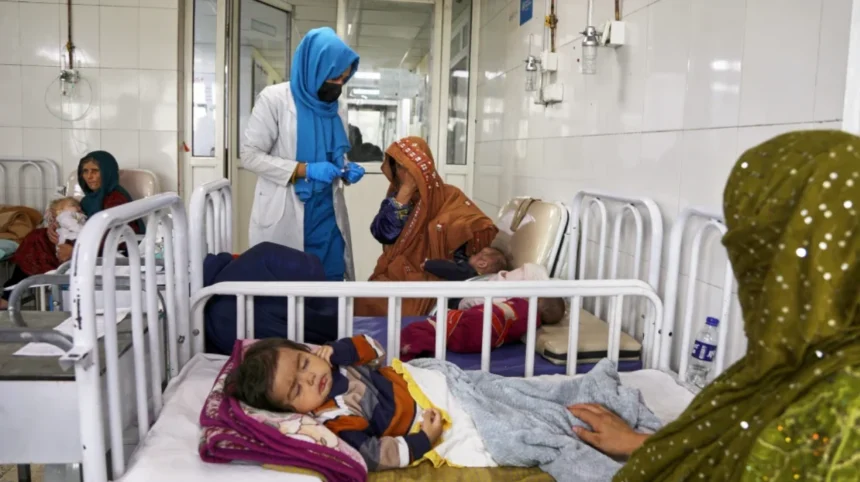
According to the organization, the problem is expected to get worse, as budget shortfalls lead to reductions in food distributions, nutritional assistance, and other vital forms of help that will leave millions of families who are susceptible to disease and starvation exposed. The new warning is not only because of the increasing number of hungry people, but rather due to the inability of the humanitarian system to deliver help when it is needed most. According to WFP, the problem is evident from the increasing number of severely malnourished children in the country’s health facilities where it is difficult to provide medical assistance due to lack of food and funds.
Critical levels in 12 provinces
As per reports from WFP, the level of acute malnutrition among children is now at dangerous proportions in 12 provinces – Helmand, Daykundi, Zabul, Baghlan, Urozgan, Paktika, Nuristan, Sar-e-Pul, Ghor, Kandahar, Faryab and Logar – and this figure is described by the agency as its largest in Afghanistan. This translates into about one-third of the total territory of Afghanistan falling into the most dangerous level of malnutrition, which shows that the current situation is not limited to certain regions or seasons. As reported by WFP, this stage of malnutrition represents a dire necessity of life-saving interventions, particularly for children younger than two years old who fall into the highest-risk group in terms of their health. WFP has warned that this trend will continue until October, when it usually reaches its peak in Afghanistan.
What WFP says is driving the crisis
The central cause, according to WFP, is funding collapse. The agency says aid cuts are forcing it to suspend food distributions and scale back nutrition support at the precise time when the number of people in need is climbing. WFP warned that many of its programmes cannot be maintained because it does not have the money needed to keep pipelines open, especially for emergency food assistance and specialized nutrition products.
WFP’s country director in Afghanistan, John Aylieff, gave one of the strongest warnings.
“We must act now to stem the rise in child deaths, which this crisis is provoking,”
he said, adding that
“it is already too late for too many.”
In another statement carried by WFP, he said the crisis is pushing the country’s children into a far more dangerous phase, with the number of children arriving at health centres rising sharply and too many coming too late to be saved.news.
The agency also points to operational disruptions beyond funding. It says cross-border supply problems, including the nine-month closure of the Pakistan border, have interfered with deliveries of nutrition products and other essential aid. WFP has also noted that the broader regional and global aid environment has become less reliable, making it harder to plan beyond the immediate emergency.
Scale of the human need
The magnitude of the situation is simply unbelievable. According to the WFP, about 3.7 million children in Afghanistan will suffer from malnutrition this year, alongside 1.2 million pregnant and lactating women. It is an indication that this is not an isolated case of malnutrition among children but rather a manifestation of the larger problem of maternal malnutrition, dietary insufficiency, and inadequate household food security in the nation. UN reports indicate that 14 million people in Afghanistan are at risk of severe hunger, although only one out of nine persons receive help from the WFP. UN briefing indicates that a normal situation among these people includes a case where babies are being fed tea and bread.
The Nutrition Cluster’s quarter-one 2026 surveillance already showed serious or critical malnutrition in 10 provinces, with especially high rates in Helmand, Daikundi, Zabul and Baghlan. Earlier IPC analysis had also signalled worsening trends, including more provinces likely to shift into critical acute malnutrition phases. Those findings show that the current WFP alert is part of a broader, steadily worsening pattern rather than a sudden spike.
Aid cuts and service collapse
What makes the current phase especially dangerous is the collapse of prevention services. WFP says the distribution of specialized nutritious foods intended to prevent malnutrition and stunting halted completely in May 2025, and the agency has since been unable to fully restore coverage. That matters because malnutrition treatment becomes much harder when prevention programmes disappear, especially in communities already struggling with poverty, displacement and poor access to health care.
Additionally, the agency states that in 2025, 142 nutrition centers were closed down because of a lack of support, leaving over 13,000 children unable to access nutrition assistance. In essence, this crisis is not only about starving families but also a flawed system of referral and treatment which allows the wasting of children to become deadly before assistance is provided. The WFP has consistently stated that its programs of nutrition assistance are underfunded. In its broader statement regarding Afghanistan, it stated that emergency food assistance and nutrition in 2026 are estimated to cost around $900 million. However, the current budget shortfall prevents it from covering even basic requirements. Previous reports by WFP have further revealed that due to the massive shortage in funding, the agency had to reduce the ration and specialized food assistance of millions of needy people in Afghanistan.
WFP’s funding appeal
WFP says it needs an urgent injection of cash to stop the situation from deteriorating further. The agency has put its immediate requirement at roughly $500 million to $540 million over the coming months, depending on the specific programme window being referenced. That money, WFP says, would help keep emergency food aid and nutrition programmes running through the most dangerous part of the year, particularly ahead of winter when hunger typically intensifies.
The agency’s message is clear: without immediate funding, it will have to continue reducing support in the very places where it is most needed. WFP says the coming months are a critical window, not only because the current crisis is already severe, but also because the winter months usually become the sharpest flashpoint for food insecurity in Afghanistan. That is why WFP has framed the issue not merely as a budget problem, but as a race against time.
Why the warning matters now
This warning matters because it shows a convergence of risks: rising malnutrition, reduced aid, closed health centres and a shrinking humanitarian safety net. Afghanistan is already among the world’s most fragile humanitarian settings, and the current warning suggests that children under two are bearing the heaviest burden. WFP says they are the worst affected group, and aid workers report that many arrive too late for treatment to succeed.
John Aylieff’s language reflects that urgency.
“The number of children being rushed to health centres is soaring and we’re seeing this visibly,”
he said, warning that
“80 per cent of the worst cases are children under two years of age”
and that too many of them are arriving too late to be saved.
He also added that without any funds, the next six months would mean higher burdens and more misery for many. The larger message from this humanitarian angle is that malnutrition not just results from the absence of food but also from the decay of a holistic approach towards this issue. As food distributions become low, hospitals shut down, as do the movements of nutritional products and mother’s access to assistance becomes difficult; child wasting gets tougher to control and also becomes more deadly. This is what WFP wants to bring to the attention of the world.
Regional and global implications
The situation in Afghanistan also has implications for humanitarian policies beyond the borders of that country. WFP has maintained that aid reductions not only lower the amount of aid but change the nature of the crisis itself by making organizations have to make impossible choices, like choosing between prevention or an emergency response or limiting the coverage of affected areas for only the most severe cases. In this way, the current situation in Afghanistan seems to be a perfect example of what they are talking about. This is why the message sent out by WFP must not only be considered a warning about the problems in that particular country but also a warning to the donors as well.